
Short answer: choose the 5-head walnut linear pendant (L 31.4″) for tables roughly 60–72 inches long, and the 7-head version (L 47.2″) for tables 84 inches and up. Hang the bottom of the fixture about 30–36 inches above the tabletop on an 8-foot ceiling, and use G9 LED bulbs around 2700K–3000K so the walnut reads warm rather than orange.
That is the whole decision in three lines. What follows is the reasoning behind each number, plus the details that decide whether a linear pendant looks architectural or accidental.
What this fixture actually is
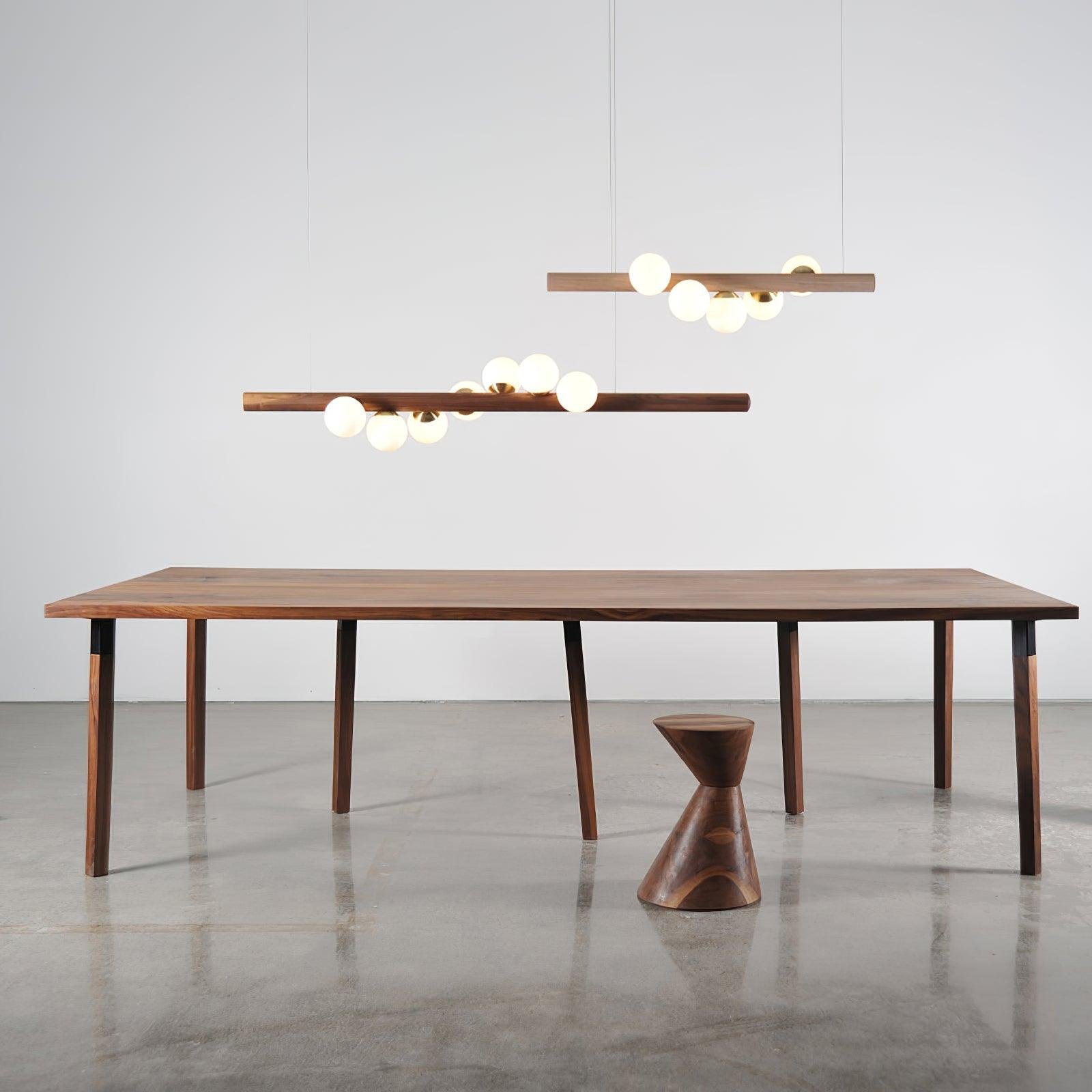
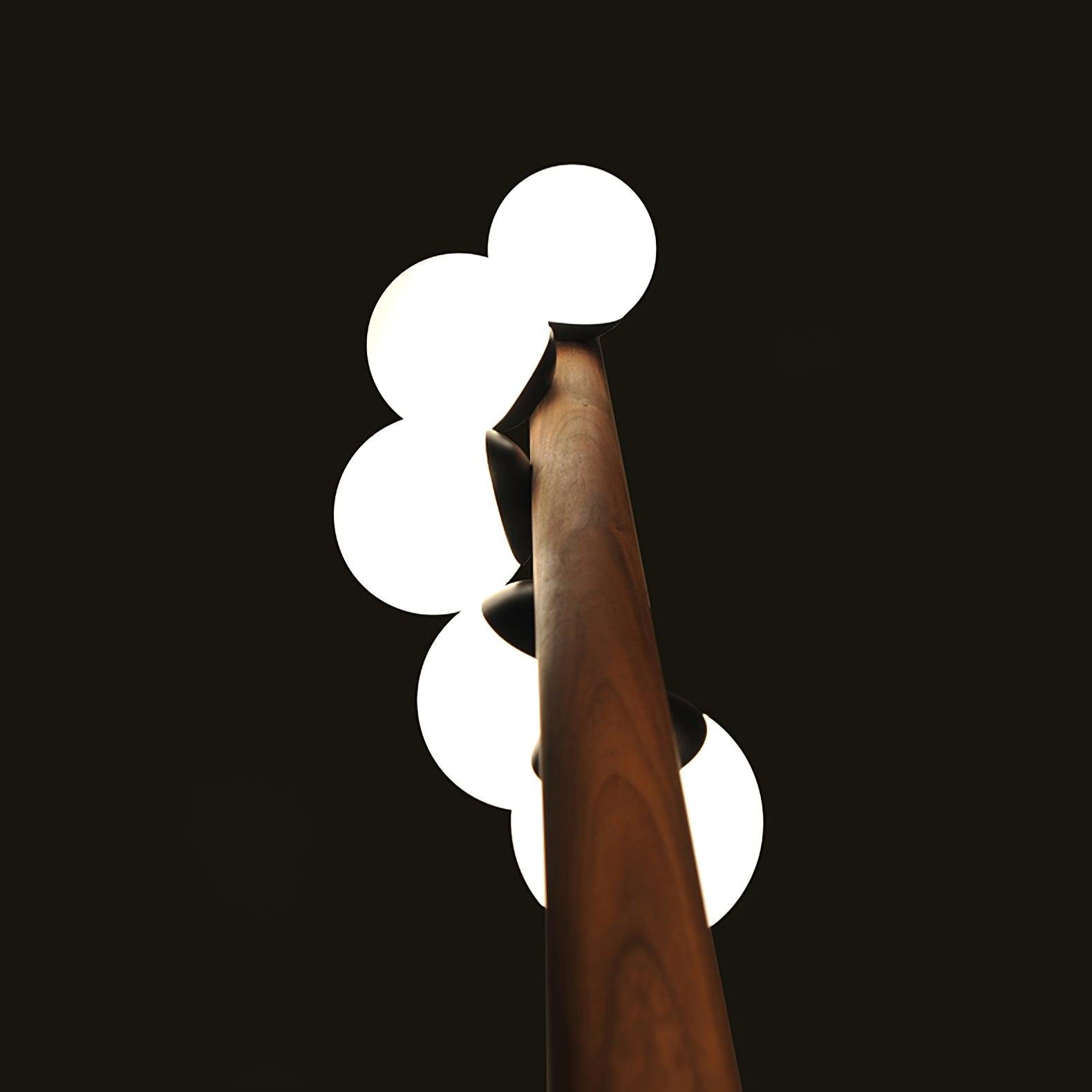
This is a walnut linear pendant light built around a horizontal wooden structure crossed by vertical elements — a floating, open form rather than a shade that hangs like a bowl. The frame is metal and aluminum, the wood element is finished in walnut, and the diffusers are white glass. Because the structure is open, light spills upward and sideways as well as down, which is why it reads as sculpture first and task light second.
It is a hardwired ceiling fixture with a 59″ (150cm) adjustable cable, designed for flat ceilings. It runs on AC 110–240V and takes G9-base LED or Edison bulbs, which are not included.
Why walnut works over a dining table
Walnut is the warmest of the common Scandinavian woods, and that matters in a room where people sit for an hour at a time. Oak and ash push a space toward bright and cool; walnut pulls it toward evening. Paired with white glass, the contrast keeps the fixture from going heavy — the wood supplies the weight, the glass keeps the light clean.
In practice this means the piece sits comfortably in three settings:
- Warm minimal dining rooms — white walls, pale floor, one wood note. The pendant becomes the only warm element in the room and carries it.
- Japandi and mid-century interiors — walnut already appears in the table or sideboard, so the pendant continues an existing line instead of introducing a new one.
- Open-plan kitchens with an island — a long horizontal form marks the dining zone without a wall or a rug to do it.
It is less at home in rooms built entirely from cool materials — grey concrete, black steel, high-gloss lacquer — where the wood can look stranded.

Sizing: 5-head or 7-head
The two versions differ mainly in length, not in height — both are 6cm (2.3″) tall, so the choice is about span.
| Version | Length | Height | Best for |
|---|---|---|---|
| 5-head | L 80cm / 31.4″ | H 6cm / 2.3″ | Tables ~60–72″ (5–6 seats), compact dining nooks |
| 7-head | L 120cm / 47.2″ | H 6cm / 2.3″ | Tables 84″+ (8 seats and up), long islands, open-plan zones |
The rule of thumb worth applying: the fixture should run roughly half to two-thirds the length of the table. A pendant much shorter than half the table looks like it belongs to a different room; one longer than the table overhangs it and throws light past the seating.
If your table sits between the two sizes, size up only when the room is open on both long sides. In a narrow dining room, the 7-head will dominate the ceiling plane even if the table could carry it.
Hanging height and placement
These numbers are starting points, not rules. Adjust for ceiling height, eye level when seated, and whether anyone at the table is tall.
- Above a dining table: bottom of the fixture 30–36 inches (76–91cm) above the tabletop. On an 8-foot ceiling that typically lands the fixture 78–84 inches from the floor.
- Above a kitchen island: 30–36 inches above the counter, measured the same way, since people stand rather than sit.
- Centered on the table, not the room. Hang it over the table’s centerline. If the table is off-center in the room — common in older houses — the fixture follows the table.
- Cable adjustment: the 59″ cable gives you room to work with. Set the height with the fixture in place and the cable trimmed at final install, not before.
- Flat ceilings only. This fixture is designed for flat ceilings. A sloped ceiling needs a licensed electrician’s assessment before you buy, not after.
One practical check most people skip: sit in a chair at the table and look straight ahead. The bottom edge of the fixture should sit above your sightline to the opposite wall, not across it. If it cuts that line, raise it two inches and re-check.
Bulbs, color temperature and dimming
The fixture takes G9-base bulbs — LED or Edison — and they are not included, so budget for them. Two decisions matter more than brand:
Color temperature. 2700K if the room is used mostly in the evening and you want the walnut to look deep and warm. 3000K if the dining area opens onto a kitchen that is already lit at 3000K and you want the two to match. Above 3500K the wood starts to look bleached and the white glass turns clinical — worth avoiding in a room whose whole appeal is warmth.
Bulb shape. Because the frame is open, the bulbs are visible. Clear or amber-tinted Edison-style G9 bulbs become part of the design; frosted LED capsules disappear into the white glass and give a softer, more even spread. Neither is wrong — clear bulbs are more decorative, frosted bulbs are more comfortable to sit under.
Dimming. This is where people get caught. Dimming requires both dimmable G9 bulbs and a compatible dimmer switch; a standard wall switch will simply turn the fixture on and off. If dimming matters for your room, confirm compatibility with the dimmer you plan to use before installation — retrofitting after the ceiling is patched is the expensive version.
The fixture is compatible with a common wall switch, which is not included.
Installation and room suitability
This is a hardwired fixture, so plan for an electrician unless you are already confident with ceiling wiring. Three points are worth settling before the box arrives:
- Ceiling type. Flat ceiling, hardwired. Sloped ceilings need professional advice first.
- Moisture rating. The fixture is IP20 damp-rated, intended for indoor use away from moisture. That rules out bathrooms and outdoor areas — including covered porches, which are outdoor areas regardless of the roof.
- Junction box position. The fixture hangs from a single point, so the existing ceiling box defines where it lands. If the box is not centered over the table, either move the box or accept an offset — a swag chain is not part of this design.
Certification on this model: UL, ETL, CE and SAA listed, with RoHS and FCC compliance stated by the manufacturer. If your project requires documentation for an inspector, ask for it at the point of order rather than during installation.
A quick buying checklist
- Table length measured, and pendant length between half and two-thirds of it
- Ceiling confirmed flat, and junction box confirmed over the table centerline
- Ceiling height checked against a 30–36″ drop above the tabletop
- Bulb count, color temperature (2700K or 3000K) and dimmer compatibility decided up front
- Electrician booked if hardwiring is outside your comfort zone
Ready to spec it? The 5-head and 7-head walnut linear pendant are both listed with full dimensions, and support can help with custom dimensions, lighting layout advice, or expedited shipping if your timeline is tight.
FAQ
What are the dimensions of this pendant?
The 5-head version measures L 80cm x H 6cm (L 31.4″ x H 2.3″). The 7-head version measures L 120cm x H 6cm (L 47.2″ x H 2.3″). Both use a 59″ (150cm) adjustable cable.
What bulbs does it use, and are they included?
G9-base LED or Edison bulbs. Bulbs are not included, so plan for them separately.
Can it go on a sloped ceiling?
No — it is designed for flat ceilings. For a sloped ceiling, consult a professional electrician before purchasing.
Can I use it in a bathroom?
It is IP20 damp-rated, suitable for indoor use away from moisture. Bathrooms and outdoor areas are not recommended.
Does it work on 110V in the US?
Yes. The fixture is rated AC 110–240V.
Can I get it faster?
Expedited shipping is available — contact MiniHouzz support for current options and lead times.