
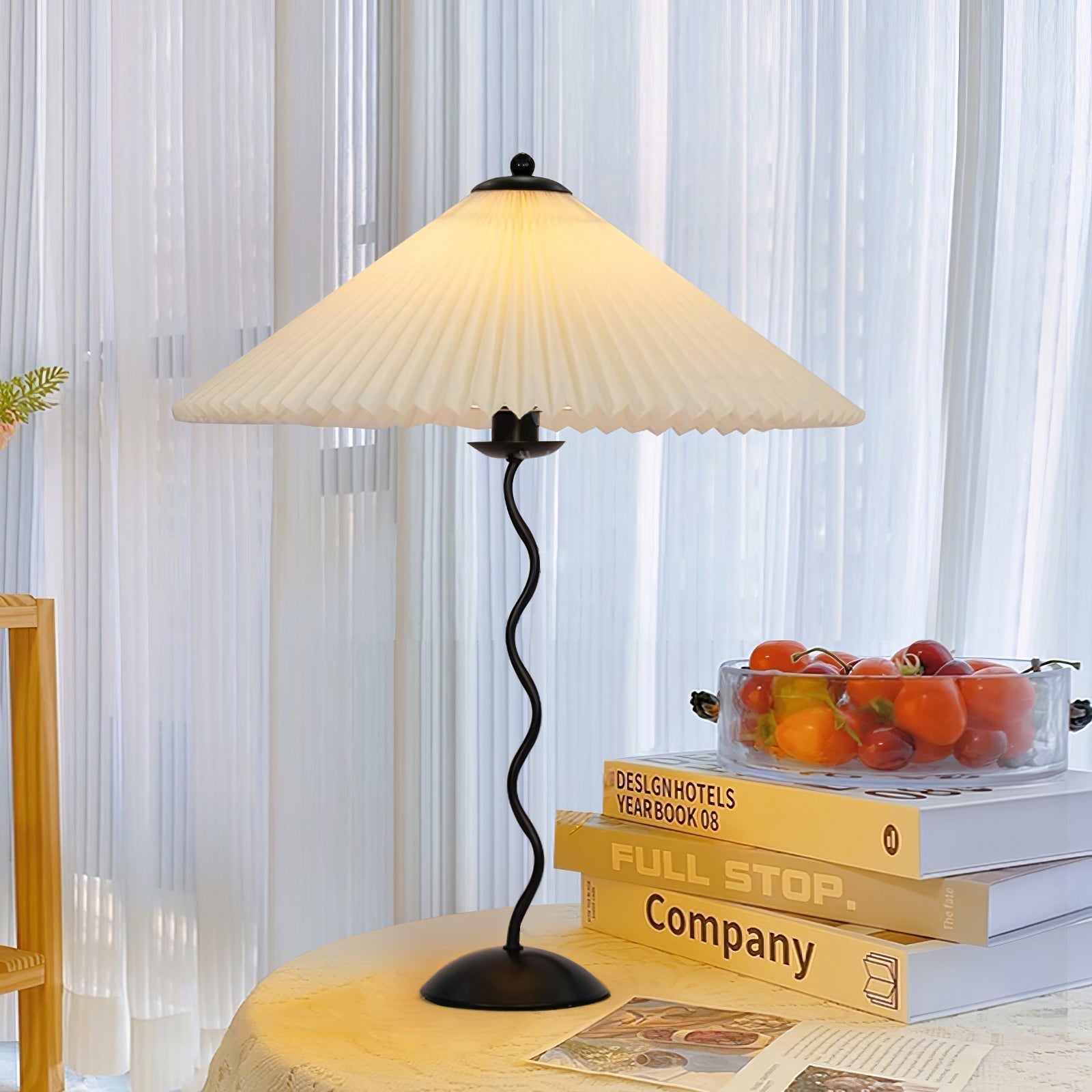
The Squiggle table lamp is a 23.6-inch (60 cm) accent lamp built around two ideas: a pleated fabric shade that softens light, and a curved black metal stem that reads as sculpture even when the lamp is switched off. It uses an E14 base bulb, runs on AC 110–240V, and is damp-rated (IP20) for indoor use. If you want warm, diffused light on a bedside table, a hallway console, or the end of a sofa — without a lamp that shouts for attention — this is the shape most people are looking for.
Below is what the piece actually is, where it works best, how to choose the bulb and shade color, and the small placement details that decide whether an accent lamp looks considered or crowded.
What the Squiggle lamp is — and what it is not
The lamp measures 17 inches (43.2 cm) in diameter and 23.6 inches (59.9 cm) tall. That is a generous shade for a table lamp: wide enough to throw a broad pool of light across a nightstand or console, compact enough to sit on a 16-inch-deep surface without hanging over the edge.
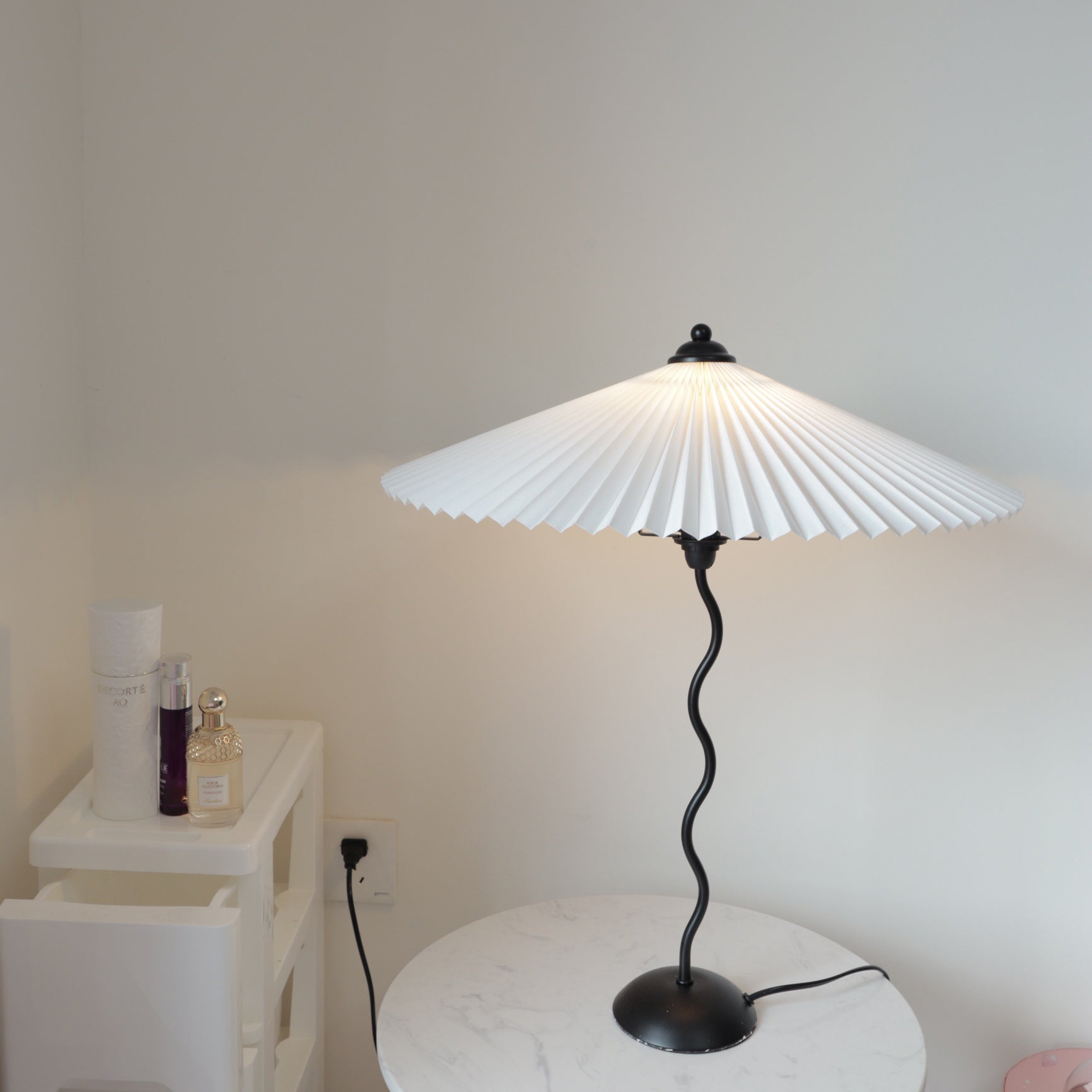
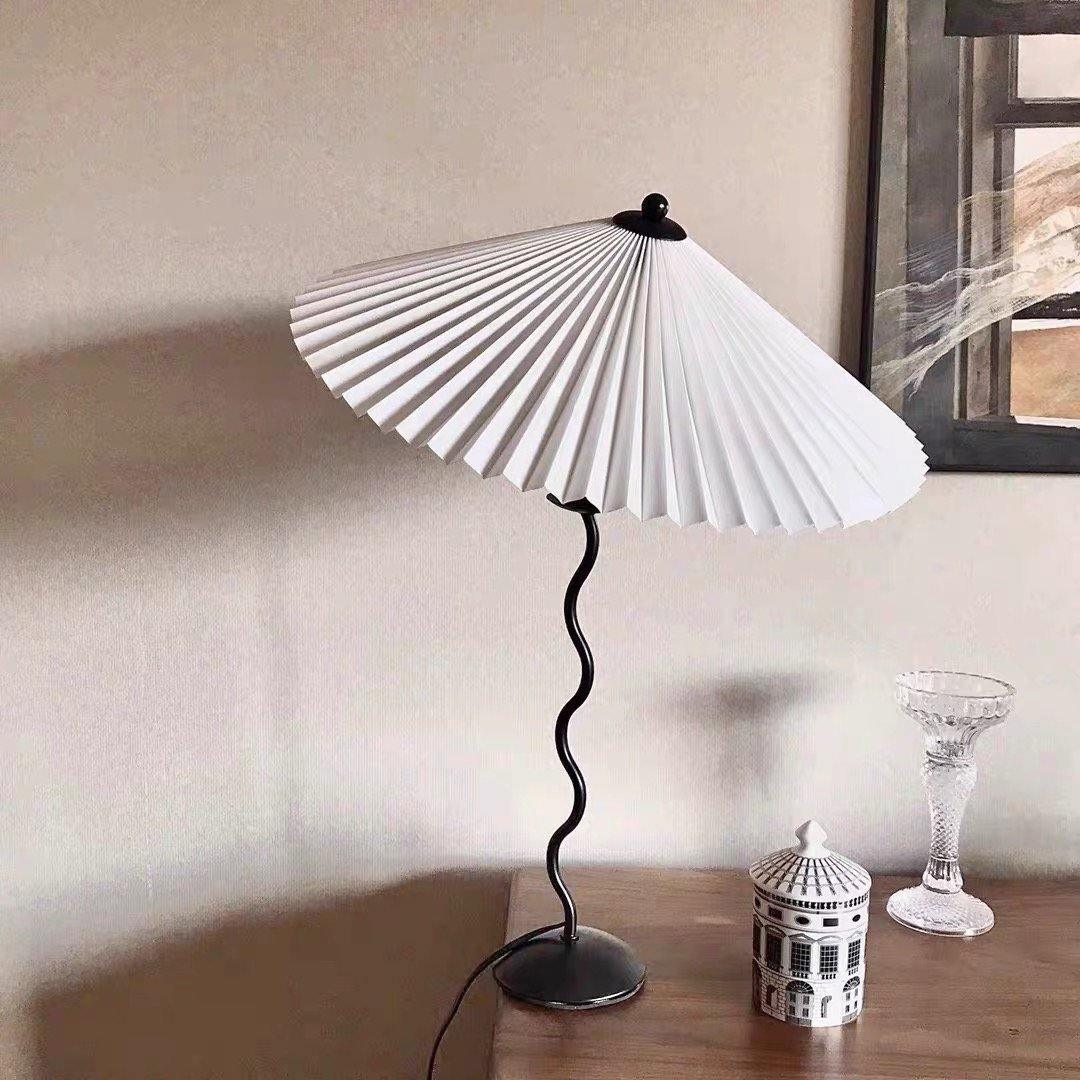
The body is black metal. The shade is pleated fabric, offered in beige, white, dark green, or black. A pleated shade does two things a smooth drum shade cannot: the folds break up the bulb’s hot spot so the light reads softer, and the vertical lines add texture that catches daylight during the day.
It is not a task lamp. There is no adjustable arm, no directed beam, and no dimmer in the base — the on/off control is an inline push-button switch on the 59.1-inch (150.1 cm) power cord. Treat it as ambient and accent lighting, and it does its job well.
Materials and build, plainly stated
- Body: metal, black finish
- Shade: pleated fabric — beige, white, dark green, or black
- Dimensions: ∅ 17″ (43.2 cm) × H 23.6″ (59.9 cm)
- Base type: E14
- Voltage: AC 110–240V
- Moisture rating: IP20, damp-rated, indoor use only
- Control: inline on/off push-button switch on the cord
- Cord: 59.1″ (150.1 cm) with plug
- Certification: UL, ETL, CE, SAA listed
Where the Squiggle lamp works best
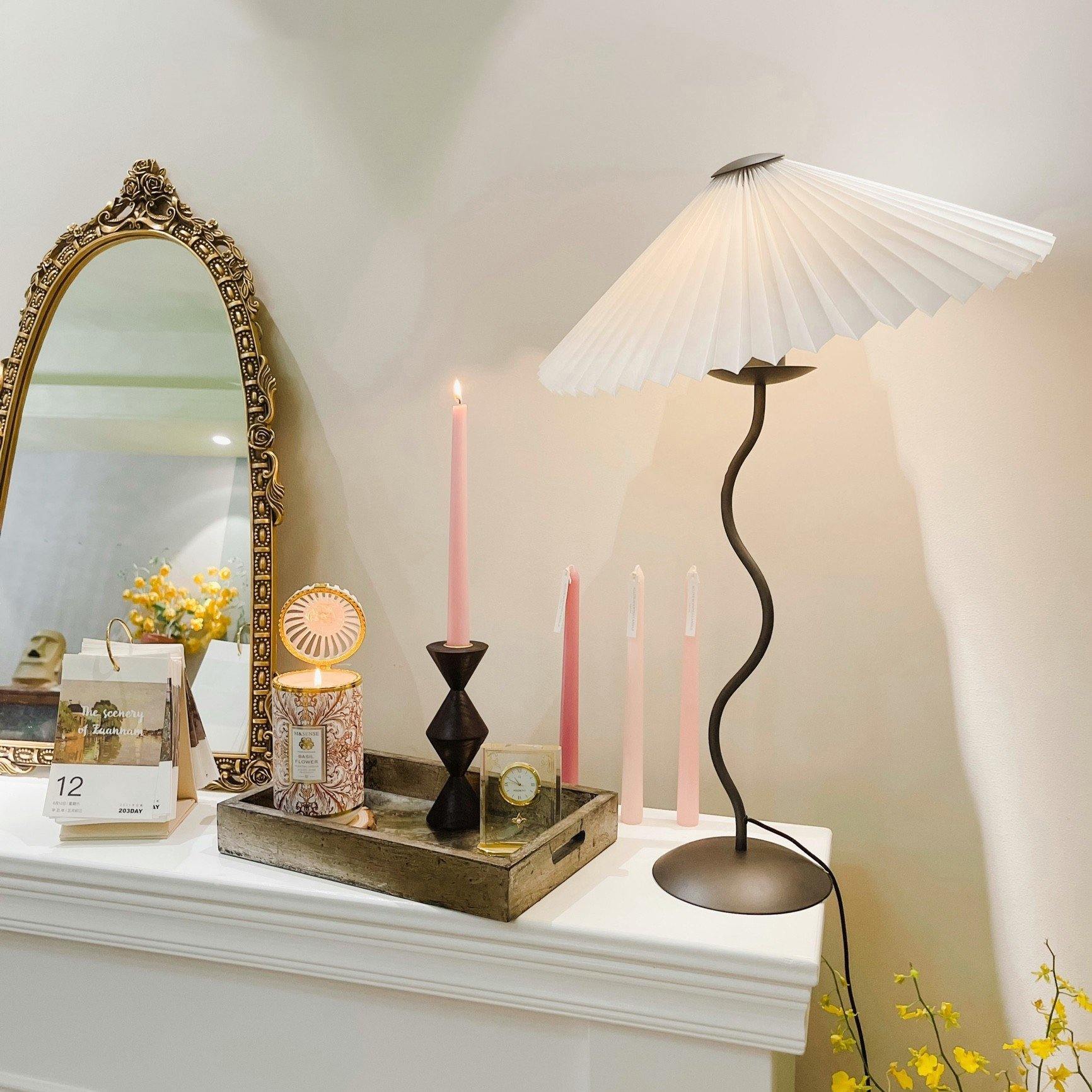
The curved stem leans slightly, so the shade sits off-centre from the base. That asymmetry is the point — it gives the lamp movement — but it also means the lamp wants a little breathing room. Give it roughly 6–8 inches of clear space on the leaning side so the curve reads as intentional rather than bumped.
Bedside
At 23.6 inches tall, the lamp suits a nightstand that is 24–28 inches high: the shade lands near seated eye level, so the light falls on your book or phone rather than into your eyes. If your nightstand is lower than 22 inches, the shade will sit above eye level when you are lying down and may feel bright at the edges — in that case angle the lamp slightly toward the wall and use a lower-output bulb.
Because the switch is inline on the cord rather than on the base, plan the cord route before you commit. A nightstand pushed against the wall hides the cord cleanly; a floating nightstand leaves 59.1 inches of cord to manage, which is enough to reach a nearby outlet along the baseboard.
Hallway or entry console
A console 30–34 inches high is the sweet spot here: the lamp tops out around chest height, so a visitor sees the sculptural stem first and the glow second. Pair it with a shallow tray and one object — the pleats already carry visual texture, so a busy console fights it.
Living room side table
Next to a sofa, the wide shade works as a soft secondary light source for evening conversation, especially in a corner where a floor lamp would block traffic. Keep it out of the direct line of a television screen; a 43 cm shade at eye level will reflect.
Choosing the bulb and the light quality
The lamp takes an E14 bulb, and it is compatible with LED or Edison-style bulbs. The bulb is not included, so this is the one decision that most changes how the lamp feels.
- For a warm living-room glow: a 2700K LED in the 4–6W range gives roughly the output of a 40–60W incandescent while keeping heat low under a fabric shade.
- For reading at a bedside: step up to 6–8W at 2700–3000K. Avoid anything above 3000K in a bedroom — the cooler tones work against the cocoon feel the pleats create.
- For a deco, filament look: a low-wattage Edison-style E14 bulb shows off the shade texture, but check the bulb’s length against the shade’s internal clearance before ordering.
One practical note on fabric shades: heat is the enemy, not brightness. A modern LED runs cool enough that the pleats stay crisp for years; an oversized incandescent can fade and stiffen the fabric. If you want maximum output, choose an LED.
Shade color: how each option changes the room
The body stays black in every configuration, so the shade color is doing the styling work. Here is how the four options read in a typical room.
| Shade color | Light effect | Best fit |
|---|---|---|
| Beige | Warmest, most diffused — softens the bulb noticeably | Bedrooms, neutral and wood-toned rooms, layered textiles |
| White | Brightest and cleanest; keeps the contrast with the black stem sharp | Modern and Nordic interiors, hallways, white-walled rooms |
| Dark green | Moodier; the shade glows from within rather than lighting the room | Reading corners, vintage and eclectic schemes, dark walls |
| Black | Most sculptural — the lamp reads as a silhouette | Monochrome and industrial rooms, desks and consoles as a statement |
If you are unsure, beige is the safe choice in a room with warm woods and textiles; white is the safe choice in a room with cool or neutral finishes. Dark green and black are the confident picks — they look deliberate in photos and quiet in person.
Placement checklist before you buy
- Measure the surface depth. The shade is 17 inches across; a table shallower than 16 inches will look top-heavy.
- Check the outlet distance. The cord is 59.1 inches. Anything further needs an extension cord, and a visible extension cord undoes the styling.
- Confirm the switch is reachable. The inline switch sits on the cord, so it needs to land somewhere you can reach without crawling — usually near the table edge or on the floor beside it.
- Decide the bulb before the lamp arrives. E14, LED or Edison-style, warm white.
- Keep it indoors. IP20 and damp-rated means it handles humidity but not direct water — a covered porch is fine, a rain-exposed patio is not.
Ready to see the current price and shade options? View the Squiggle table lamp at MiniHouzz.
Frequently asked questions
What bulb does the Squiggle table lamp use?
An E14 base bulb — LED or Edison-style both work. It runs on AC 110–240V, so it suits US and European outlets without a converter. The bulb is not included.
Is it bright enough to read by?
The shade is wide and diffused, which spreads light rather than concentrating it. For close reading, choose a 6–8W warm-white LED in the E14 base; for ambient glow, 4–6W is plenty.
Can I use it in a bathroom?
It is damp-rated (IP20) and intended for indoor use, so a bathroom or covered porch is acceptable as long as it is not exposed to direct water contact. It is not a wet-rated fixture.
Does it have a dimmer?
No. Control is an inline on/off push-button switch on the 59.1-inch power cord. If you want dimming, use a smart E14 bulb or a plug-in dimmer.
How do I clean a pleated fabric shade?
Dust with a soft brush or a vacuum on the lowest setting with a brush attachment, working along the pleat direction. Avoid wet cloths, which can leave water marks on fabric.
The short version
Buy the Squiggle table lamp if you want a warm, sculptural accent light for a bedside table, hallway console, or sofa-side surface, and you are happy with an inline switch and a bulb you choose yourself. Skip it if you need directed task light or built-in dimming. Choose beige for warm rooms, white for cool rooms, dark green or black when you want the lamp to be the statement.