
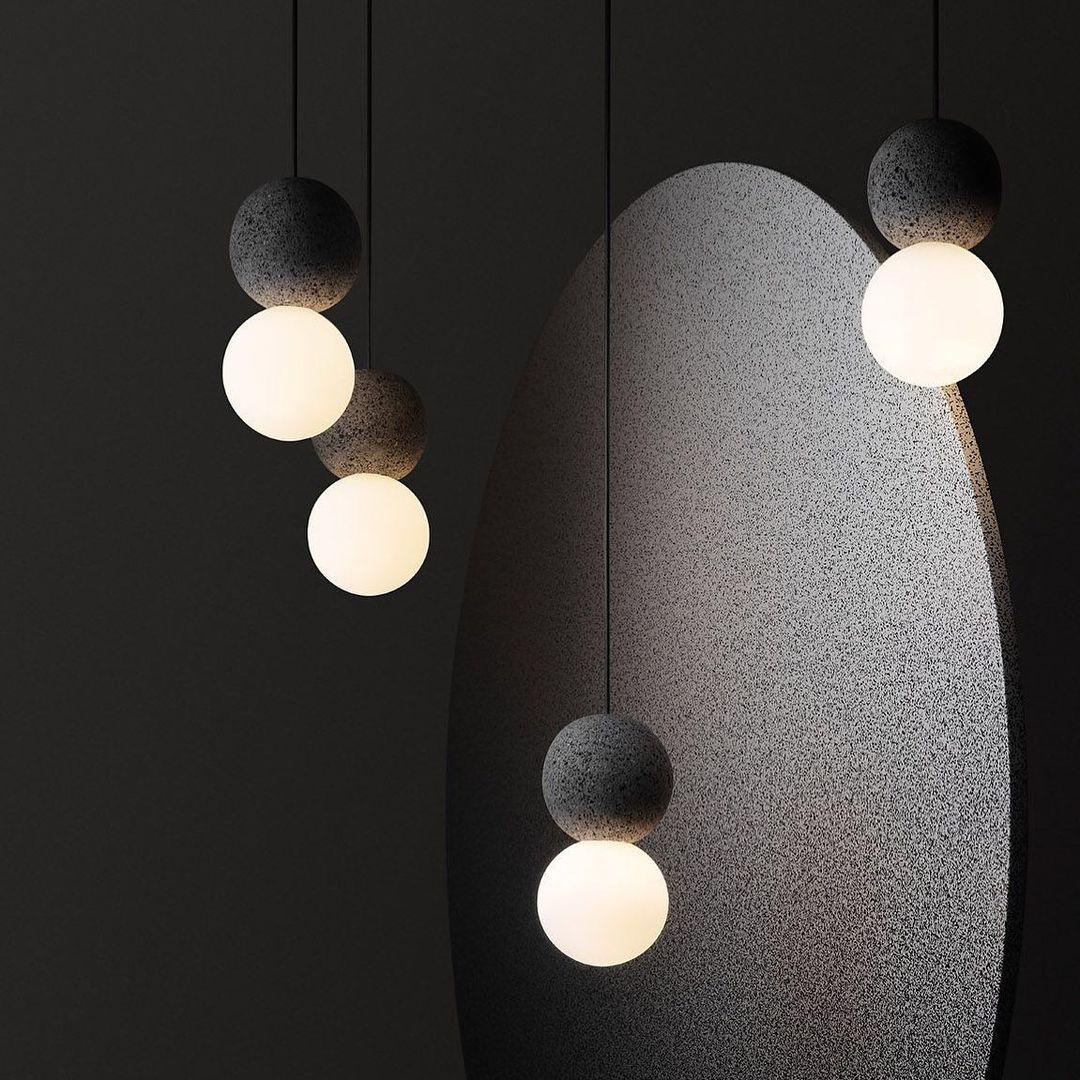
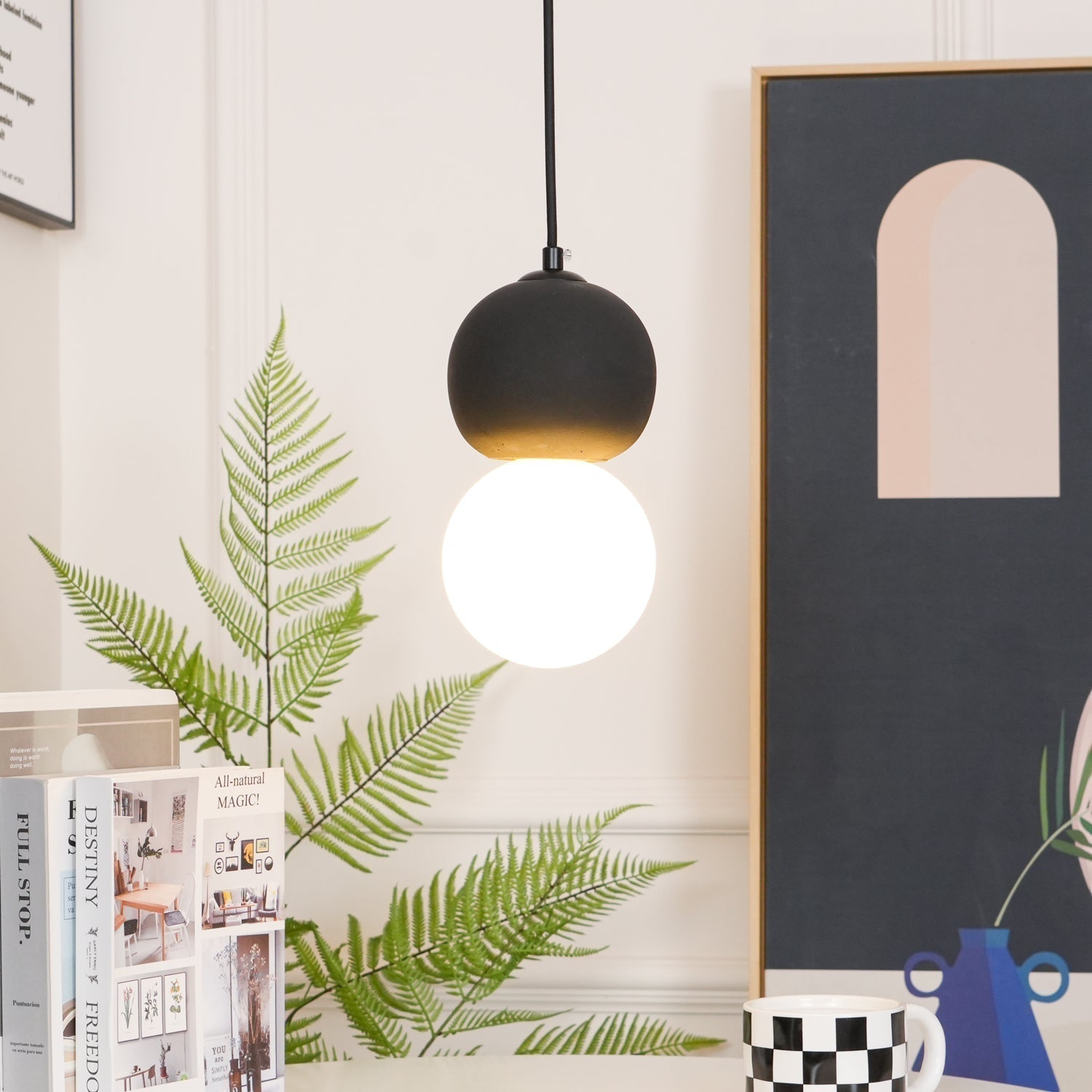
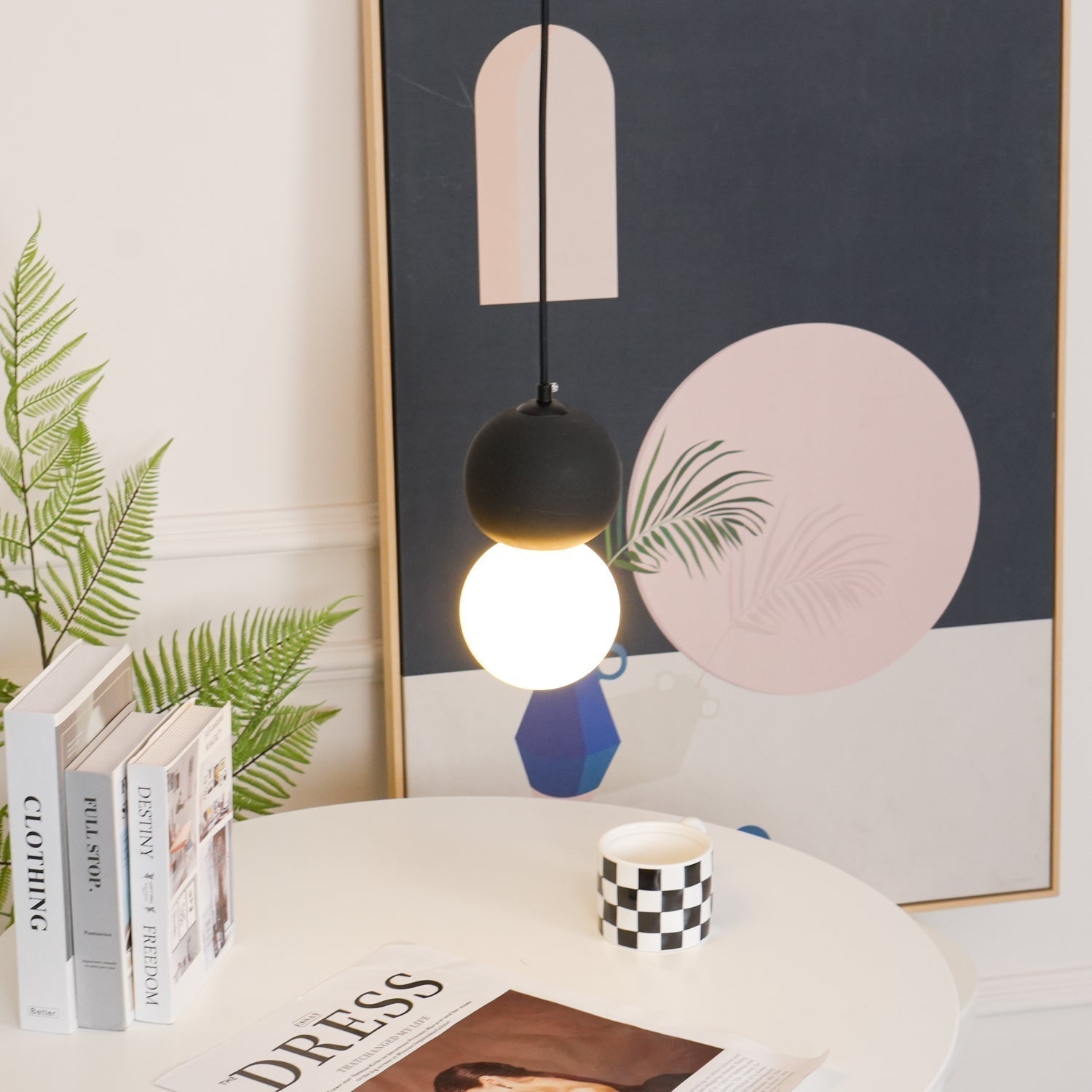
A cement pendant light is the simplest way to add architectural weight to a small fixture. This one pairs a cast cement body with an opal glass diffuser: the cement gives you texture and shadow, the opal glass spreads the light so you see a soft glow instead of a bare bulb. At roughly 10 cm (3.9″) in diameter and 20 cm (7.9″) tall it is a compact pendant — best used singly over a small table, in pairs over a kitchen island, or in a run of three down a hallway where a larger shade would crowd the space.
Why cement and opal glass belong together
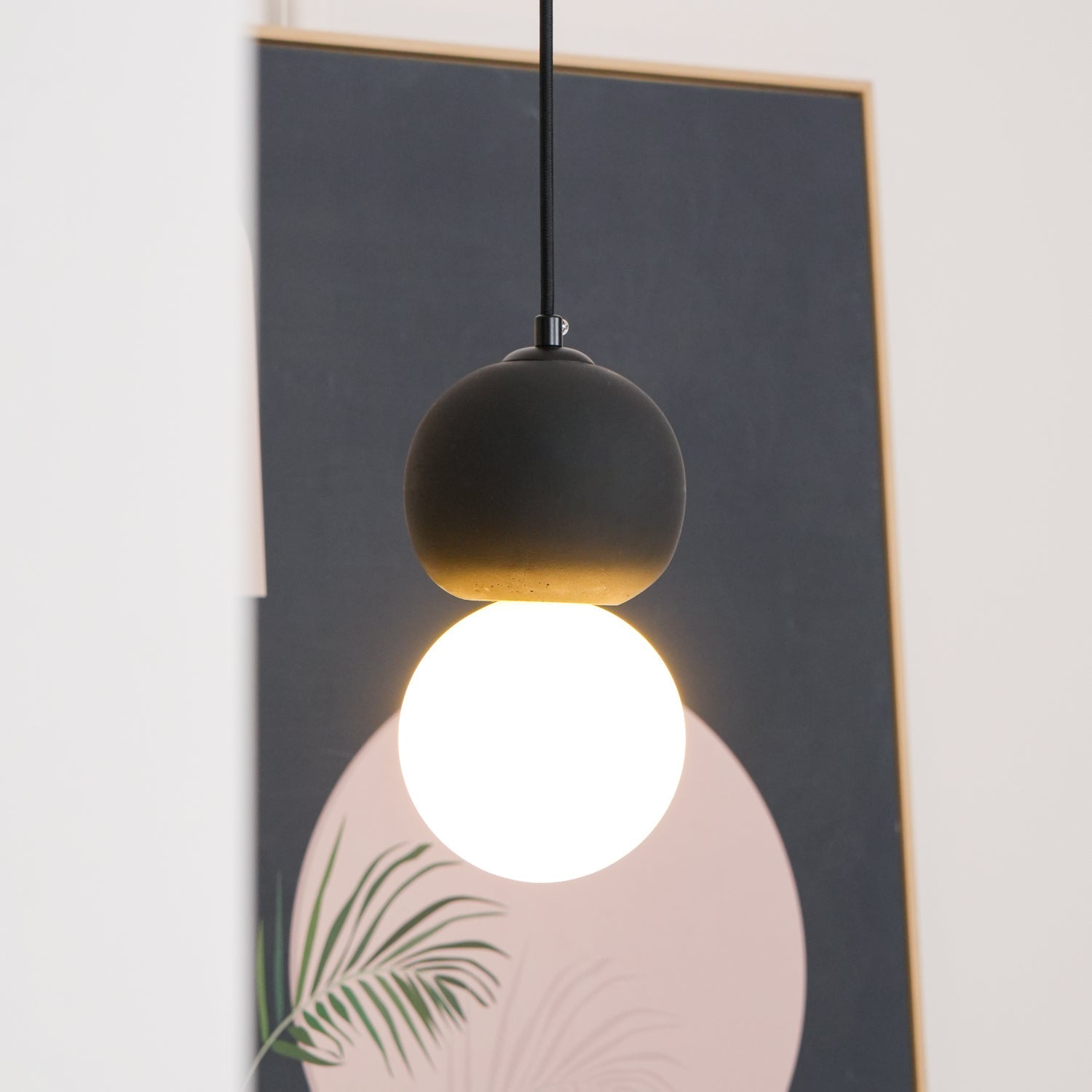
Most pendant lighting picks one idea and commits to it: metal for precision, glass for lightness, ceramic for warmth. This fixture holds two at once. The cement body reads as volcanic rock — matte, slightly irregular, absorbing light rather than bouncing it. The opal glass shade does the opposite. It diffuses, so the light leaves the fixture evenly and the material’s relief and contour become visible only at the edges where the two surfaces meet.
The practical result is a pendant that looks heavier than it is and glows softer than its size suggests. That combination is why cement fixtures sit comfortably in rooms that resist anything shiny — plaster walls, oak, linen, raw stone counters — and why they tend to look out of place in high-gloss modern kitchens.
Materials and finishes
The body is offered in grey or black, with the shade in white. The listed material build is cement with black sandstone, white sandstone and glass. Each cement pour has slight tonal variation, so two pendants in the same room will never be identical — worth knowing before you order a matched pair, and part of the appeal if you are not chasing uniformity.
Where it works — and where it does not
This is a small pendant, and small pendants are placement problems more than style problems. It reads best when it is clearly doing one job in a defined zone.
Kitchen island and peninsula
Use two or three in a row rather than one. With a 10 cm shade, a single pendant over a 2-metre island looks like a mistake; a row of three at even spacing looks deliberate. A working rule: divide the island length by (number of pendants + 1) to get the gap between centres. For a 2.4 m island with three pendants, that is a 60 cm gap between centres.
Hang the bottom of the shade 75–85 cm (30–33″) above the countertop. Go toward the higher end if people sit at the island, lower if it is purely a work surface. Because the cable adjusts to 59″ (149.9 cm), most standard ceilings have room to spare.
Dining room
For a small round or square table, one pendant centred overhead is enough. Set the bottom of the shade about 75 cm (30″) above the tabletop — low enough to define the table as a zone, high enough that nobody’s sightline is blocked across the table. Over a long rectangular table, two or three smaller pendants at even intervals will usually look better than one large fixture.
Bedroom, hallway, foyer
These are the natural homes for a single unit. A pair flanking a bed reads as bedside lighting without the floor-lamp footprint. In a hallway, a run of three at 90–120 cm intervals gives rhythm at eye level. In a foyer, hang it so the shade bottom sits roughly 200–210 cm (79–83″) above the floor — above head height, still visible as you enter.
Rooms to skip
The fixture is IP20 rated: damp-rated, intended for indoor use where it is not exposed to moisture. That rules out bathrooms, covered porches, and anywhere steam or spray reaches the shade. It is also not the right choice for a room where you need general illumination from one point — a 10 cm shade at 20 cm tall is an accent and task light, not a room light. Plan on recessed or floor lighting alongside it.
Bulb and colour temperature
The socket is G9, and the fixture accepts LED or Edison bulbs at AC 110–240V. G9 bulbs are physically small, which is what allows the compact proportions — check the bulb’s maximum length against the shade interior before you buy a decorative Edison-style lamp.
Colour temperature is where most installations go wrong. For a dining room or bedroom, 2700K keeps the opal glass warm and the cement from looking grey-cold. Over a kitchen island used for prep, 3000K gives better colour judgement on food. If you want the fixture to disappear into the architecture, match the bulb to your other downlights; if you want it to read as a lit object, go one step warmer than everything else in the room.
Control notes
The fixture is hardwired and works with common wall switches, which are not included. It is not supplied with a dimmer — if dimming matters for your dining room, confirm compatibility with your dimmer and bulb combination with your electrician before installation rather than after.
Specifications
| Dimensions | Dia 10 cm x H 20 cm / ∅ 3.9″ x 7.9″ |
| Cable length | 59″ (149.9 cm), adjustable, can be lengthened as required |
| Bulb | G9 base, LED or Edison bulb |
| Voltage | AC 110–240V |
| Mounting | Ceiling, hardwired |
| Rating | IP20, damp-rated, indoor use |
| Finishes | Body: grey or black · Shade: white |
| Materials | Cement, black sandstone, white sandstone, glass |
| Certifications | UL, ETL, CE, SAA listed; RoHS compliant; FCC certified |
Dimensions may have slight manual measurement variations. Colours and colour temperature may vary slightly due to photography lighting, monitor displays and batch differences.
Cement, metal or glass? A quick comparison
If you are choosing between fixture types for the same spot, the material decides how the light behaves more than the shape does.
- Cement with opal glass — soft, even glow; strong texture; best where you want the fixture to feel like part of the architecture. Heavier visually, so it anchors a small space.
- Bare metal — directional and crisp; throws highlights and hard shadows; reads more industrial or more precise depending on finish.
- Clear glass — visually light, lets the bulb be the object; needs a decorative bulb and shows dust.
- Fabric or paper shade — warm and quiet, but flat in texture and prone to sagging over time.
The cement-and-glass pairing is the one that survives both trends: the shade type is classic, the body material is what dates or does not. Because the same series is available in other formats, a matching run over an island and a single over a side table is straightforward to specify.
Installation checklist
- Confirm the ceiling box is rated for a hardwired fixture and that power is off at the breaker.
- Decide the finished height first, then trim or coil the cable — 59″ of cable is generous, and excess should be managed inside the canopy, not looped above it.
- For a row of pendants, mark centres on the ceiling before drilling; sight lines from the main entry point of the room are what people actually notice.
- Fit the bulb before the final tighten if the shade opening is narrow, and check that the bulb does not touch the glass.
- Use the fixture on a switch you would naturally reach for — a pendant on a switch behind a door is a pendant nobody turns on.
Frequently asked questions
How big is this pendant light?
The shade measures approximately Dia 10 cm x H 20 cm (∅ 3.9″ x 7.9″), with a 59″ (149.9 cm) adjustable cable. It is a compact fixture — plan on one over a small table, or two to three over an island.
What bulb does it take?
A G9 bulb, LED or Edison style, at AC 110–240V. G9 bulbs are small, so check the physical length against the shade interior if you are using a long decorative bulb.
Can it go in a bathroom or outside?
No. It is IP20 and damp-rated for indoor use where it is not exposed to moisture. Bathrooms, outdoor areas and other high-humidity spaces are not recommended.
Is it dimmable?
The fixture is hardwired and compatible with common wall switches, which are not included. Dimming depends on the bulb and dimmer you pair it with — have your electrician confirm compatibility for your setup.
How high should I hang it over an island?
Around 75–85 cm (30–33″) from the countertop to the bottom of the shade. Use the higher end where people sit, and keep three pendants evenly spaced rather than centred as a pair over a long island.
Ready to specify it? See the cement and opal glass pendant light, finishes and current pricing here — grey or black body, white shade, UL, ETL, CE and SAA listed.
Need custom dimensions, a lighting layout for a longer island, or expedited shipping? Contact the MiniHouzz design team through the product page.