
A brass picture light is the cheapest way to make a framed piece look like it belongs in a gallery. Instead of lighting the whole room and hoping the art catches some of it, a picture light puts light on the face of the artwork itself: stronger on the surface, softer around it. This antique brass version from MiniHouzz does that while acting as part of the wall decor — the brass body is visible, not hidden behind the frame.
If you are choosing one, three decisions matter more than anything else: length, mounting height, and bulb. Get those right and the piece reads sharp and rich. Get them wrong and even good art looks flat or glare-heavy.
Quick reference before we go deeper:
- Length: pick a lamp roughly 50–65% of the artwork width.
- Mounting: most installations sit about 2–3 in (5–8 cm) above the top of the frame.
- Bulb: E12 or E14 socket, bulbs not included — a warm 2700–3000K bulb flatters paint and paper.
- Wall clearance: this fixture projects 7.9 in (20 cm) from the wall.
Why a picture light beats a ceiling fixture
Ceiling light arrives at the wall at a shallow angle. On framed art that produces two problems: the top of the piece looks brighter than the bottom, and glass surfaces throw reflections back at the viewer. A dedicated wall-mounted light changes the geometry — it sits close to the piece and aims across it, so the whole surface is lit at a similar intensity.
Three practical differences you will notice:
- Even coverage. The falloff from top to bottom is much gentler, so the bottom third of a print does not disappear into shadow.
- Controlled spill. The light stays mostly on the art instead of washing the entire wall, which keeps the room’s ambient level calm.
- Texture. Raking light reveals brush stroke, paper grain, and canvas weave — often the reason a piece looks better in a gallery than at home.
Matching lamp length to artwork width
The common mistake is buying a lamp as wide as the frame. A picture light slightly narrower than the artwork looks intentional; one that matches edge to edge flattens the composition and lights the wall beside the piece. As a working rule, aim for 50–65% of the frame width.
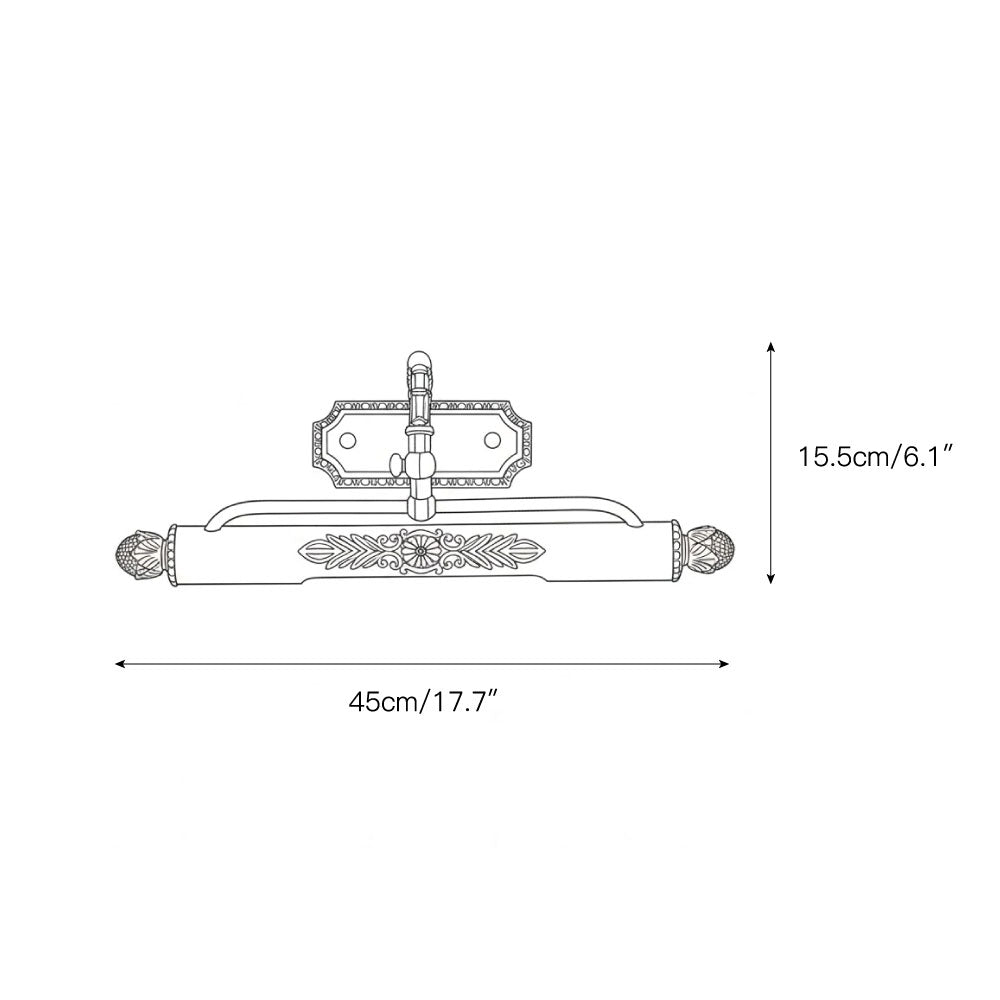
This fixture comes in three lengths. Here is how those sizes map onto typical artwork widths under that rule:
| Lamp length | Height of body | Artwork width that suits it |
|---|---|---|
| 45 cm (17.7 in) | 15.5 cm (6.1 in) | About 70–90 cm (28–35 in) |
| 58 cm (22.8 in) | 15.5 cm (6.1 in) | About 90–115 cm (35–45 in) |
| 76 cm (29.9 in) | 15.5 cm (6.1 in) | About 115–150 cm (45–59 in) |
Those artwork ranges are guidance, not a rule of law — a very tall portrait or a busy abstract can take a wider lamp, and a small, dense etching often looks better with the shorter one. If your piece sits outside all three ranges, this lamp can be ordered in custom dimensions through MiniHouzz support.
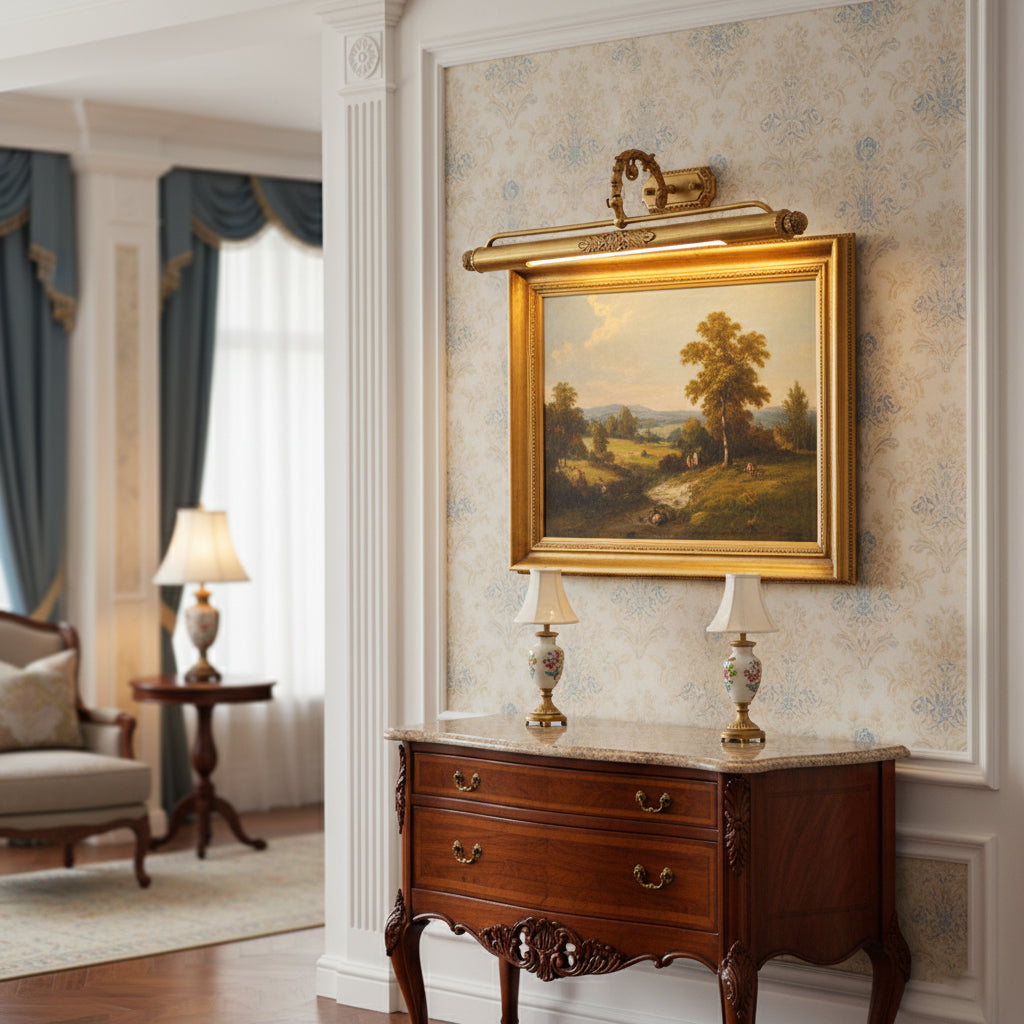
Mounting height, angle, and clearance
The lamp should throw light across the piece, not sit on top of it. A short checklist that works for most frames:
- Mark the centerline. Measure the frame, mark its vertical center on the wall, and align the lamp body to it. A 1 in offset is visible on a symmetric frame.
- Start 2–3 in above the frame. Then check in the evening with the room lights off. If the top edge of the artwork looks hot and the bottom looks dull, raise the fixture slightly or adjust the angle.
- Tilt down, but not straight down. A downward angle of roughly 15–30° from horizontal is the usual sweet spot. Too shallow and light spills up the wall; too steep and the frame casts a hard shadow band across the top of the piece.
- Respect the projection. This lamp extends 7.9 in (20 cm) from the wall. On a hallway wall or above a console, check that the arm does not collide with a door swing or shelf before you drill.
- Account for glass. If the piece is glazed, stand where you will normally view it and look for a reflection band. A small angle change usually removes it.
For a piece hung at eye level — typically 57–60 in (145–152 cm) to center — the lamp ends up around 70–75 in from the floor on an average 8 ft wall. If the artwork hangs over a sofa or sideboard, keep roughly 6–10 in of breathing room between the frame top and the bottom of the lamp so the fixture does not crowd the composition.
Bulbs: socket, color temperature, and output
This lamp uses an E12 or E14 socket, and bulbs are not included. That is genuinely useful, because the bulb decides whether the artwork looks warm or clinical.
- Color temperature: 2700K–3000K keeps oils, watercolors, and photography in warm territory without turning whites yellow. 3500K and up starts to read as office lighting on a residential wall.
- CRI: look for a bulb rated CRI 90 or higher. Low-CRI bulbs mute reds and greens, which is exactly what you notice on art.
- Type: an LED filament or frosted LED in E12/E14 candelabra base runs cool and is comfortable near paper and canvas. Match the bulb’s rated wattage to what the fixture and your circuit allow; when in doubt, go lower rather than higher.
- Dimming: if you want the light to drop to a low evening level, confirm your bulb is dimmable and that the dimmer is compatible with LED loads.
One more practical note: on a wide piece, two shorter lamps at the same height usually beat one long lamp for even coverage, because each one lights only half the distance and the falloff is smaller.
Antique brass in real rooms
Antique brass is a warm, low-sheen finish. It sits comfortably against dark green, navy, and charcoal walls, and it picks up the tones of walnut, oak, and leather rather than competing with them. Three placements where it does the most work:
- Living room. Above a single large piece over a sofa or console. Keep the lamp narrower than the frame so the brass reads as a deliberate accent line.
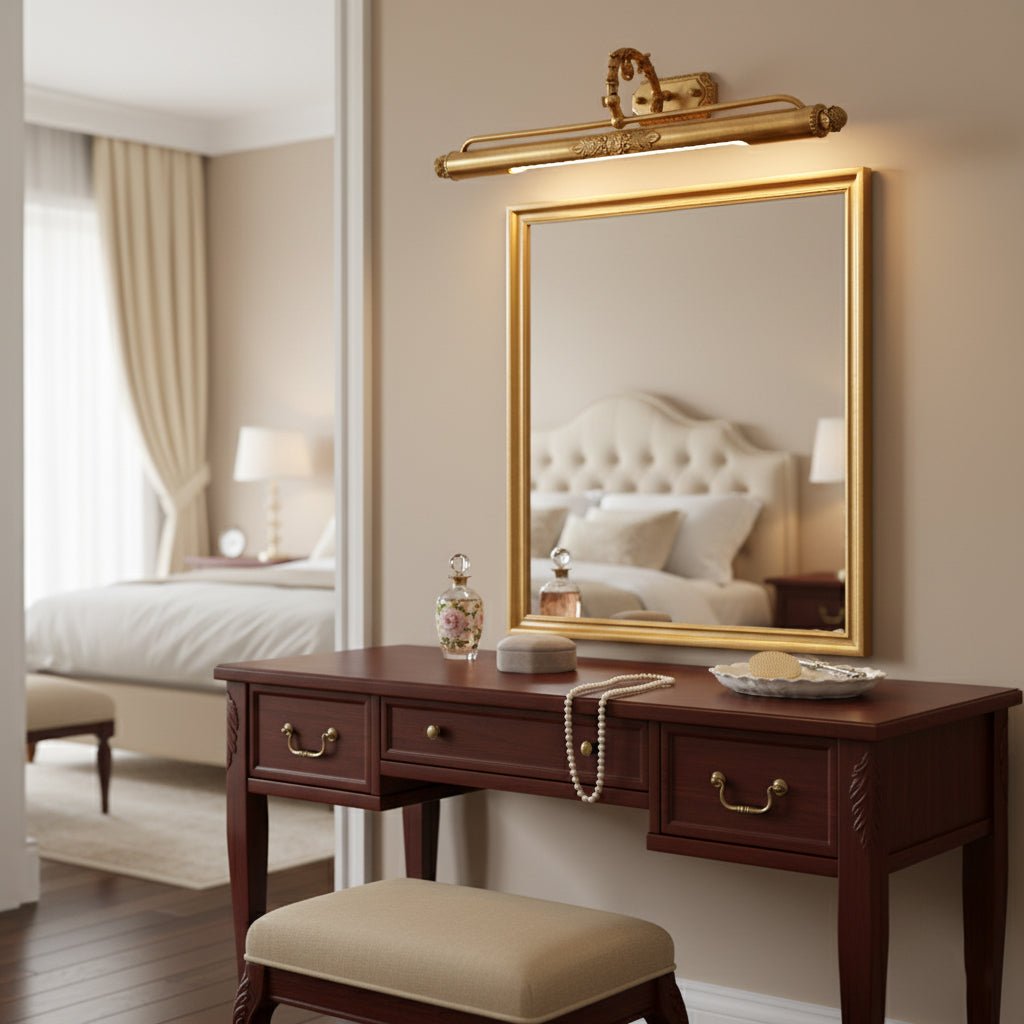
- Bedroom. Over a small framed print beside the bed, or in a pair flanking a dresser. Because the light is directional, it is easy on the eyes at night while still showing the piece.
- Entry, hallway, or study. Narrow walls are where picture lights earn their keep — the projection of 7.9 in is enough to light the art without blocking the walkway, as long as you keep the fixture above shoulder height.
Finish consistency matters more than people expect. If the room already has brass hardware, door levers, or a brass lamp base, stay in the same family. Antique brass next to polished chrome usually looks like a mistake; antique brass next to unlacquered brass or bronze reads as intentional.
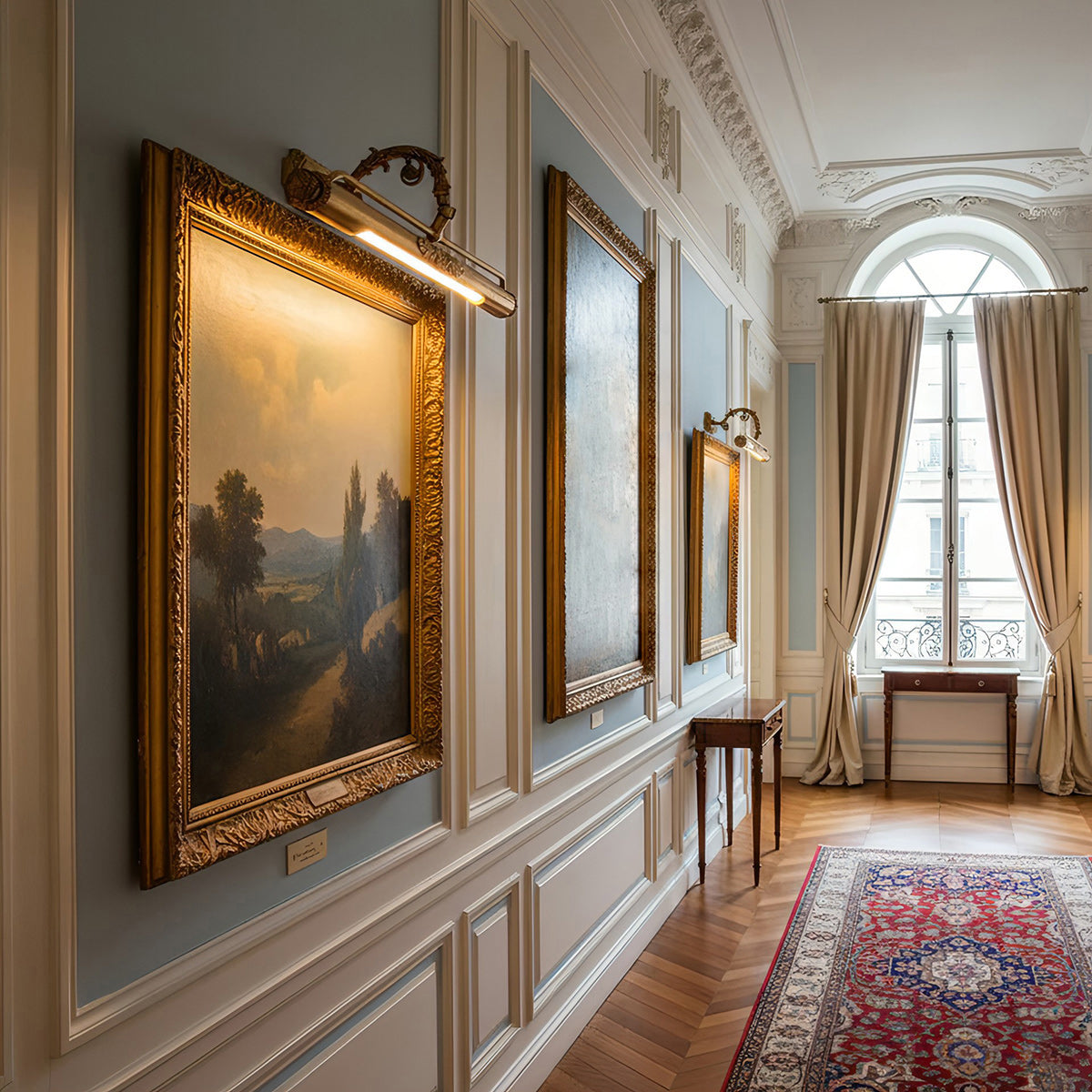
Lighting a gallery wall with more than one lamp
With several frames, the goal is one consistent light plane. Pick the height of the largest frame first, mount its lamp, then align the others to that line rather than to each individual frame.
- One lamp per piece when frames are 20 in wide or more; skip lamps on small pieces and let them sit in the spill.
- Spacing: keep at least one frame-width of wall between lamps so the light pools do not overlap into a flat wash.
- Symmetry: on a symmetric grid, mirror the lamp offsets exactly. Asymmetry reads as error on a gallery wall, even when the frames themselves are offset.
- One circuit, one dimmer. If all lamps are on the same switch, dimming stays consistent across the wall.
Specifications
| Spec | Detail |
|---|---|
| Material | Brass; brass lamp body |
| Finish | Antique brass |
| Length options | 45 cm / 58 cm / 76 cm (17.7 in / 22.8 in / 29.9 in) |
| Body height | 15.5 cm (6.1 in) |
| Distance from wall | 20 cm (7.9 in) |
| Socket | E12 or E14 (bulbs not included) |
| Certification | UL, ETL, CE, RoHS, FCC |
| Typical use | Living room, bedroom, study, entry / foyer |
Dimensions are manually measured and may vary slightly. Brass tone and color temperature can also shift a little in photos because of lighting, monitor calibration, and batch differences.
FAQ
What sizes does this brass picture light come in?
Three: 45 cm × 15.5 cm (17.7 in × 6.1 in), 58 cm × 15.5 cm (22.8 in × 6.1 in), and 76 cm × 15.5 cm (29.9 in × 6.1 in). Each projects 20 cm (7.9 in) from the wall.
What bulb does it take, and is one included?
It uses an E12 or E14 socket. Bulbs are not included — a dimmable LED in that base, around 2700–3000K and CRI 90+, is the usual pick for artwork.
Can it be used to display and light artwork?
Yes. It is designed to highlight a picture or artwork and create a gallery-style display; the brass body and integrated light work together on the piece rather than only on the room.
How far above the frame should I mount it?
Start around 2–3 in (5–8 cm) above the top of the frame and check the result in the evening. If the top edge of the art looks hot, raise it slightly or reduce the downward tilt.
Does MiniHouzz offer custom sizes or expedited shipping?
Yes — custom dimensions, lighting layout advice, and expedited shipping can all be arranged by contacting MiniHouzz support.
Bottom line
Choose the length at roughly 50–65% of the artwork width, mount it 2–3 in above the frame, and fit a warm high-CRI E12/E14 LED. That combination is what separates a lit piece from a lit room. The antique brass body carries the look when the light is off, which is most of the time.
View the Brass Picture Light Wall Lamp at MiniHouzz →
Lighting a longer wall? Add a second brass picture light at the other end of the composition so both sides of the arrangement sit on the same light plane.