
A modern pendant light for a kitchen island is usually hung with the bottom of the shade 30 to 36 inches above the countertop, and the answer to “3 heads or 5 heads” depends on the surface length more than on style. As a rule of thumb: one 3-head cluster suits islands and tables up to roughly 6 feet long, while a 5-head cluster reads better over 7-foot-and-longer surfaces or open dining tables where you want a wider visual footprint. Both versions in this MiniHouzz collection share the same slim-cylinder language — gold, chrome, or black tubes suspended around a central sphere — so the choice is mostly about scale, sightline, and how much of the ceiling plane you want the fixture to occupy.
What this fixture actually is
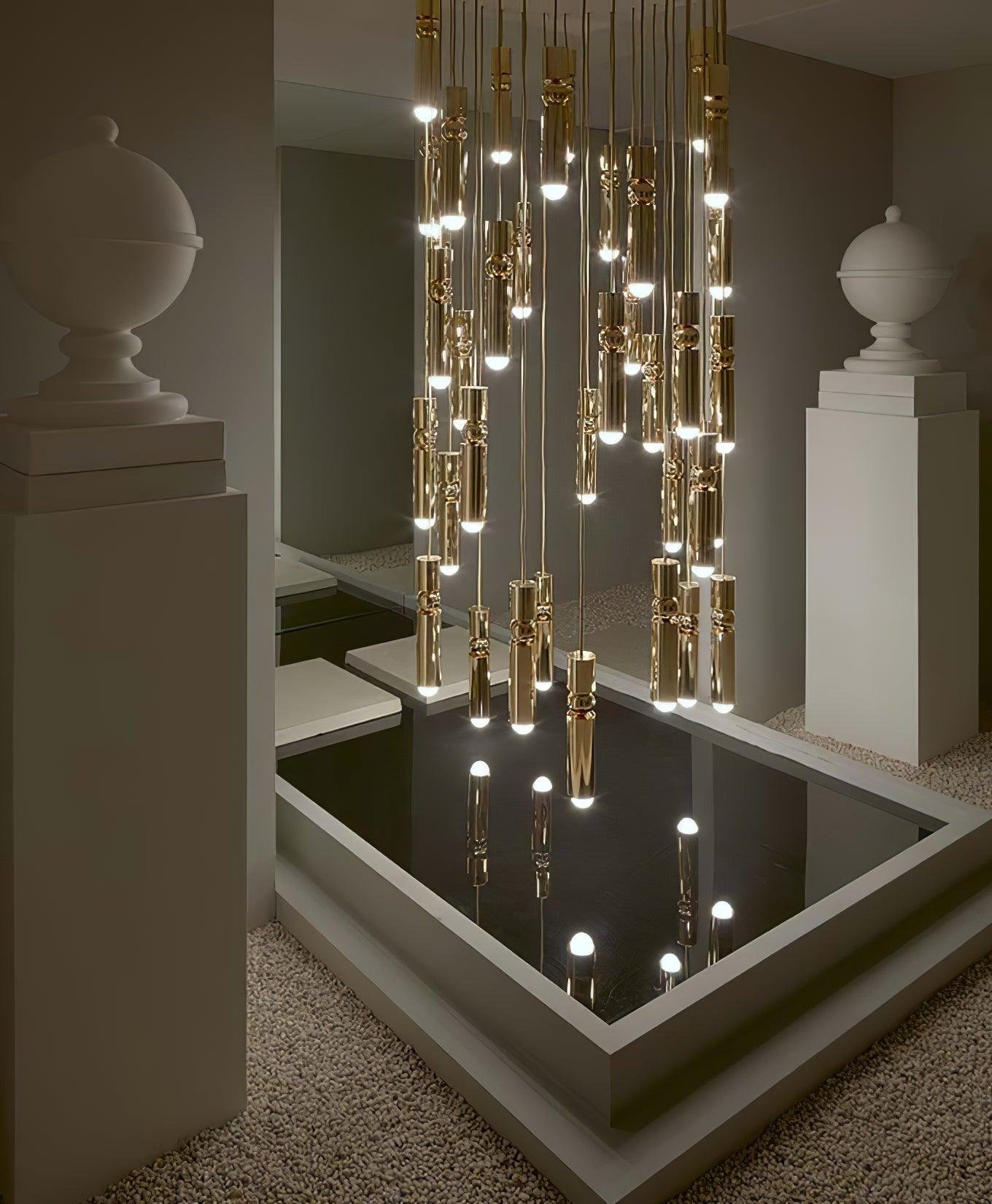
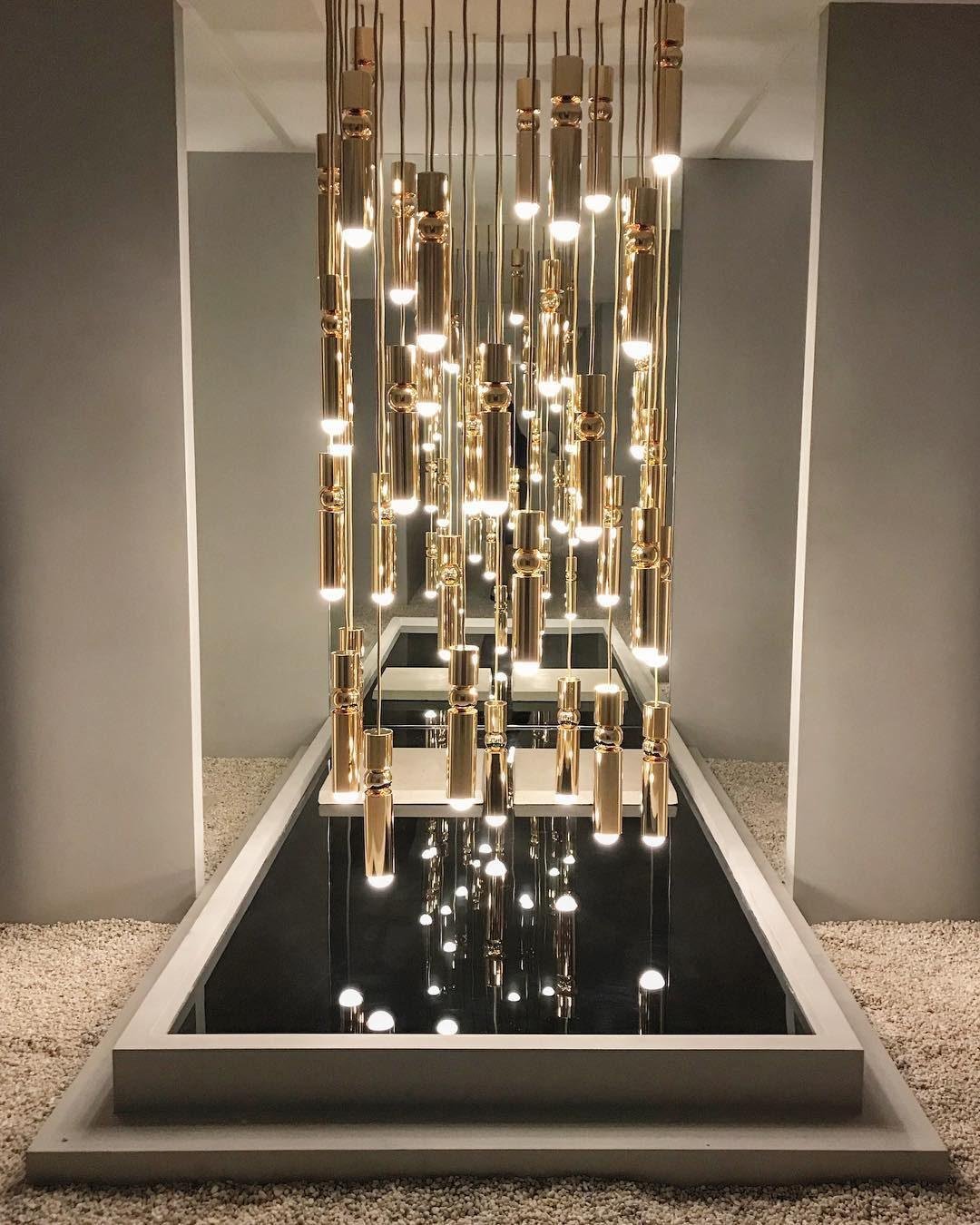
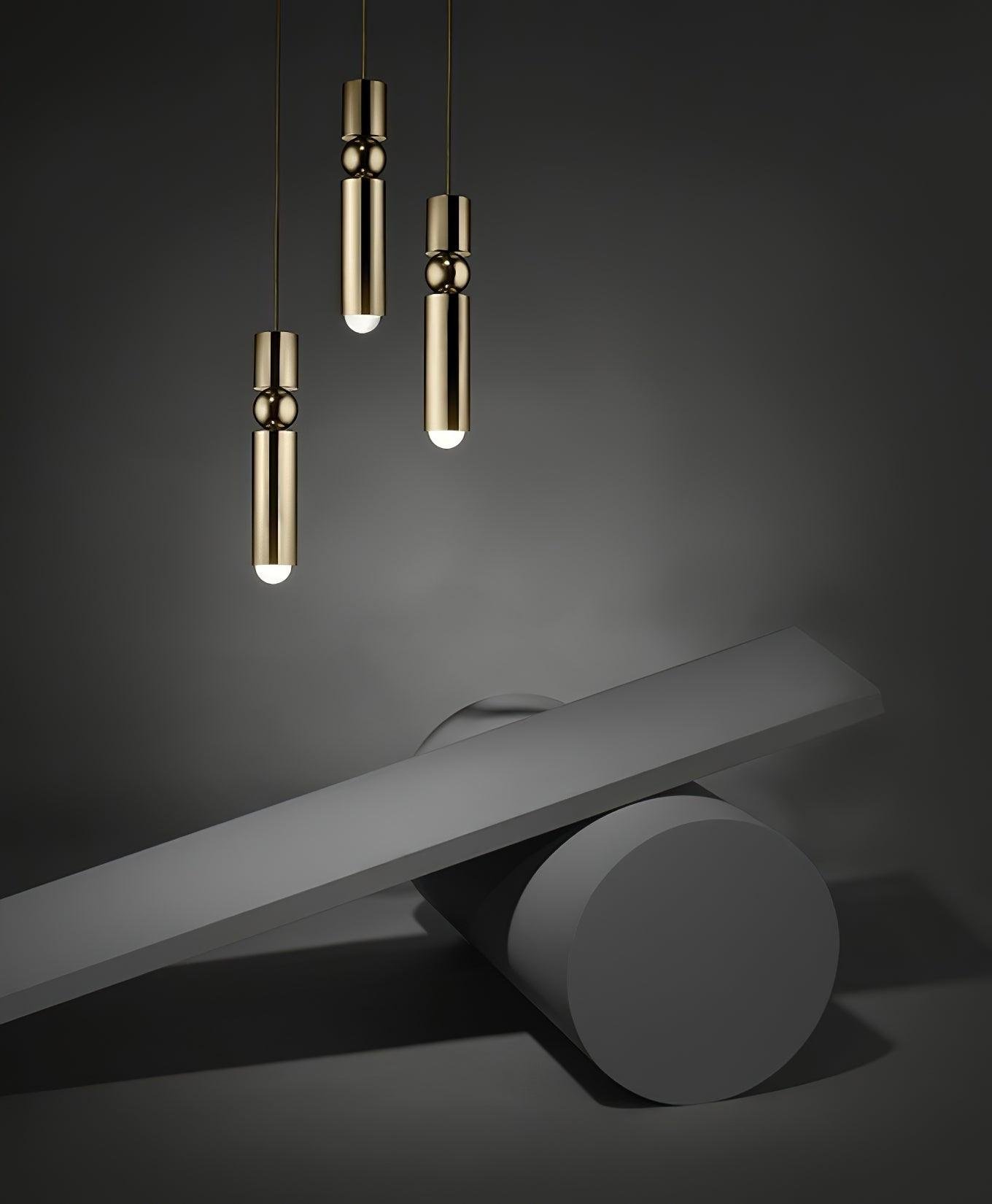
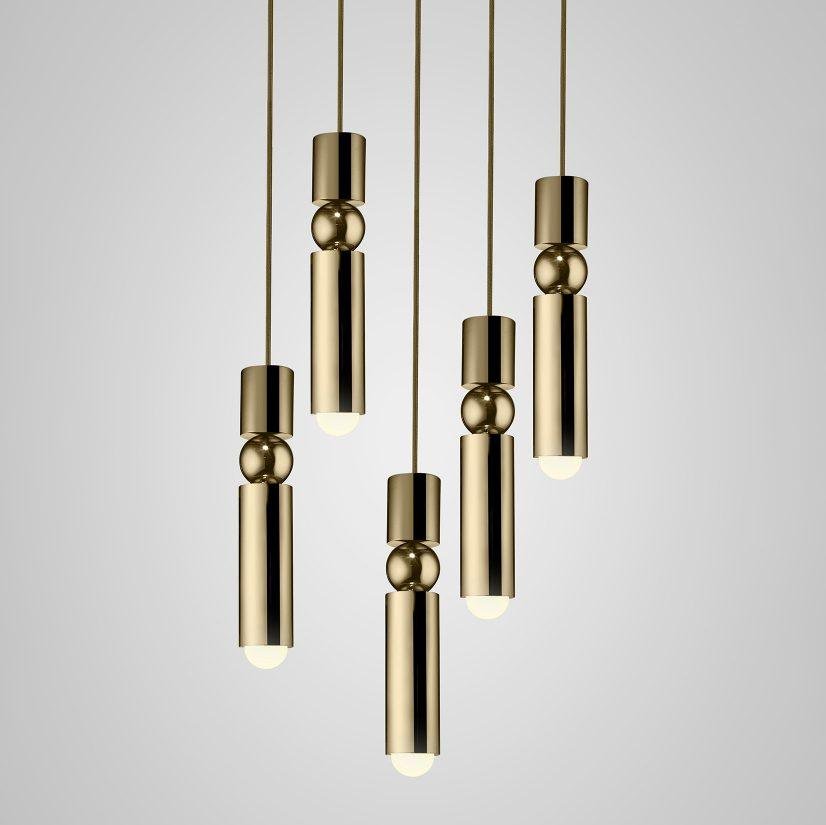
The Fulcrum-style cluster is built from three or five slim cylinders arranged around a central sphere, with the arms acting as both structure and ornament. It is a boutique-hotel idea executed at residential scale: narrow verticals instead of a big drum or globe, so the fixture stays visually light even when it is physically large.
Materials are listed as metal, glass, and aluminum, which is a sensible combination for this shape — the aluminum and metal carry the frame and canopy, while the glass cylinders keep the light soft and non-glare. The fixture is hardwired for ceiling mounting, runs on AC 110–240V, and is offered in black, chrome, and gold finishes. It is rated IP20 damp-rated, meaning indoor use where it is not exposed to direct moisture.
3-head or 5-head: match the fixture to the surface
The two configurations are not just different sizes — they are different gestures. A 3-head cluster is a punctuation mark; a 5-head cluster is a composition. Choose based on the length of what sits underneath it and how far away people will view it from.
| Configuration | Fixture size | Best fit |
|---|---|---|
| 3-head | Approx. 9.9 in diameter × 59 in overall hanging length | Islands and dining tables up to about 6 ft; galley kitchens; rooms where the fixture is seen up close |
| 5-head | Approx. 11.8 in diameter × 59 in overall hanging length | Islands and tables 7 ft and longer; open-plan dining; double-height or vaulted rooms |
Two details worth knowing before you decide. First, the overall diameter difference is modest — roughly two inches — because the heads sit in a tight cluster, not spread across the ceiling. The 5-head version reads larger mainly through density and the wider silhouette, not through a dramatically wider spread. Second, if your island runs past about 8 feet, a single cluster starts to look stranded; two 3-head fixtures spaced along the run is usually a better composition than one 5-head.
How high to hang it, and how much cable you will use
Hanging height is the single most common mistake with cluster pendants. The fixture is tall — the cylinders are long, and the cluster hangs from a 59-inch cable — so a fixture mounted at the wrong drop can either crowd the sightline or float too high to read as a focal point.
- Over a kitchen island: 30–36 inches from the countertop to the lowest point of the fixture. Use the lower end for ceilings at or below 8 ft, and the higher end if your household is tall or the island doubles as a prep-and-serve surface.
- Over a dining table: 30–34 inches from the tabletop to the lowest point. Hang lower (30–32 in) for intimate, warm dining light; higher (33–34 in) if the table is also used for homework, laptops, or crafts.
- Clear the sightline: from the main doorway into the room, you should not see the bottom of the fixture below eye level. If you do, raise it 2–3 inches.
- Budget the cable: the adjustable hanging length is 59 inches (149.9 cm), so a standard 8 ft ceiling with a 36 in counter leaves roughly 27–33 inches of drop to play with after the canopy. On 9–10 ft ceilings you will use most of the cable, and the listing notes that an extension may be available — confirm before ordering.
Spacing and placement
Because the heads are clustered rather than fanned out, you center one fixture on the island or table rather than spacing individual pendants. Three practical rules that hold up in real kitchens:
- Center on the surface, not the room. Align the canopy with the centerline of the island or tabletop; an off-center fixture is the first thing the eye catches.
- Keep the canopy off the sink and cooktop. Aim for ceiling placement behind the island’s working edge, so the fixture lights faces and plates rather than casting your shadow onto the counter.
- Watch the walkway. The lowest point should sit at least 78 inches above the floor in any path people walk through — usually automatic once the 30–36 inch counter clearance is respected, but worth checking on low ceilings.
Bulbs, base type, and color temperature
The fixture takes G9 base bulbs and is described as compatible with LED or Edison-style bulbs. G9 is a small bi-pin base, so the bulbs sit neatly inside slim glass cylinders — which is exactly why this design works without bulky shades.
Two honest caveats. The listing does not state a maximum wattage per socket, so confirm that with support before installing high-output bulbs. And the control description specifies compatibility with standard wall switches; if dimming matters to you, verify dimmer and bulb compatibility before you buy rather than after.
For color temperature, match the room’s job:
- 2700K — warm, hospitality-grade light for dining rooms and evening entertaining.
- 3000K — a cleaner white that still feels residential; the safer default for islands used for prep.
- Avoid mixing. Keep every bulb in the cluster at the same CCT, or the fixture will look mismatched head to head.
Black, chrome, or gold: choosing a finish
All three finishes are architectural rather than decorative, and each does something different to a room:
- Black — the most graphic option. It draws the eye and holds its own against dark cabinetry, black window frames, and industrial materials.
- Chrome — the most reflective. It nearly disappears against white ceilings and light stone, and it flatters cool-toned kitchens.
- Gold — the warmest. It picks up brass hardware, oak, and warm white walls, and it is the finish that most reads as boutique-hotel.
If your kitchen already has two metals, choose the finish that matches the lighting-age metal (faucet, cabinet pulls) rather than the appliance metal. Stainless appliances are deliberately neutral; the fixture should follow the hardware.
Installation and electrical notes
This is a hardwired ceiling fixture, not a plug-in, so plan on a junction box at the mounting point and a licensed electrician for the connection. A few things to confirm before the electrician arrives:
- Ceiling structure. The canopy needs a box rated for fixture weight; cluster pendants are heavier than a single-shade pendant of the same visual size.
- Voltage. AC 110–240V means it works on US 120V circuits without a transformer.
- Location. IP20 damp-rated is indoor, away from direct moisture — fine over an island or table, not a choice for a shower or covered porch.
- Compliance paperwork. The listing states UL, ETL, CE, and SAA listing along with RoHS and FCC compliance; your electrician will want to see the markings on the fixture itself.
Specifications
| Item | Detail |
|---|---|
| Materials | Metal, glass, aluminum |
| Finishes | Black, chrome, gold |
| Light source | LED or Edison bulb, G9 base (bulbs not included) |
| Voltage | AC 110–240V |
| Mounting | Ceiling, hardwired |
| Control | Standard wall switch (not included) |
| Hanging length | 59 in / 149.9 cm adjustable cable; extension may be available |
| Individual cylinder | Approx. 2.4 in diameter (6.1 cm); height listed as both 13.8 in (35 cm) and 11.8 in (30 cm) — confirm with support |
| 3-head fixture | Approx. 9.9 in diameter × 59 in overall |
| 5-head fixture | Approx. 11.8 in diameter × 59 in overall |
| Environment | Indoor, IP20 damp-rated |
| Listings | UL, ETL, CE, SAA; RoHS and FCC per listing |
Note: dimensions can vary slightly with manual measurement, and colors and color temperatures may shift a little between photography, monitor calibration, and production batches.
FAQ
How many heads do I need over a 6-foot island?
One 3-head cluster. A 6-foot island is at the upper edge of comfortable for a single small cluster; past about 7 feet, move to the 5-head, and past 8 feet, consider two 3-head fixtures spaced along the run instead of one wider fixture.
What bulbs does it take, and are they included?
G9 base LED or Edison-style bulbs. The listing does not include them, and it does not publish a maximum wattage per socket — confirm that with MiniHouzz support before buying high-output bulbs.
Can it be used in a bathroom or outdoors?
No. The fixture is IP20 damp-rated for indoor use where it is not exposed to direct moisture. It is suited to dining rooms, kitchens, living rooms, bedrooms, and similar interiors.
Will it work on a standard US ceiling?
Yes — the fixture accepts AC 110–240V and mounts to a ceiling junction box. The 59-inch adjustable cable covers most 8–10 ft ceilings; if yours is taller, ask about the optional extension before ordering.
Is the light dimmable?
The listing describes control via a standard wall switch and does not make a dimming claim, so dimming depends on the bulb and dimmer you pair with it. Verify compatibility first if dimming is a requirement.
The short version
For most kitchens, the decision comes down to three numbers: surface length (under 6 ft favors 3 heads, 7 ft and up favors 5), counter clearance (30–36 inches), and ceiling height (59 inches of cable is generous at 8–10 ft and tight above that). Pick a finish that matches the hardware rather than the appliances, keep every bulb in the cluster at the same color temperature, and confirm the socket wattage and dimming question before installation day.