
A single glass globe pendant light is the quietest way to light a kitchen island or dining table: one sphere, one cord, one pool of light exactly where people sit. It works because it does one job. It does not light the whole room, and it will look wrong if it is too small for the surface beneath it or hung too high above it. So the practical answer comes down to three decisions — globe diameter, hanging height, and color temperature — and everything else is finish and hardware details.
This guide walks through those three decisions in order, using the actual specifications of the MiniHouzz single globe pendant (8″, 10″, and 12″ glass spheres, 59″ adjustable cord, E26/E27 base, 3-step 3000K/4500K/6000K color switching) so the numbers you read here are numbers you can apply.
Why a single globe reads as “Nordic” and not “bare”
Nordic lighting design leans on a few consistent ideas: one visible light source, a diffusing shade rather than a bare bulb, and a fixture that disappears into the architecture instead of competing with it. A glass sphere does all three. The glass on this fixture is a high light transmittance type, so the globe glows evenly rather than showing a hot spot where the bulb sits, and the glass is specified as rust resistant — relevant if you live somewhere humid or the pendant hangs near a sink.
The finish is electroplated in either gold or silver, which gives the collar and canopy a thin, bright metallic layer rather than a painted coat. Electroplating reads as jewelry at close range, which matters most over an island where you see the fixture from two feet away while chopping vegetables.
What the fixture does and does not do
- Downlight direction. The light is directed downward, so you get a defined pool rather than ambient wash. Good over counters and tables; not a substitute for ceiling or recessed lighting.
- 1-light, 1-tier. One bulb, one globe. No layering, no second tier to align.
- Stated coverage: 108–161 sq ft (10–15 sq m). That is the manufacturer’s illumination area for the fixture — treat it as a general guide for the zone it serves, not as a claim that one pendant lights an entire open-plan floor.
- Adjustable height. The 59″ (149.9 cm) cord adjusts, which is what makes the same fixture usable over a 30″ table or a 42″ bar counter.
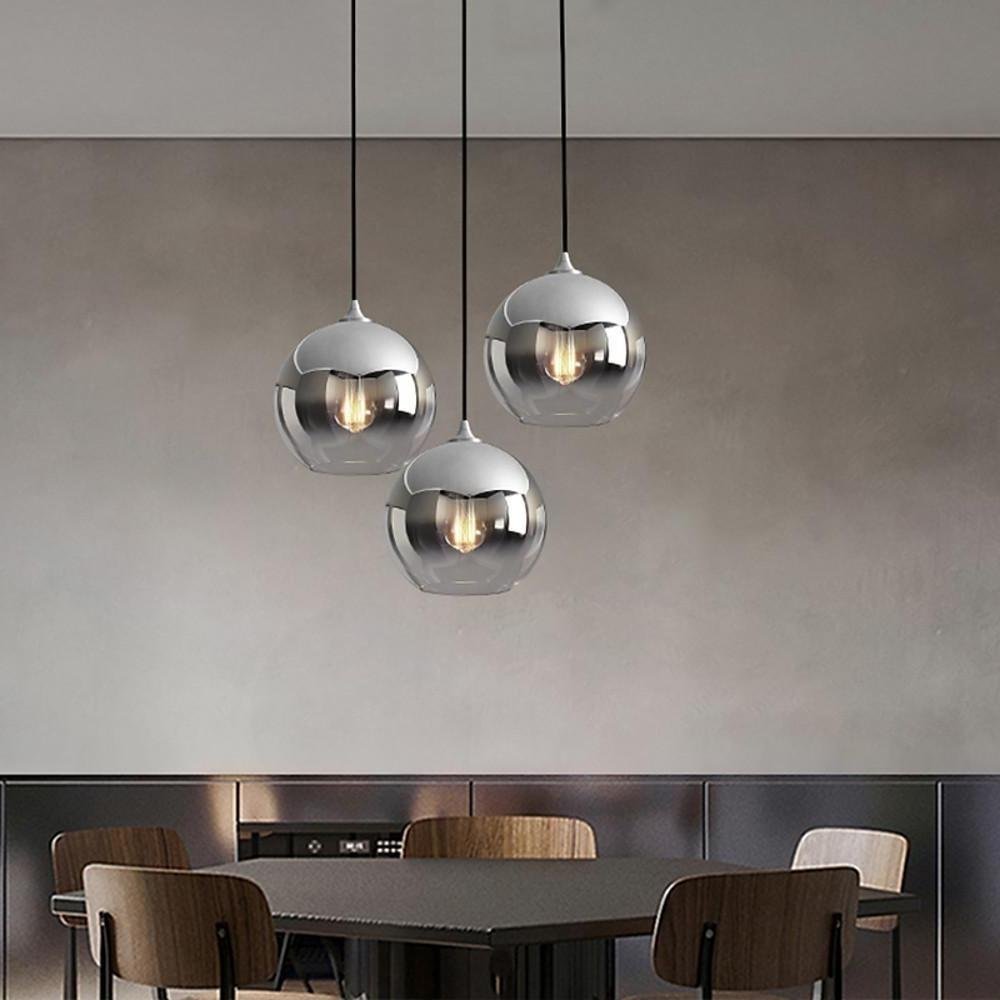
Step one: pick the globe diameter from the surface, not the room
The most common mistake with globe pendants is buying by ceiling height. Buy by the width of what the light hangs over. A 12″ globe over a 24″-deep breakfast bar is proportionate; the same globe over a narrow 18″ console looks oversized; an 8″ globe over a 48″ island looks like a lost marble.
The fixture is offered in three globe sizes, all with the same 59″ adjustable cord:
| Globe diameter | Metric | Fixture weight | Reads best over |
|---|---|---|---|
| 8″ | 20.3 cm | 1.86 lb (0.84 kg) | Small dining tables, bedside, powder room, tight corners |
| 10″ | 25.4 cm | 2.20 lb (1.00 kg) | Standard 4–6 seat dining table, small kitchen island, home office desk |
| 12″ | 30.5 cm | 2.56 lb (1.16 kg) | Full-size island, large dining table, double-height entries |
A workable rule of thumb: the globe diameter should be roughly one-third to one-half the width of the table or island it hangs over, and no more. For a 36″-wide island, a 10″ or 12″ globe both sit in range. For a 30″ bistro table, 8″ to 10″ is the sane zone.
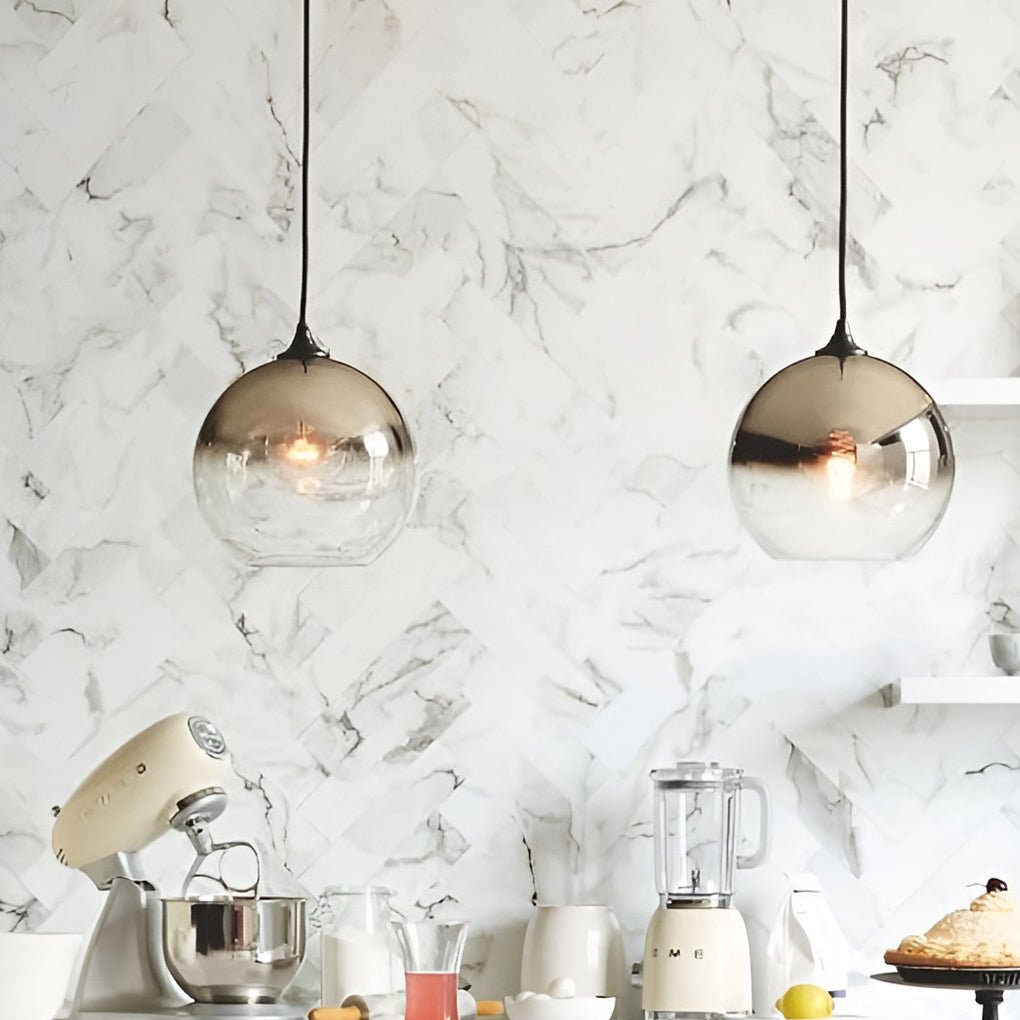
Step two: hang it low enough to actually work
Hanging height is where most single-pendant installs go wrong, because the instinct is to leave headroom. Over a surface people stand or sit at, the fixture should feel close — close enough that the globe is part of the table setting, not part of the ceiling.
Above a kitchen island or peninsula
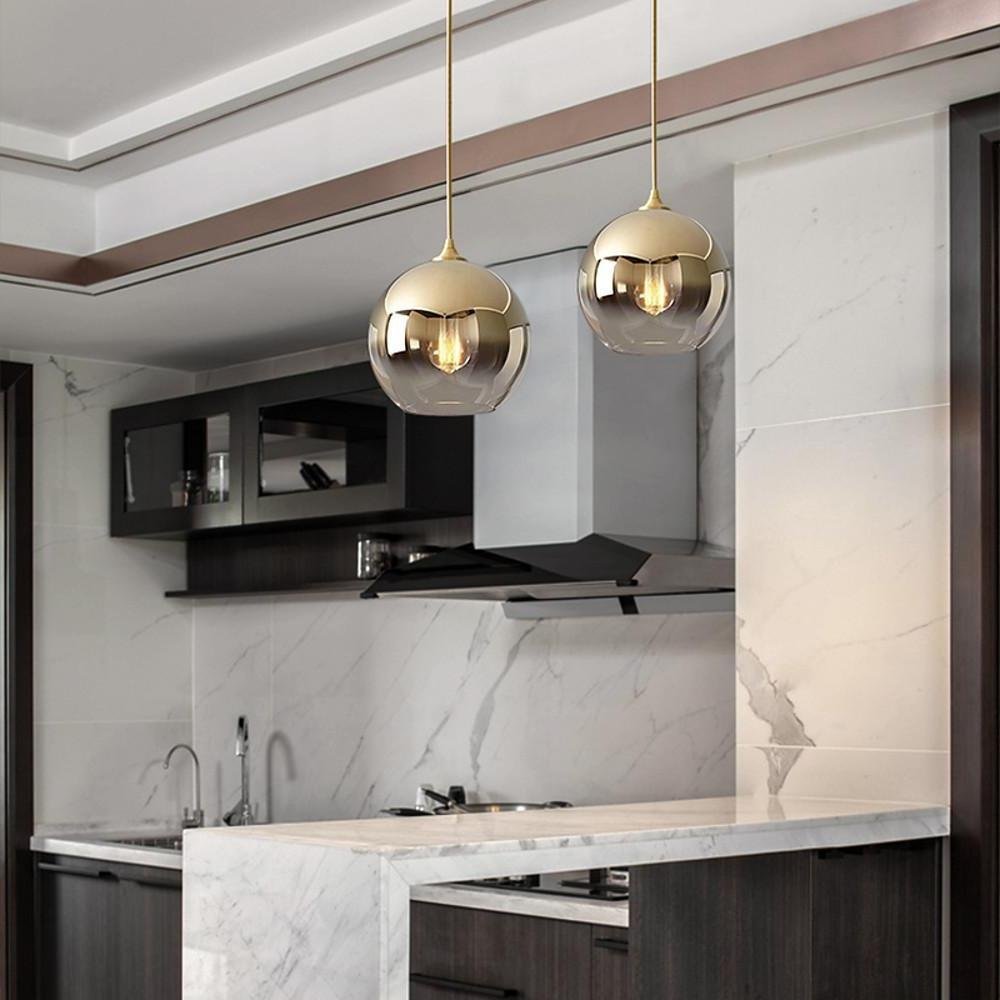
The design convention is to set the bottom of the globe 30 to 36 inches above the countertop. Land on the lower end (30–32″) if the island is used for prep and you want task light on the cutting board; go higher (34–36″) if the island is a seating bar where people lean in, or if the household includes tall family members.
Horizontally, center the pendant on the island’s length. A single globe is the right call for islands up to roughly five or six feet; beyond that, a single fixture starts to look lonely and the ends of the island fall into shadow, and you should be thinking about two or three smaller globes spaced evenly instead.
Above a dining table
Set the bottom of the globe 30 to 34 inches above the tabletop. That puts the light just above eye level for seated diners, so faces are lit rather than silhouetted, and nobody at the table is staring into the bulb. If the room has an 8-foot ceiling, that typically leaves the globe hanging around 60 to 66 inches off the floor.
Match the pendant to the table’s center, not the room’s center. Ceiling medallions and existing junction boxes are frequently offset, and a globe that is centered in the room but off-center over the table looks wrong from every seat.
Sloped, vaulted, and arched ceilings
The mounting design is described as suitable for both flat and inclined ceilings, and the adjustable cord is what makes that work. On a slope, the pivot point is the canopy, so the globe will hang plumb even though the ceiling is not. Set the cord length by measuring from the ceiling at the mounting point down to your target height above the counter or table — not by measuring along the slope.
Step three: choose a color temperature, then accept the trade-off
This fixture offers three color temperatures — 3000K warm white, 4500K neutral white, and 6000K cool white — switchable in steps. That covers most of what a home needs, and the mapping is fairly predictable:
- 3000K — dining rooms, bedrooms, evening living rooms. Warm, slightly golden, flattering to wood and to skin tones. This is the default for anywhere people eat or relax.
- 4500K — kitchens, home offices, laundry and utility areas. Neutral, close to midday daylight through a window, and it makes white cabinets and stone counters read accurately.
- 6000K — task-heavy work zones, garages, detailed hobby work. Crisp and bluish; generally too clinical for a dining table.
The important caveat, stated plainly by the manufacturer: the 3-step dimming on this fixture changes color temperature only, not brightness. You switch between warm, neutral, and cool using an ordinary wall switch; the fixture does not get dimmer or brighter in the process. If you want true brightness dimming, you need a dimmable bulb and a compatible dimmer — plan for that at the bulb stage, not after installation.
Bulbs, wiring, and the checks to do before you buy
Three specifications decide whether this fixture drops straight into your existing setup:
- Base: E26/E27. E26 is the standard North American medium screw base; E27 is the slightly deeper European equivalent. The fixture accepts both, so ordinary US bulbs fit. Compatible bulb types are listed as LED and incandescent.
- Voltage: 110–120V. Matches standard US and Canadian residential circuits. Confirm your circuit before ordering if you are outside North America.
- Certifications: UL Certified, ETL Listed, CE Approved, RoHS Compliant, FCC Certified. As listed by the manufacturer — worth checking against your local inspector’s requirements if the install is in a rental, a commercial space, or a new build that needs sign-off.
Two practical notes. The fixture is rated for a single bulb, so buy one bulb per pendant and buy a spare — a globe with a dead bulb is a dark sphere in the middle of your kitchen. And because the globe is glass and open at the bottom on a single-sphere design, bulb swaps are straightforward: you are reaching up into the sphere, not disassembling a shade.
The glass shade also means fingerprints and kitchen aerosol show up. A dry microfiber cloth on the outside and a quick pass inside at bulb-change time keeps the glow even; the electroplated collar needs nothing more than the same dry cloth, since abrasive polish can dull a plated finish.
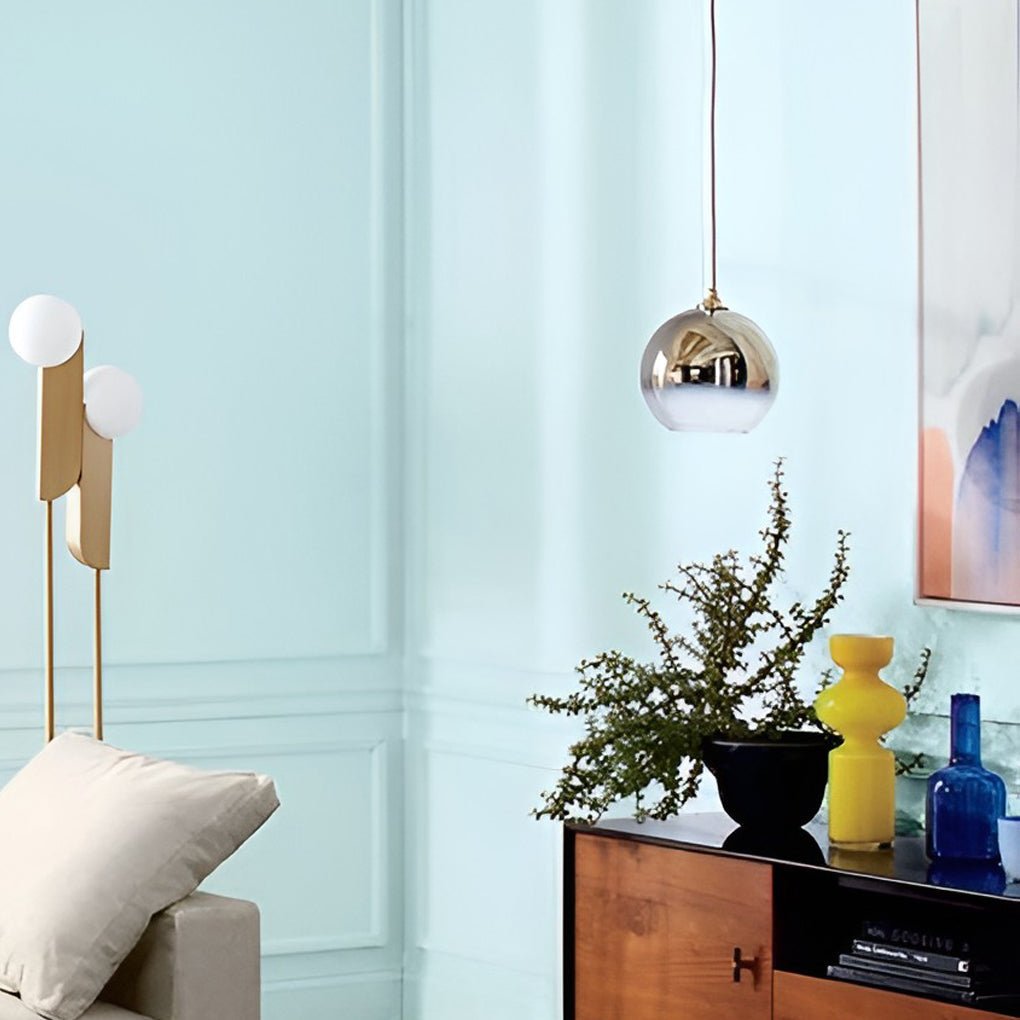
Single globe vs. multi-light: which one belongs in your room
| Your situation | Single globe pendant | Multi-light fixture |
|---|---|---|
| Island or table up to ~6 ft | Ideal — one fixture, one focal point | Usually too busy |
| Long island, 8 ft and up | Works as a pair or trio of identical globes | Also works, but harder to align |
| Room with no other lighting | Insufficient on its own | Better, or add recessed cans |
| Sloped or vaulted ceiling | Easy — adjustable cord hangs plumb | Often needs a slope adapter |
| Rental or quick refresh | Simple swap, single junction box | Heavier, more mounting work |
If you are lighting an open-plan kitchen-dining room from scratch, plan the globe as accent and task light over the island, and let recessed or ceiling fixtures handle general illumination. A single 1-light pendant carrying an entire room will always look under-lit at the edges, no matter which bulb you install.
Frequently asked questions
Is this pendant dimmable?
It offers 3-step switching between 3000K, 4500K, and 6000K using a standard wall switch — that changes the color of the light, not its brightness. For actual dimming you would need a dimmable bulb plus a compatible dimmer switch.
Can it be mounted on a sloped or arched ceiling?
Yes. The mounting design is described as suitable for flat and inclined ceilings, and the adjustable cord lets you set the drop so the globe hangs level. Measure vertically from the mounting point down to your target height.
What bulb does it take?
An E26 or E27 base bulb, LED or incandescent, on 110–120V wiring. One bulb per fixture.
How high should it hang over an island?
About 30 to 36 inches from the countertop to the bottom of the globe — lower for prep work, higher for seating. Over a dining table, 30 to 34 inches above the tabletop.
Gold or silver finish?
Both are electroplated. Gold reads warmer and pairs with brass hardware, oak, and cream stone; silver reads cooler and sits better with stainless appliances, black fixtures, and cool grey counters. Match the finish to the room’s other metals rather than to the wall color.
The short version
Size the globe to the table or island (roughly one-third of its width, capped around half), hang the bottom 30–36 inches above a counter or 30–34 inches above a dining table, and pick your color temperature by room function — 3000K to eat, 4500K to work, 6000K for detailed tasks. Then confirm the boring parts: E26/E27 bulb, 110–120V, single bulb, and a 59-inch cord that is long enough for your ceiling height.
You can see all three globe sizes, both finishes, and the full specification list on the Modern Glass Globe Pendant Light product page, currently listed at $83. If you are matching it to an existing island or a specific ceiling drop, the MiniHouzz design team takes layout questions before you order — cheaper than discovering the drop is wrong after the box is open.