
This is an accent light, not a floodlight. The bamboo rattan solar lantern runs on a 1.2V 600mAh battery that charges from daylight, glows at 3000K warm white, and carries an IP44 rating. That combination tells you exactly what it is for: a table on the deck, a porch step, a shepherd’s hook by the gate, a branch over the seating area. It creates the kind of low, honey-colored pool of light that makes people linger outside after dinner. It will not light a staircase you need to walk down safely, and it will not throw light across a lawn.
Knowing that upfront saves you a return. Read on for how the materials behave, where the fixture fits, the heights and spacing that look right, and what to do about rain, snow and dull weeks.
What the lantern is actually made of
Bamboo, rattan, wood and hemp rope — that is the entire exterior. There is no painted metal shell pretending to be wicker. Because these are natural materials, no two units match exactly: the weave tension, the tone of the bamboo, the grain of the wood and the shade of the rope will all vary slightly from piece to piece. The listing says so plainly, and it is worth treating as a feature rather than a defect. A matched set of three identical plastic lanterns reads as mass-produced from ten feet away. Three slightly different woven lanterns read as collected.
The dimensions matter more than most people expect. At 7.4 inches in diameter and 10.6 inches tall, with a 9.4-inch handle, this is a substantial object — closer to a small basket than a jam jar. Plan for real visual weight, and check that whatever you hang it from can take 2.2 pounds without sagging.

Where it works, and where it doesn’t
The listing is unusually honest on this point: it is for garden, yard and balcony atmosphere decoration, and it cannot illuminate large areas. Take that seriously when you plan placement.
Good placements:
- Patio and deck tables — the centerpiece role. A 3000K source at table height flatters faces, food and glassware in a way that 4000K or 5000K never will.
- Porch and entry steps — one lantern per landing, offset to one side rather than dead center.
- Tree branches and pergola beams — hung at head-clearing height so it reads as a floating glow among the leaves.
- Shepherd’s hooks along a path — decorative markers, not safety lighting. Keep actual step lighting separate.
- Indoors — a shelf, a console, or near a bright window so it can still charge. The rustic weave sits comfortably in farmhouse, coastal and boho rooms.
Poor placements: deep shade under a dense canopy, north-facing walls with no direct sun, unlit covered porches, and anywhere you need functional task light. If the panel sees no daylight, the battery sees no charge — no fixture design can work around that.
Heights and spacing that look right
These numbers assume you want the lantern read as a glow rather than a bulb. Adjust if your ceiling or branch is unusually high or low.
- Above a dining table: hang the bottom of the lantern 26–32 inches above the tabletop. Higher and the light stops reaching the surface; lower and it blocks sightlines across the table.
- Walking clearance: keep the lowest point at 78 inches or more over any path people use after dark. The 9.4-inch handle gives you a natural hook point, so measure from the bottom of the body, not the top of the handle.
- Porch and railing: mount so the body sits 12–18 inches below the top rail — visible from the yard, out of elbow range.
- Row spacing: 4–6 feet apart along a railing or fence line. Tighter turns into a solid band of light; wider and the rhythm breaks.
- Odd numbers: three lanterns beat four in almost every grouping. Two reads as symmetrical and stiff; three reads as intentional.
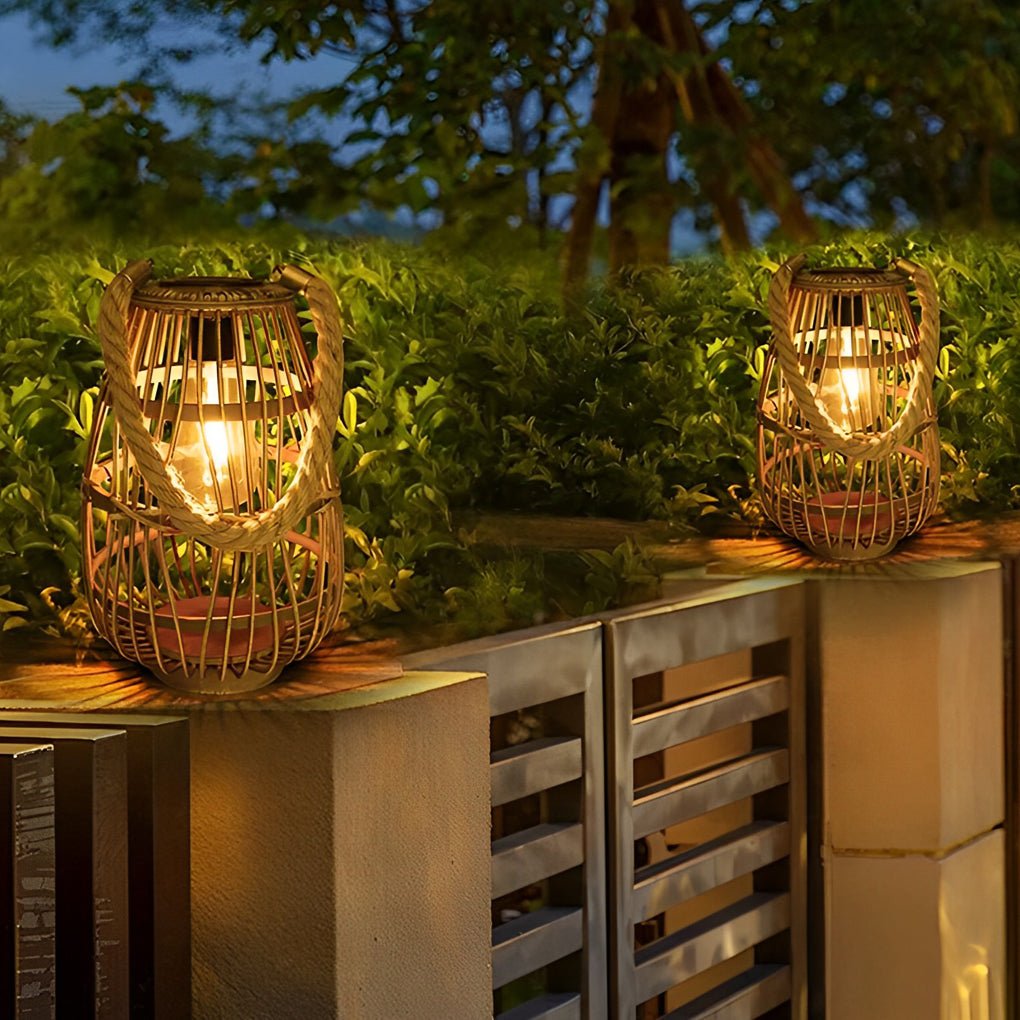
What 3000K and a 600mAh battery actually mean
3000K is the warm end of white light — the color of a good incandescent bulb or a candle flame seen from a few feet away. It is the right choice for relaxation spaces, and it is the reason this lantern photographs well at dusk. It is the wrong choice for a workbench or a security fixture.
The battery is 1.2V at 600mAh, which is a small cell. Combined with the stated purpose — atmosphere, not area illumination — you should expect a soft, low output rather than a bright beam. Run time after dark depends on how much direct sun the panel received that day, so treat any single evening as a variable rather than a guarantee. What the listing does commit to is charge time: 6–8 hours of direct sunlight to reach full charge.
For safety and compliance, the listing states UL certification, ETL listing, CE approval, RoHS compliance and FCC certification. If you need documentation for a commercial or rental installation, request the certificates from the seller before ordering rather than assuming the spec sheet is enough.
Specifications at a glance
| Spec | Detail |
|---|---|
| Materials | Bamboo, rattan, wood, hemp rope |
| Light source | LED |
| Color temperature | 3000K warm white |
| Battery | 1.2V 600mAh |
| Charge time | 6–8 hours of direct sunlight |
| Weather rating | IP44 |
| Diameter | 7.4 in / 18.8 cm |
| Height | 10.6 in / 26.9 cm |
| Handle height | 9.4 in / 23.9 cm |
| Weight | 2.20 lb / 1.00 kg |
| Style | Retro, rustic modern |
Rain, snow and the honest limits of IP44
IP44 means protection against solid objects larger than 1mm and against water splashing from any direction. It is a real outdoor rating, and it is enough for rain and snow on an open patio. It is not a submersion rating. Do not leave the lantern sitting in a puddle, do not store it in a bucket, and do not hose it down during cleaning.
The listing adds a recommendation worth following: place it in a sheltered spot to prolong its lifespan. Under a roof overhang, against a wall, or beneath a pergola gives you the same visual effect with far less water exposure. In coastal areas with salt air, wipe the bamboo and rope down occasionally and let everything dry fully before the next charge cycle. Natural fibers that stay damp are the most likely failure point on this fixture — not the electronics.
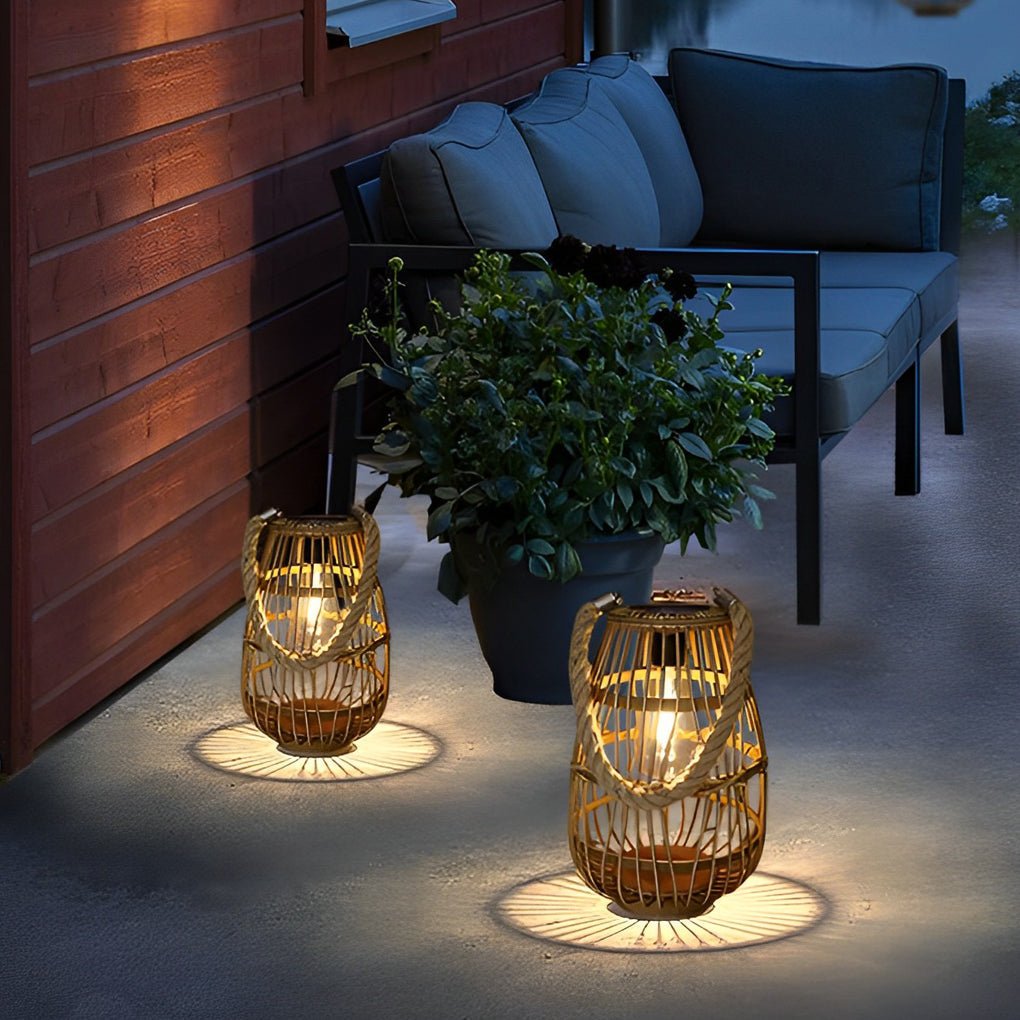
A realistic charging routine
Solar lanterns fail more often from placement than from hardware. Three habits cover almost everything:
- Give the panel a clear southern or western view. Six hours of unobstructed sun is the target. Dappled shade all afternoon gives you a dim evening.
- Move it, don’t fight it. If a spot stays dark by 9pm two nights running, the panel is starved — relocate the lantern rather than buying a bigger one.
- Bring it in for long dark spells. During overcast weeks or winter, a few hours near a bright window keeps the cell from sitting fully drained.
One more note on expectations: the same small cell that makes this lantern safe and lightweight also means output tapers as the charge depletes through the night. That gradual dimming is normal for the category and is part of why the glow feels gentle rather than flat.
How it compares to the alternatives
Versus plastic solar lanterns: the plastic versions cost less and survive being knocked off a table. This one looks considerably better in daylight, which matters if the light is visible before sunset — and on a patio, it always is.
Versus wired outdoor pendants: a wired fixture gives consistent brightness and no charging routine, at the cost of an electrician, a junction box and a permanent hole in your structure. If you rent, or if you want to try a look before committing, solar wins on flexibility.
Versus candle and oil lanterns: no fuel, no flame, no soot on the ceiling, and safe to leave unattended on a wooden deck. If open flame is off the table for insurance or family reasons, this is the closest visual substitute.
Who should skip it: anyone who needs path lighting for safety, anyone with a fully shaded courtyard, and anyone expecting a lantern to light a 20-foot patio on its own. Buy two or three and let them work as a group.

Styling it without trying too hard
The weave is the texture, so keep everything around it quiet. Weathered teak, terracotta, linen, unglazed ceramic and dark green foliage all sit well next to bamboo and hemp rope. Skip chrome, glossy black metal and anything with a visible cool-white LED — the color clash is the fastest way to make a warm lantern look cheap.
Group it with a low bowl of succulents, a stack of two outdoor cushions, or a single lantern on an empty step. Negative space is doing half the work. If you are layering light, pair this with a warm 2700–3000K string light overhead and let the lanterns handle the low, close-to-the-table layer.
For seasonal swaps, the lantern transitions cleanly: bare branch and dried grasses in autumn, evergreen and berry in winter, nothing at all in summer. It is a container as much as a light.
Frequently asked questions
How long does it take to charge?
The listing specifies 6–8 hours of direct sunlight for a full charge. After that it switches on automatically at dusk and provides warm white light through the evening. Expect the output to taper as the charge drains.
Is it really safe outdoors in rain and snow?
Yes — IP44 covers splashing water from any direction, which includes rain and snow. It does not cover immersion, so keep it out of standing water and hose spray. A sheltered position under an overhang is recommended to extend its life.
Can I use it indoors?
Absolutely. The rustic weave works on a table, shelf or console. Place it near a window during the day so the panel still gets light, or move it outside to charge and bring it in for the evening.
Will one lantern light my whole patio?
No. The manufacturer describes it as atmosphere decoration that cannot illuminate large areas. For a seating zone, plan on two to three units spread 4–6 feet apart, and keep separate functional lighting for steps and walkways.
Do the lanterns match if I order several?
Not exactly, and that is disclosed upfront. Natural bamboo, rattan and wood vary in texture and color from piece to piece. Order the full set at once so the variation sits within one batch, and expect slight differences rather than identical twins.
Are there certifications?
The product listing states UL certification, ETL listing, CE approval, RoHS compliance and FCC certification. Confirm current documentation with the seller if you need certificates for a commercial installation.
Bottom line
Buy this lantern for the look and the warm 3000K glow, not for lumen output. It suits a patio table, a porch step, a pergola beam or a tree branch, and it rewards being bought in threes and placed with a little thought about sun exposure. Give it direct daylight, keep it out of standing water, and it will do the one thing it was designed to do: make an outdoor evening feel finished.
See the bamboo rattan solar lantern, sizing and current pricing at MiniHouzz →