
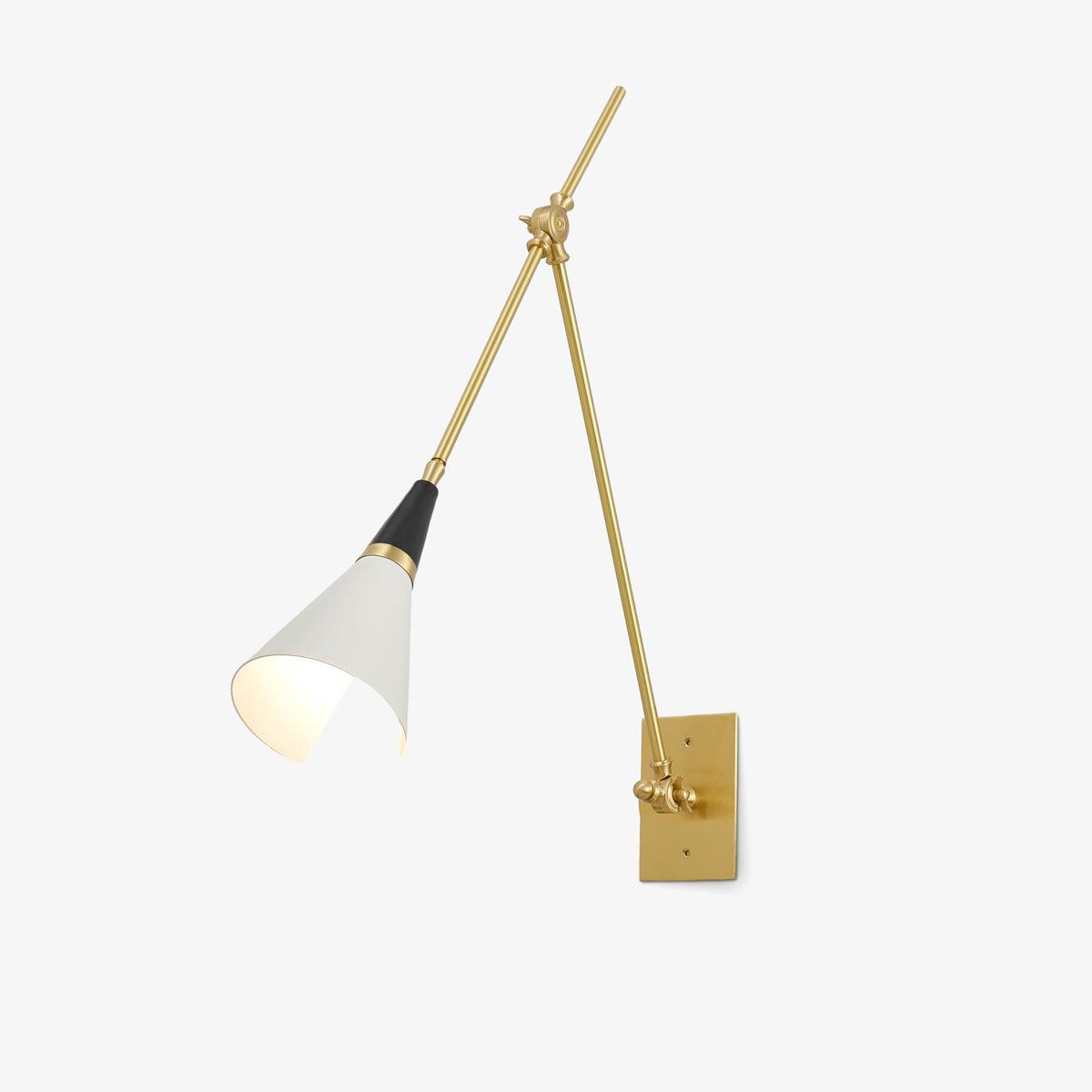
Short answer: this is a hardwired wall sconce measuring 29.1 inches long by 26 inches high (L 74 cm × H 66 cm), built from metal, brass and aluminum with a white glass shade and a single E14 socket. The articulating arm is the reason to buy it: you can swing the shade over a nightstand, angle it down onto a book, or push it flat against the wall when you want the room to feel quieter. It suits bedrooms, reading corners and living-room walls — as long as you have a wall junction box and can source E14 bulbs.
What makes this sconce read as mid-century
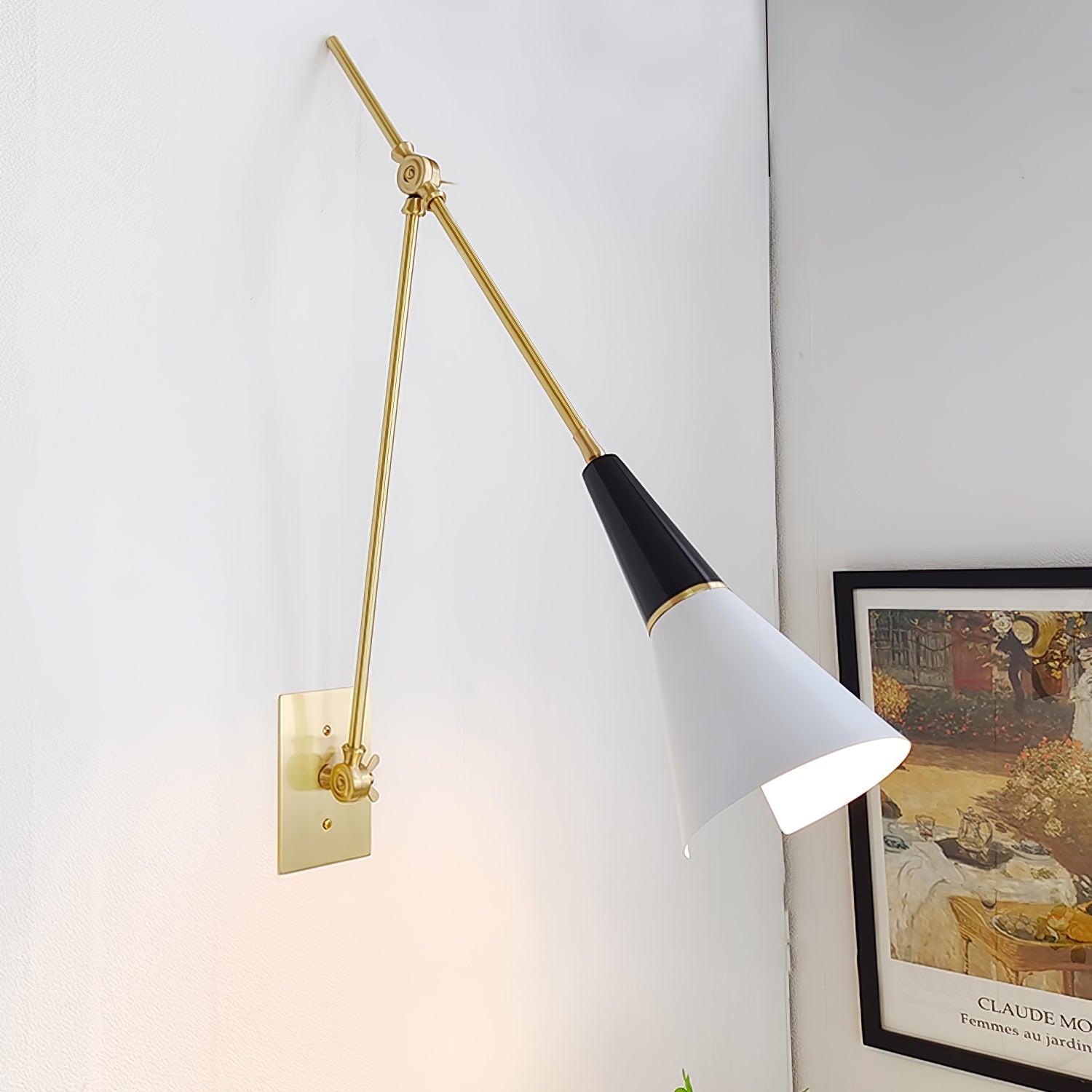
Mid-century lighting is less about a decade and more about a set of decisions: thin metal arms instead of heavy cast bodies, a shade that is angled rather than purely conical, and hardware that admits it is hardware. This fixture follows that brief. The edge-angled glass shade is the signature element — it throws light down and out at an angle rather than in a flat wash, and it keeps the bulb itself partly hidden from eye level.
The articulating joints do the practical work. A fixed sconce commits you to one beam direction forever; an arm that pivots lets you correct for a taller mattress, a deeper sofa, or a chair that ended up two feet further left than the floor plan said. In a room where furniture moves, that flexibility is worth more than another inch of shade diameter.
Finishes are white, black and brass on the body, with the shade in white across all three. The brass option is the one that will show the most personality over time; black reads more architectural and disappears against dark paint; white is the safest choice for rentals, plaster walls, and rooms where the lamp should not compete with anything else.
Materials and build: what the spec sheet actually tells you
The body combines metal, brass and aluminum, with a glass shade. That mix is typical of mid-century reproductions and it matters for two reasons. Aluminum keeps the arm light enough that the joints hold their position instead of sagging under their own weight; brass gives the pivot points and stem a warmer finish that patinas rather than chips. Glass shades, unlike fabric or acrylic, do not yellow and can be wiped clean — useful in a bedroom where a lamp sits within arm’s reach of hand cream and hair products.
The fixture is hardwired, not plug-in. There is no cord to hide and no outlet to design around, which is the cleaner look, but it also means the install is a real electrical job. As with any hardwired wall light, plan for a wall junction box and a licensed electrician. If your wall is brick, plaster-on-lath, or a rented apartment where you cannot cut in a box, this is the point to stop and reconsider rather than the point to improvise.
The product listing states UL, ETL, CE and SAA listing, along with RoHS compliance and FCC certification. Those are the claims published on the product page; ask support for the certificate documentation if your project requires it for inspection.
Where it works best, room by room
Beside a bed
This is the natural application. Mount the sconce so the bottom of the shade sits roughly 20 to 24 inches above the top of the nightstand, or about 48 to 60 inches above the floor. Both numbers are conventions, not rules — what you are really solving for is a shade that clears your shoulder when you sit up and does not glare into your eyes when you lie down. If you read in bed, set the arm so light falls across the page from the side rather than over your head; side light produces far less shadow from your own hands.
Because the arm articulates, you can mount slightly further from the bed than you would a fixed sconce and still reach the pillow zone. Keep the shade at least a hand’s width from the headboard so it does not knock against the frame when you swing it.
Over a reading chair or sofa corner
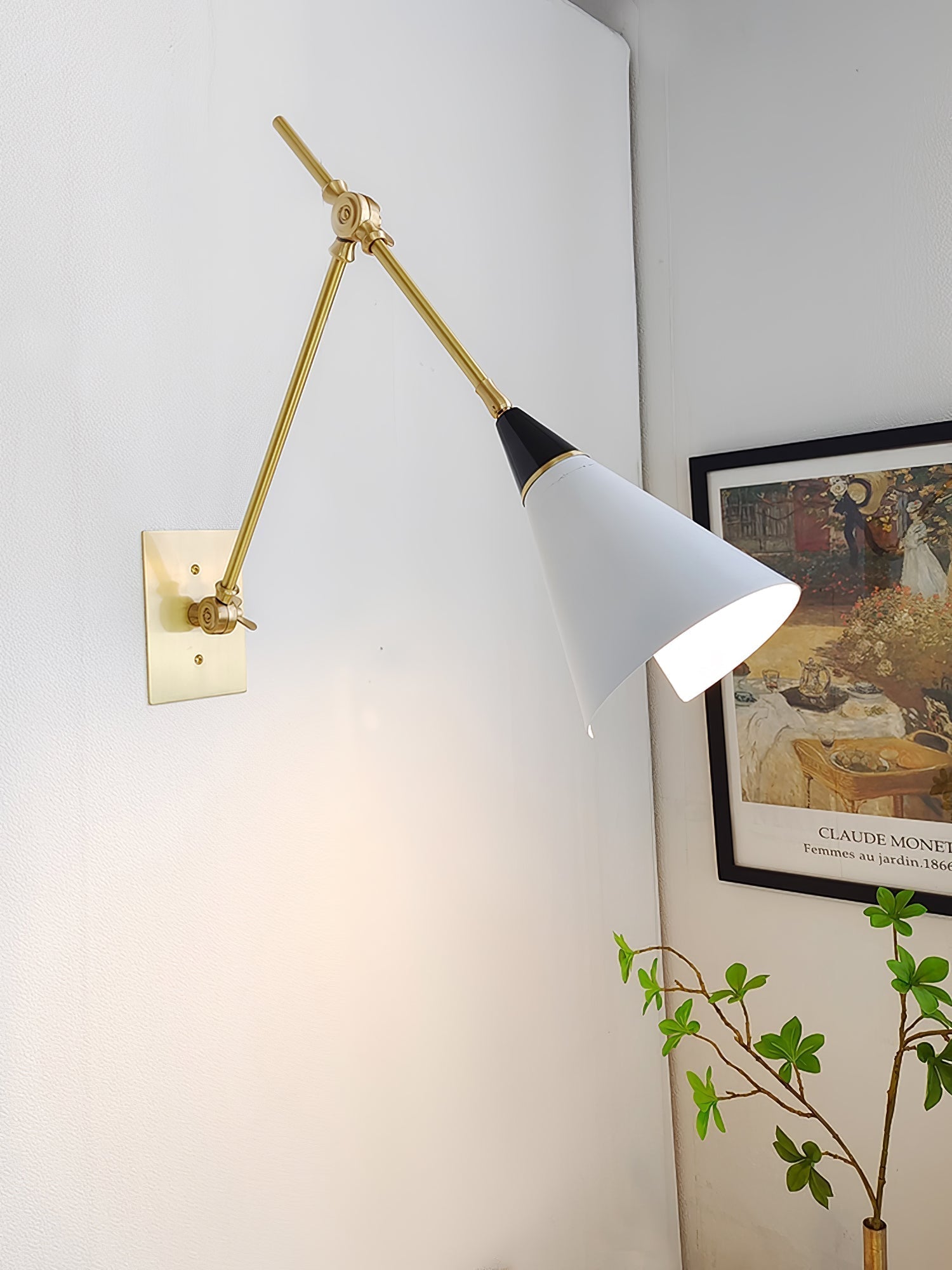
A floor lamp eats floor space and a table lamp needs a table. Swinging this sconce over a chair solves both problems in one move. Aim for the shade to sit about 12 to 18 inches off the wall and roughly level with your ear when seated, angled slightly back toward the wall so the light rakes across your reading material without hitting your face.
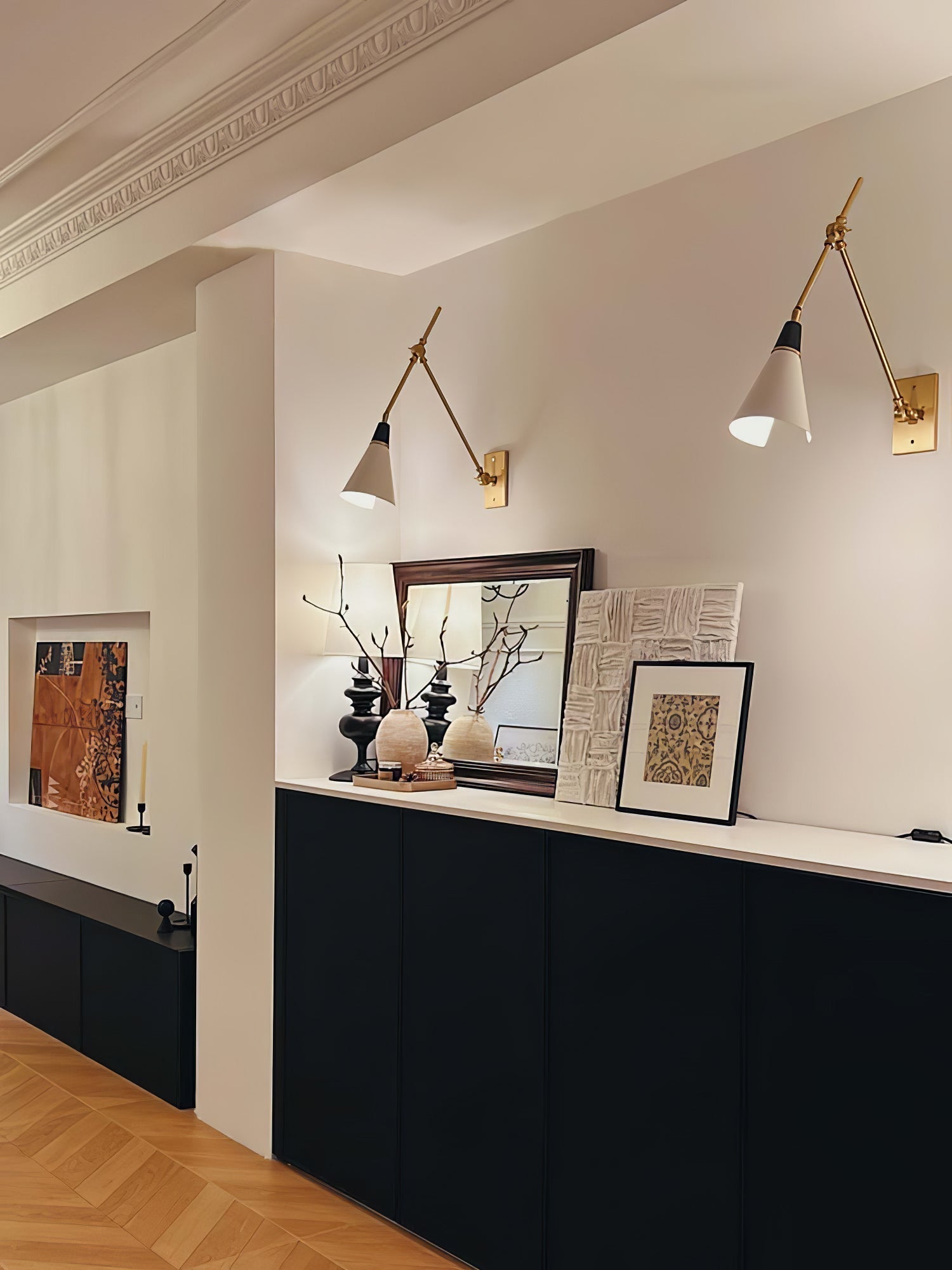
Pair it with a second sconce on the opposite side of the sofa if you want symmetry, but do not feel obliged to: a single asymmetric sconce over one chair is a very deliberate mid-century gesture and often looks more considered than a matched pair.
Flanking a living-room wall, mirror, or artwork
Two sconces flanking a mirror or a large piece of art give you the hotel-bathroom effect without the bathroom. Space them roughly 60 to 72 inches apart on center for a typical 36 to 48 inch mirror, or set them 4 to 6 inches outside the frame of the artwork. Align the horizontal center of each shade with the vertical center of the piece they flank — not with each other’s mounting plate, which is a common and visible mistake on an articulated fixture.
Bulbs, brightness, and color temperature
The socket is E14, and bulbs are not included. This is the detail most likely to trip up a US buyer, so treat it as a planning step rather than an afterthought. E14 — a 14 mm Edison screw — is the standard small screw base in Europe; most American fixtures use E26 (26 mm, the familiar medium base) or E12 candelabra (12 mm). E14 bulbs are widely available online, but they are not what you will find in most supermarket lighting aisles. Order the bulb with the fixture, and check the base diameter reads 14 mm rather than assuming a candelabra bulb will fit. The listing does not mention an included adapter, so plan on the bulb itself being E14.
For color temperature, work backward from the room. In a bedroom, 2700K is the comfortable default — warm enough to feel like evening light, neutral enough that your book pages still look white. In a living room used for conversation, 2700K to 3000K. If this sconce is going to serve as a genuine reading light, 3000K with a higher output will feel more useful and less yellow than a decorative 2700K bulb of the same shape. Whatever you choose, buy a bulb rated for the enclosed-ish environment of a glass shade and avoid anything oversized that presses against the glass.
On brightness: the fixture’s output is set by the bulb, not the lamp. A 5–7 W LED (roughly 450–800 lumens) is a sensible bedside starting point; step up to 8–10 W if it is your only reading light. The listing states the lamp is compatible with common push switches (not included) and does not specify dimming. If dimming matters to you, treat this as a switch-only fixture and confirm with support before wiring a dimmer into the circuit.
Specifications at a glance
| Overall size | L 74 cm × H 66 cm (L 29.1 in × H 26 in) |
|---|---|
| Materials | Metal, brass, aluminum, glass |
| Shade | White glass, edge-angled |
| Body finishes | White, black, brass |
| Socket | E14 (LED or Edison bulb, not included) |
| Voltage | AC 110–240 V |
| Mounting | Wall, hardwired |
| Rating | IP20 damp-rated, indoor use only |
| Control | Compatible with common push switches (not included); dimming not specified |
| Certification (as listed) | UL, ETL, CE, SAA listed; RoHS compliant, FCC certified |
| Price | $265.99 |
Buy it if — skip it if
Buy it if you have a wall junction box and an electrician you trust; you want directional light without giving up nightstand or floor space; you like the brass-and-white mid-century palette; and you are willing to order E14 bulbs rather than pick them up locally.
Skip it if you need a plug-in fixture for a rental; you want a dimmable lamp out of the box; the installation is for a bathroom wet zone or any outdoor wall, since the IP20 damp rating is indoor-only; or you need a light that floods a whole room rather than illuminating a specific task area.
A note on the 29.1-inch length: on an articulating fixture, that figure describes the overall envelope of the arm and shade rather than a fixed projection. In a tight alcove, measure the wall zone you intend to use and confirm the extended reach with support before committing — it is the one dimension most likely to surprise you in a narrow space.
Frequently asked questions
How much wall space does it need?
The published size is L 74 cm × H 66 cm (29.1 in × 26 in). Reserve at least that envelope plus a few inches of clearance so the arm can swing freely, and keep the shade clear of headboards, curtains and cabinet doors.
Is it dimmable?
The listing does not specify dimming and describes control as compatible with common push switches. If you need dimming, confirm with MiniHouzz support before installing it on a dimmer circuit.
What bulb should I buy?
An E14-base LED or Edison-style bulb, not included. For a bedroom, 2700K at roughly 450–800 lumens is a good starting point; for a dedicated reading light, consider 3000K at the higher end of that range. Check that the base measures 14 mm.
Can it be used in a bathroom or outdoors?
No. It is IP20 damp-rated and specified for indoor use only.
Does it plug in?
No, it is hardwired and wall-mounted. Installation requires a wall junction box and should be done by a licensed electrician.
The bottom line
This is a fixture you buy for the arm. The mid-century detailing — edge-angled white glass, slim brass-toned metalwork, three body finishes — is well judged and will sit comfortably in a bedroom or living room without demanding to be the centerpiece. The trade-offs are honest ones: a hardwired install, a European bulb base you need to plan for, and no dimming on the spec sheet. If those three fit your project, the flexibility of the articulating arm will earn its keep every time someone moves the furniture.
View the Mid-Century Modern Articulating Wall Sconce →
Planning a pair for a bedroom or a matched set for a living-room wall? Check current pricing and finish availability on the product page, or contact the MiniHouzz design team for layout advice and custom requirements. Bulbs, switches and installation hardware are sold separately — see the full specification list before you order.