
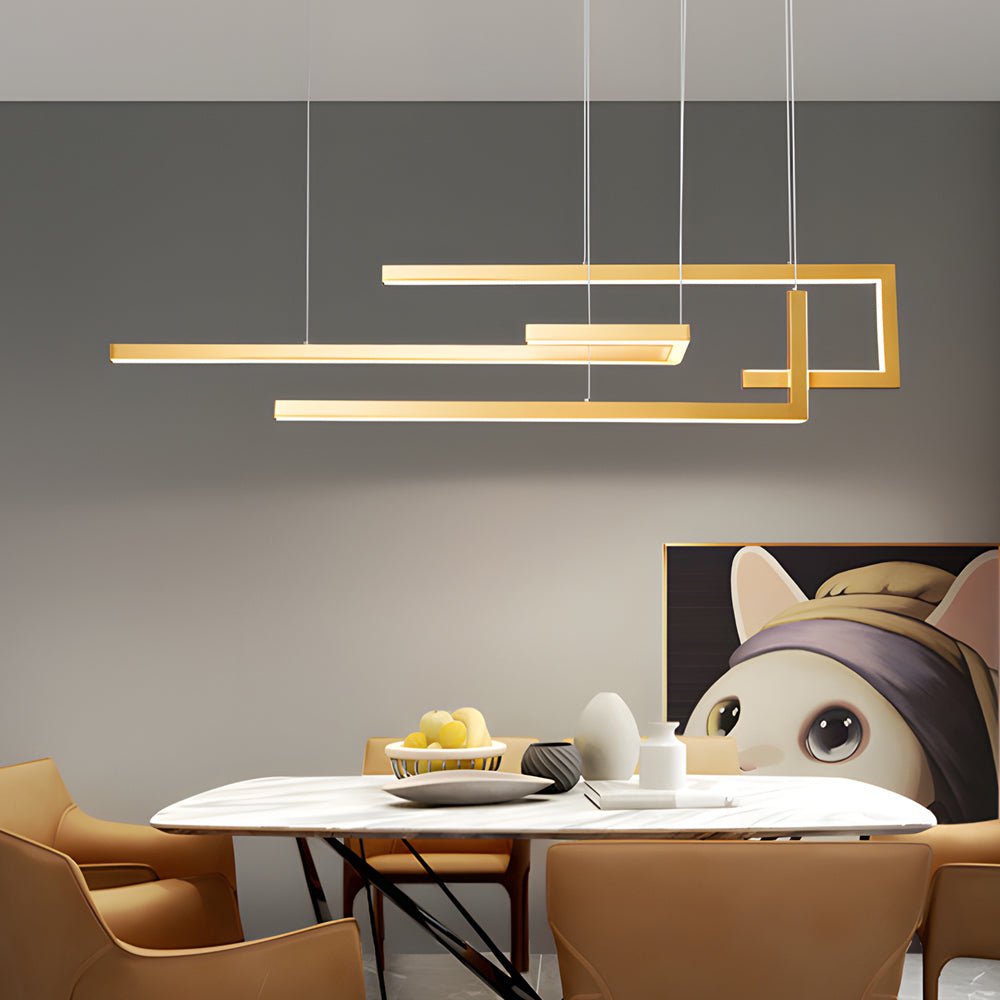
A geometric LED chandelier is a linear, hardwired fixture built from simple intersecting lines rather than arms and bulbs. This one from Minihouzz uses a painted metal frame wrapped in silicone, with an integrated LED array driven by a remote that moves both brightness and color temperature between 3000K and 6000K. It comes in two widths — 39.4 inches (100 cm) and 59.1 inches (150 cm) — in black or gold, and it is intended for dining rooms, kitchen islands, and similar open spaces of roughly 86 to 215 square feet (8 to 20 square meters).
If you are shopping for a fixture that looks architectural rather than decorative, keeps a low profile over a table, and lets you shift from warm evening light to crisp task light without a wall dimmer, this is the category worth understanding properly. Below is what the geometry actually does in a room, how to size and hang it, and where it stops being the right choice.
Design and Materials: What You Are Actually Buying
The silhouette is a set of clean horizontal and vertical strokes — no crystals, no fabric shades, no exposed bulbs. That matters for two reasons. First, a linear fixture reads as part of the architecture, so it works in contemporary, minimalist, and transitional rooms without fighting the furniture. Second, because there are no downward-facing bulb sockets, there is no glare point at eye level when you are seated at the table.
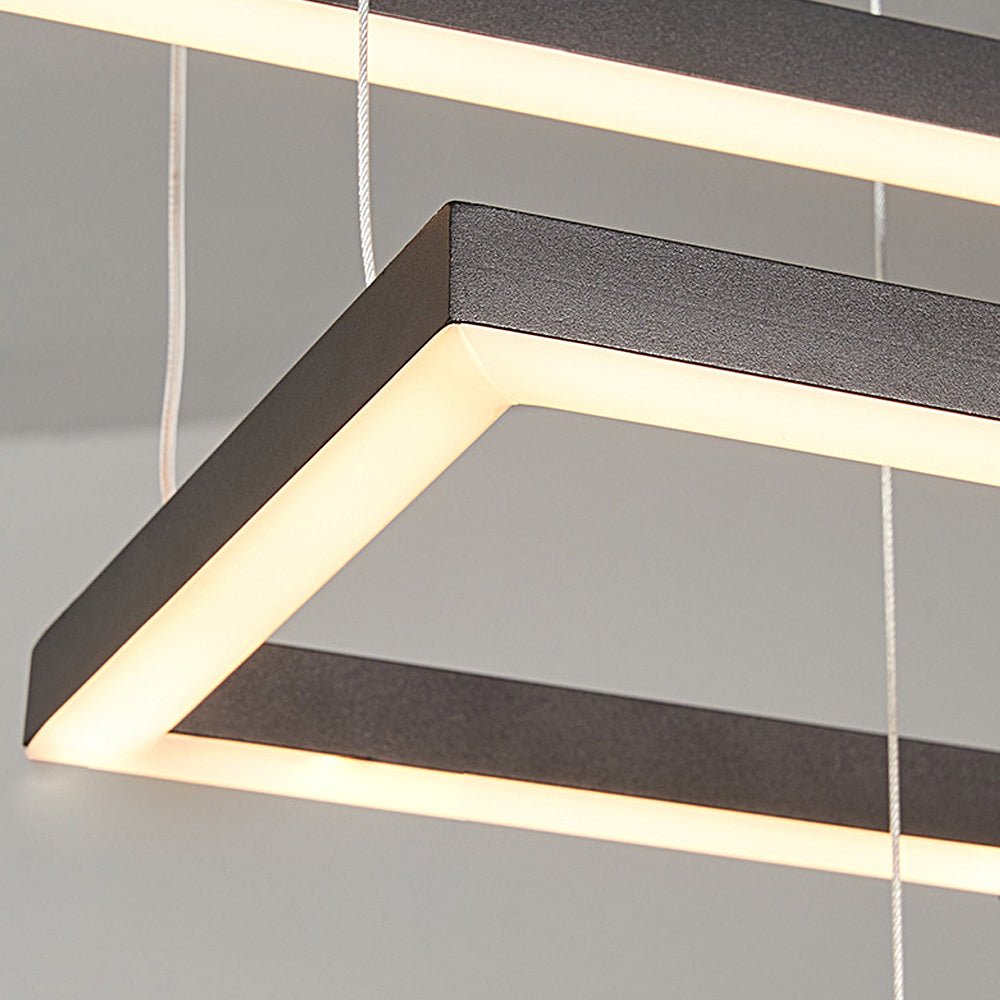
The body is hardware plus silicone. The metal carries the structure and the finish, which is applied through painting and polishing; the silicone diffuses the LED so the light appears as a continuous line instead of a row of hotspots. Practically, that combination gives you a soft, even wash across the tabletop and a fixture that stays cool to the touch because the LED source is integrated and low-power.
Integrated LED also means no bulb inventory. You will not be matching GU10s or replacing a lamp every eighteen months, and you will not lose the color consistency across the run. The trade-off is familiar to anyone who has bought LED fixtures before: when the module eventually reaches end of life, the fixture is serviced as a unit rather than re-lamped.
Sizing: 39.4 Inches or 59.1 Inches?
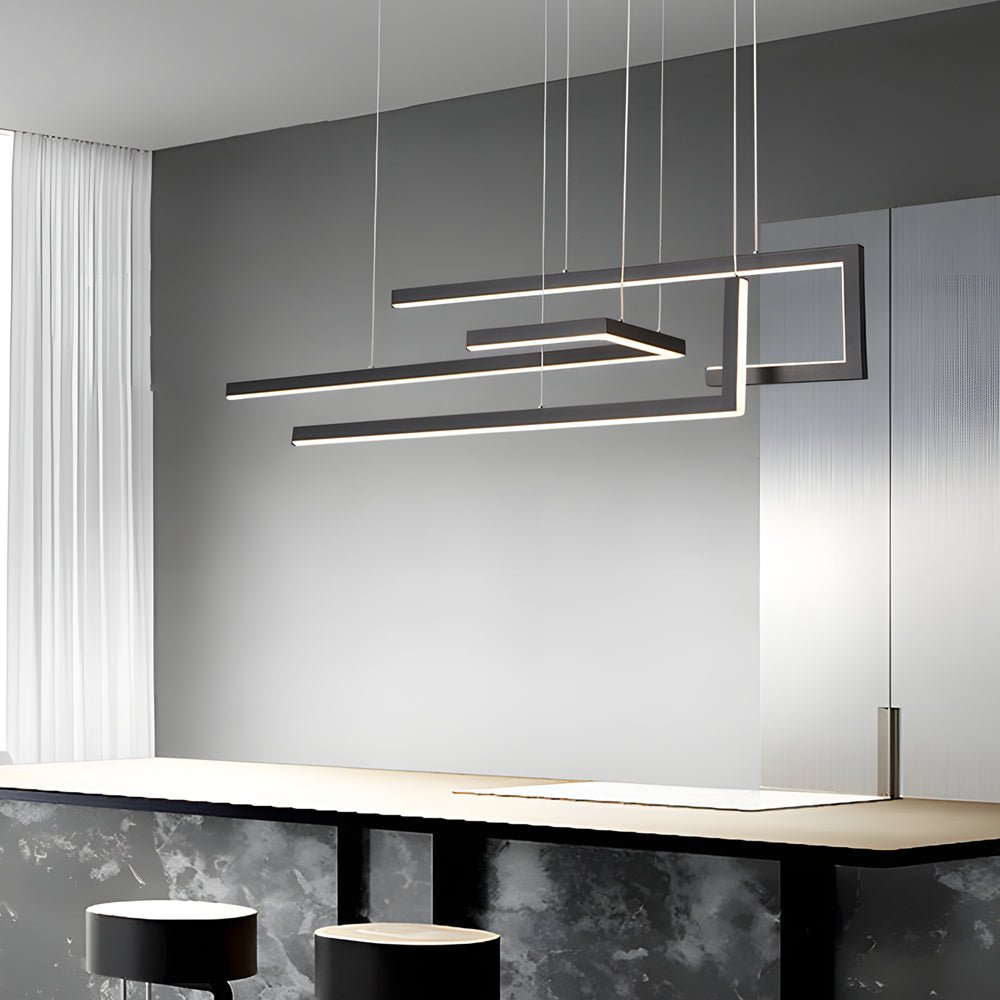
Choose by table length, not by room size. As a working rule of thumb in residential design, a linear fixture should span roughly one-half to two-thirds of the table it lights. That keeps the light distributed over the seating rather than over the floor at each end.
- 39.4 in (100 cm) width — best over tables in the 5 to 6 foot range, or over a compact island. 5.73 lb (2.6 kg).
- 59.1 in (150 cm) width — best over tables seating six to eight, roughly 7 to 9 feet long. 7.93 lb (3.6 kg).
Both options share the same depth and body height: 7.9 inches (20 cm) deep and 8.7 inches (22 cm) tall. That consistent 7.9-inch depth is what makes the fixture forgiving in narrow dining zones — over a 36-inch-wide table it still leaves clear sightlines across the room, which is rarely true of a round multi-arm chandelier of similar output.
The stated illumination area is 86 to 215 square feet (8 to 20 square meters). If your dining area sits inside a much larger open-plan room, treat the fixture as task and ambient light for the table zone and plan separate layers — recessed cans, sconces, or a floor lamp — for the rest of the space. One linear pendant asked to light 400 square feet will look underpowered no matter how bright the LED is.
You can compare both widths on the product page before committing.
Hanging Height and Installation
This is a hardwired fixture at 110V, so it needs a ceiling junction box and a switched circuit. It is not a plug-in pendant, and there is no wall dimmer required — dimming and color control live in the remote.
The hanging cord is 39.4 inches (100 cm) and adjustable, which gives you real range on ceiling height. For a standard 8-foot ceiling, a common starting point is 30 to 36 inches from the bottom of the fixture to the tabletop; for each additional foot of ceiling height, add roughly 3 inches so the fixture does not feel like it is pressing down on the room. With an 8.7-inch body height, that leaves comfortable clearance from a typical 8-foot ceiling to the top of the canopy.
Two installation notes that save a return trip to the hardware store:
- Center it on the table, not on the room. If the dining table is offset or the room is open on one side, align the fixture with the table’s long axis. Off-center linear fixtures are the single most common complaint after installation.
- Plan the canopy position before you cut. Because the frame is fixed-width, the junction box location determines the final look. On a sloped or vaulted ceiling, confirm mounting with Minihouzz support first rather than assuming a flat-ceiling canopy will sit cleanly.
For height or layout questions on a specific room, the product page links to their design support team.
Light Quality: 3000K to 6000K, and When to Use Each
The remote adjusts two things independently: brightness and color temperature across a 3000K to 6000K range. That range covers more usable ground than most fixed-temperature fixtures, and it is genuinely useful in a room that serves more than one purpose.
| Setting | Best for | Notes |
|---|---|---|
| 3000K warm white | Dinner, evening hosting, warm wood and brass rooms | Flatters skin tones and makes food look richer |
| 4000K neutral | Everyday meals, homework at the table, kitchen islands | Good balance of clarity and comfort |
| 6000K cool white | Cleaning, projects, high-contrast modern interiors | Reads clinical over a dining table after dark — use sparingly |
A practical habit: set 3000K at whatever brightness you like for meals, then program nothing at all — the remote is right there on the table. Dimmed warm light at 20 to 30 percent is where this fixture looks most expensive; bright cool light is where it looks most useful. If you have a kitchen island within the same fixture’s coverage, 4000K is the compromise that serves both.
Specifications
| Style | Modern linear geometric chandelier |
| Finishes | Black, Gold |
| Material | Hardware + silicone |
| Light source | Integrated LED |
| Color temperature | 3000K to 6000K, remote dimmable (also available at fixed 3000K or 6000K) |
| Voltage / supply | 110V, hardwired |
| Finish process | Painting, polishing |
| 39.4 in (100 cm) option | 39.4″ W x 7.9″ D x 8.7″ H · 5.73 lb (2.6 kg) |
| 59.1 in (150 cm) option | 59.1″ W x 7.9″ D x 8.7″ H · 7.93 lb (3.6 kg) |
| Hanging cord | 39.4 in (100 cm), adjustable |
| Illumination area | 86 to 215 sq ft (8 to 20 sq m) |
| Compliance (per listing) | UL Certified, ETL Listed, CE Approved, RoHS Compliant, FCC Certified |
Compliance is stated on the listing as UL certified, ETL listed, CE approved, RoHS compliant, and FCC certified. If your project requires documentation for a permit or a commercial inspection, request the certificates before ordering rather than assuming the listed marks cover your jurisdiction’s requirements.
Black or Gold: Choosing a Finish
| Finish | Works best with | Watch out for |
|---|---|---|
| Black | White walls, pale oak, concrete, industrial and minimalist rooms, black window frames and hardware | Reads as a graphic line against a light ceiling — make sure you want that contrast |
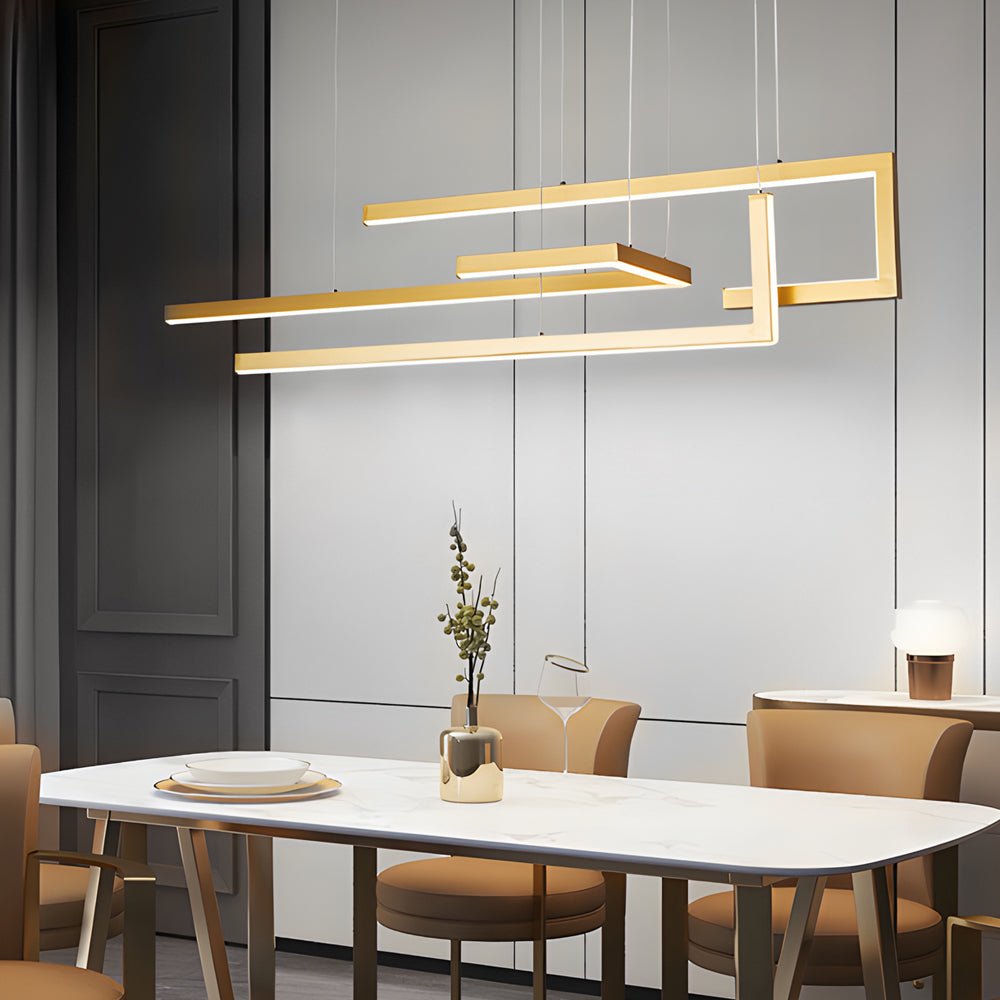
| Gold | Warm palettes, walnut and marble, brass cabinet pulls, transitional and glam interiors | Clashes with cool chrome or brushed nickel in the same sightline |
Both finishes are available across both widths, so you are not forced into a size compromise for the finish you want. See current finish and size availability here.
Before You Order: A Short Checklist
- Measure the table, not the room. Table length divided by two is your minimum fixture width; two-thirds is your maximum.
- Confirm the ceiling box. Hardwired, 110V — it needs an existing junction box and a switch leg.
- Check ceiling height against cord length. A 39.4-inch adjustable cord is generous for 8 to 10 foot ceilings; for taller spaces, verify before ordering.
- Decide on control. The remote handles dimming and color. If you want the fixture on a wall dimmer as well, confirm compatibility with support first — LED drivers are not universally dimmer-friendly.
- Account for lead time. Expedited shipping is available on request, so flag tight renovation schedules early.
Frequently Asked Questions
Is this chandelier dimmable?
Yes. The dimmable version ships with a remote that adjusts both brightness and color temperature continuously from 3000K to 6000K. Fixed 3000K and 6000K versions are also offered if you prefer a single, set color.
How long is the hanging cord, and can I shorten it?
The cord is 39.4 inches (100 cm) and adjustable, so you can set the drop to suit your ceiling and room layout during installation.
What are the dimensions and weight of each size?
The 39.4-inch (100 cm) version measures 39.4″ W x 7.9″ D x 8.7″ H and weighs 5.73 lb (2.6 kg). The 59.1-inch (150 cm) version measures 59.1″ W x 7.9″ D x 8.7″ H and weighs 7.93 lb (3.6 kg).
Do I need to buy bulbs?
No. The light source is integrated LED, so there are no bulbs to purchase or replace during normal use.
Will it work over a kitchen island?
Yes, provided the island sits within the fixture’s stated 86 to 215 square foot illumination area. For islands longer than roughly 9 feet, two fixtures spaced evenly will usually give more even coverage than one oversized unit.
Can it be installed on a sloped ceiling?
That is not specified on the listing. Contact Minihouzz support with your ceiling pitch and mounting location before ordering — do not assume a standard flat-ceiling canopy will sit correctly on a vaulted ceiling.
The Short Version
This fixture suits a specific job: a dining table that needs architecturally quiet, glare-free light with adjustable warmth, in a room where a decorative chandelier would be too much. Buy it for the geometry and the 3000K-to-6000K range. Size it at half to two-thirds of your table length, hang it 30 to 36 inches above the tabletop on an 8-foot ceiling, and run it warm and dimmed for dinner.