
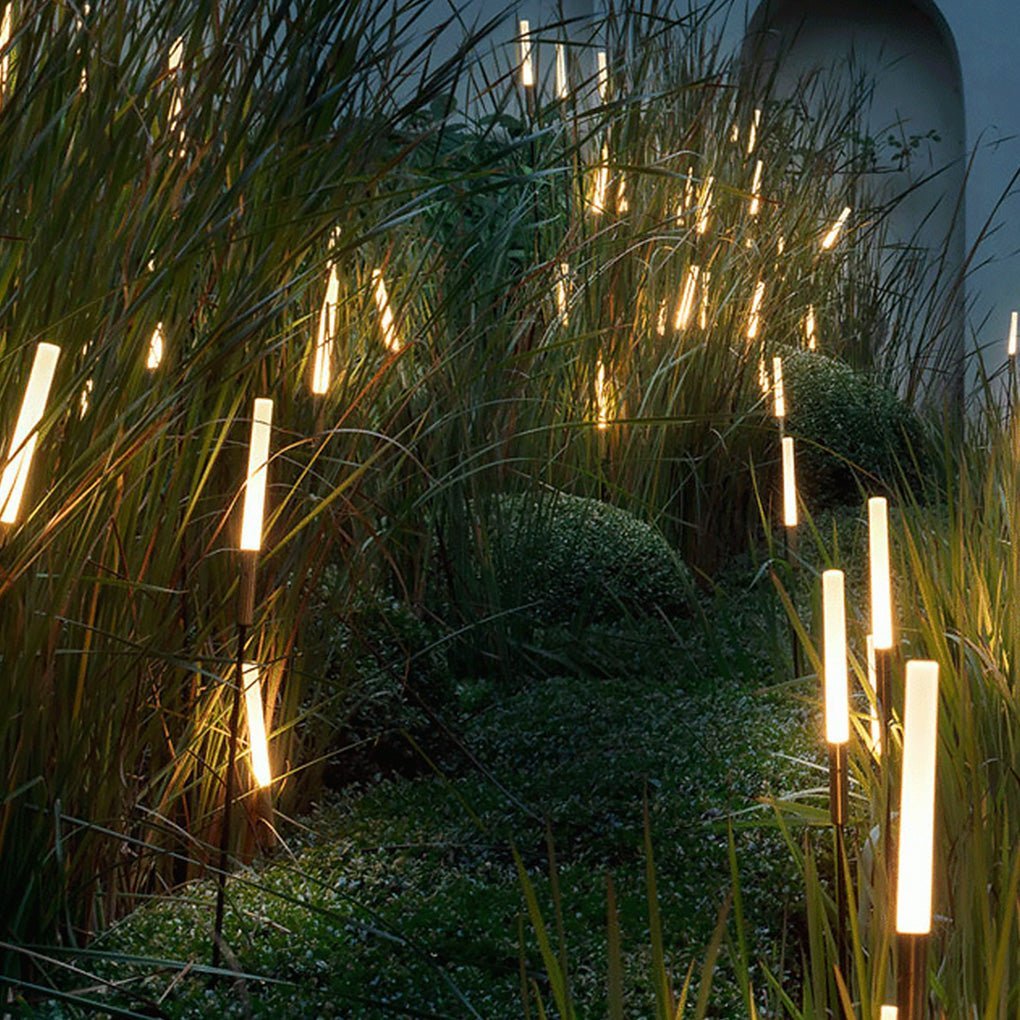
Reed and cattail solar landscape lights are decorative LED garden fixtures shaped like marsh reeds and cattail heads, mounted on slim poles rather than posts. They exist to solve one specific problem: most path and garden lighting announces itself as hardware, while these read as part of the planting. If your yard is landscaped with ornamental grasses, hostas, ferns, or a naturalistic border, the fixture almost disappears in daylight and only shows up as a warm glow at night.
The set below is the MiniHouzz six-piece version: black stainless steel and aluminum poles, gold and white lamp heads, acrylic diffusers, 3000K warm white LED, and a choice between solar and DC12V hardwired power. Everything that follows is drawn from those specifications — the parts that are genuinely worth thinking about before you buy, and the parts that are usually explained badly.
What you are actually buying
The construction is a mixed-material build, and each material is doing a job:
- Stainless steel and aluminum for the pole and body. These are the load-bearing and weather-facing parts, which is why the fixture can stay outdoors year-round rather than being brought in each season.
- Acrylic for the lamp head and diffuser. Acrylic is the reason the cattail head glows as a soft mass instead of showing a hot point of light.
- Black pole with gold and white head as the finish. The dark pole recedes against soil and mulch; the gold-and-white head catches a little daylight, which is why the fixture still looks deliberate at noon.
It is a six-piece set, which matters more than it sounds. Reed-style lighting works as repetition — a run of five or six stems at slightly different heights creates the depth. Two of them in a bed look like an accident.
Solar or DC12V hardwired: the decision that actually matters
This is where most buyers get stuck, so here is the honest split. Both versions exist in the same product line, but they are not interchangeable in practice — they serve different sites.
| Solar version | DC12V hardwired version | |
|---|---|---|
| LED power | 3W | 1.5W |
| Available heights | 36.6 in (93 cm), 48.4 in (123 cm), 60.2 in (153 cm) | 25.6 in (65 cm), 31.5 in (80 cm), 43.3 in (110 cm), 55.5 in (141 cm) |
| Power requirement | Self-contained; charges in daylight | DC12V — requires a transformer, not included |
| Runtime | Typically 6–8 hours on a full charge, depending on sun exposure and weather | As long as the circuit is switched on |
| Best suited to | Beds with direct sun and no existing low-voltage circuit | Shaded beds, or gardens already wired for 12V landscape lighting |
Choose solar if the placement spot gets direct sun for most of the day and you do not want to trench or pull cable. The trade-off is real: run time is governed by how much sun the panel collects, so a bed under a mature oak or on the north side of a house will underperform regardless of the fixture’s quality.
Choose DC12V if your beds are shaded, if you want the lights on a timer or switch, or if you are already running low-voltage landscape wiring. Budget for the transformer as a separate line item — it is required and not in the box. The hardwired version also runs at 1.5W rather than 3W, which is the more efficient way to light a long border where you are running six or more stems.
One more practical distinction: the height options differ between the two versions. The tallest solar stem is 60.2 in, while the tallest hardwired stem is 55.5 in. If a very tall reed silhouette is the whole point of the design for you, check which heights the version you are ordering actually offers before you commit.
Picking heights for your beds
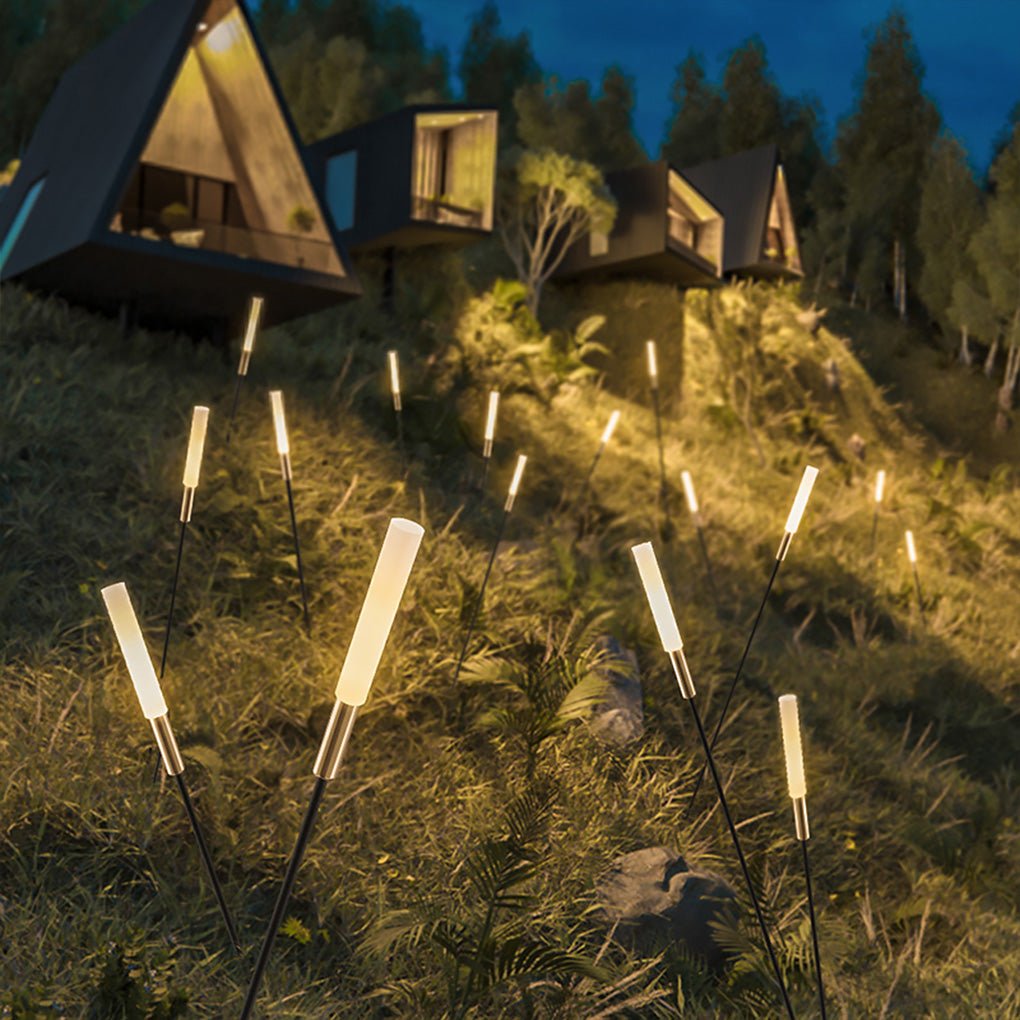
Height drives the whole visual effect, because reed lighting is a silhouette first and a light source second. Work from what is already growing rather than from the fixture’s spec sheet:
- Short stems (25.6–31.5 in) sit below or level with most ornamental grasses and read as understory. Use them at the front edge of a border or between low perennials.
- Mid stems (43.3–48.4 in) are the workhorse height. They clear low groundcover and land in the middle of the visual field when you are standing on a terrace or looking out a window.
- Tall stems (55.5–60.2 in) are the ones that carry a border on their own. They work best where there is nothing taller immediately behind them — a tall stem against a hedge just disappears.
A useful rule when ordering a single height: the stems should end up at roughly two-thirds to three-quarters of the height of the planting they sit in. If your grasses finish around 40 in, mid-height stems at 31.5 in will look intentional; 60 in stems in the same bed will look like poles.
Spacing and coverage
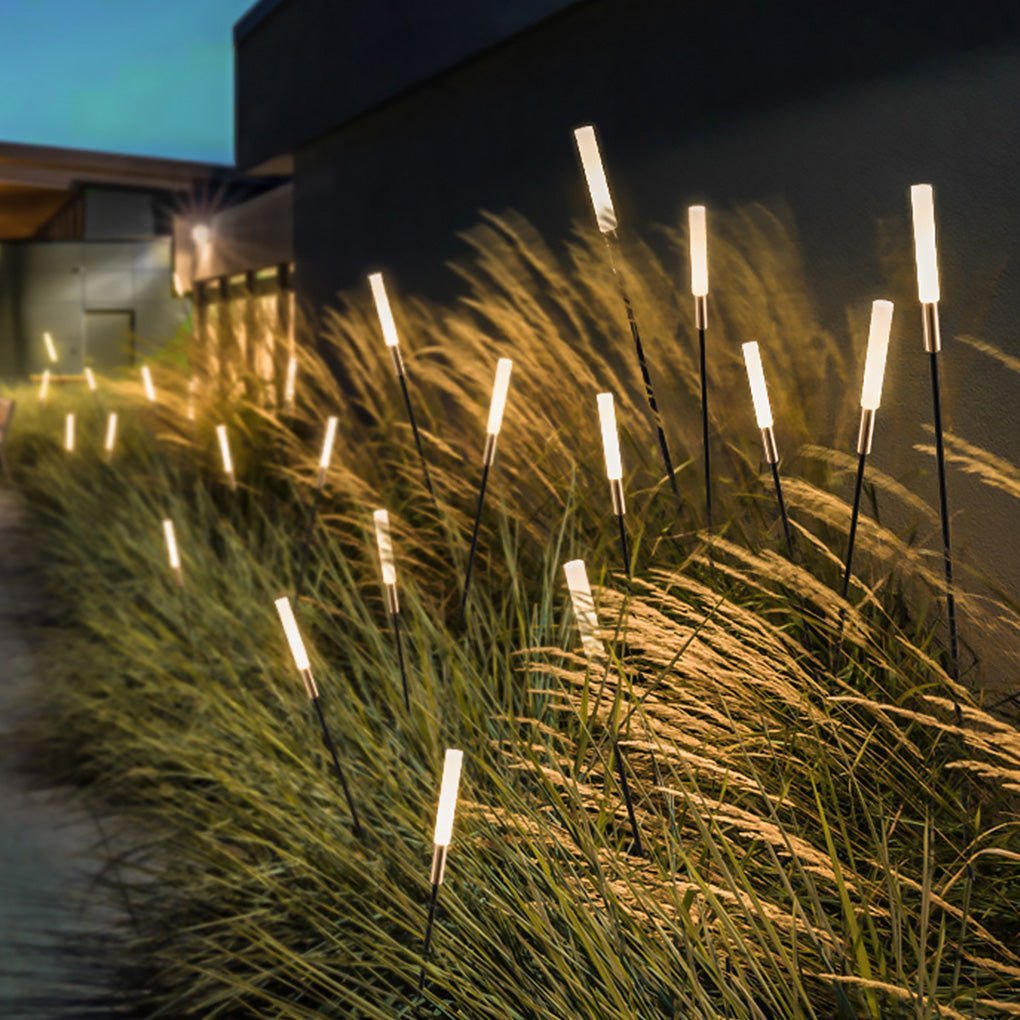
The listed coverage per set is 54–161 sq ft (5–15 sq m). That is a wide band because the same six stems can either light a tight cluster or be spread thin across a long border — treat the low end as a dense, focal grouping and the high end as a light wash where the lights are accents rather than task lighting.
For placement, three patterns work reliably:
- Cluster of six in one bed. Vary the spacing slightly — roughly 8–16 in apart at the base, staggered rather than in a line. Uniform spacing is what makes decorative lighting look like a fence.
- Two groups of three. One group at a bed’s near corner, one further along the border. This reads as depth and works well when the bed is longer than about 12 ft.
- Flanking a feature. Three stems on each side of a specimen plant, a water feature, or a garden bench. The asymmetry in height between the two sides is what makes it look grown rather than installed.
Keep stretcher clear of the immediate fixture base — the fixtures are waterproof, but a stem standing in standing water or buried in heavy mulch will not last as long as one with air around its base.
The light itself: 3000K warm white and CRI above 80
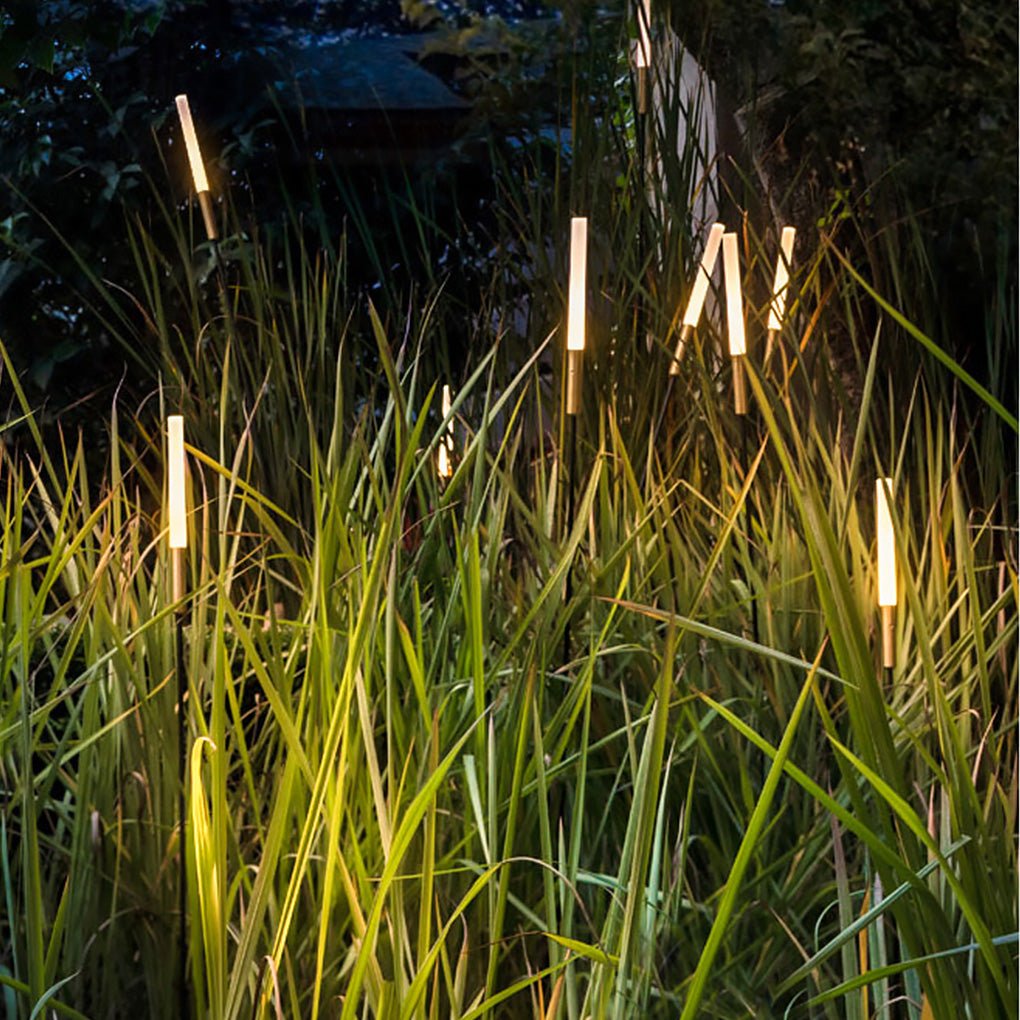
3000K is the sweet spot for residential landscape lighting. It is warm enough to flatter stone, timber, and foliage without the amber cast that 2700K can give, and it avoids the cold blue-white of 4000K and above, which is what makes cheap garden lighting look like a security installation.
A colour rendering index above 80 means colours under the light stay close to how they look in daylight. In a garden this is the difference between green foliage that still looks green at night and foliage that turns grey. It also matters for hardscape — warm-toned stone and timber retain their warmth instead of flattening out.
Because these are 1.5W and 3W fixtures, expect accent lighting, not area lighting. Six stems will define a bed and mark a route; they will not illuminate a patio for dining. If you need usable light on a terrace, that is a different fixture category, and mixing the two is usually the right answer.
Full specifications
| Set contents | 6 pieces |
| Materials | Stainless steel + aluminum + acrylic |
| Finish | Black pole; gold and white lamp head |
| Light source | LED |
| Power | Hardwired DC12V: 1.5W · Solar: 3W |
| Colour temperature | Warm white, 3000K |
| Colour rendering index | Above 80 |
| Voltage | DC12V (transformer required, not included) |
| Heights — DC12V | 25.6 in (65 cm) · 31.5 in (80 cm) · 43.3 in (110 cm) · 55.5 in (141 cm) |
| Heights — solar | 36.6 in (93 cm) · 48.4 in (123 cm) · 60.2 in (153 cm) |
| Coverage | 54–161 sq ft (5–15 sq m) per set |
| Weather resistance | Waterproof |
| Certification | UL Certified, ETL Listed, CE Approved, RoHS Compliant, FCC Certified (as listed by the manufacturer) |
| Typical use | Courtyard, villa, residential area, lawn and garden borders |
Setup notes worth knowing before installation
- Solar: site the panel for direct sun, not just ambient daylight. Six to eight hours of run time assumes a full charge; partial shade shortens it. Early evening output is strongest and tapers overnight.
- Hardwired: the transformer is a separate purchase. Confirm it matches DC12V and has capacity for the total wattage of the stems you are running before you start trenching.
- Both: drive the stake or base into soil, not into compacted gravel or root mass — a stem that cannot sit vertically will lean and undo the reed effect.
- Winter: the materials are selected for outdoor exposure, but in regions with hard freezes, lifting the solar panels clear of snow cover preserves run time.
If you are sizing a larger project or want the layout reviewed before ordering, the product page has the full specification set and a route to the design team for layout advice and custom dimensions.
Frequently asked questions
Can these lights be used in rainy or humid climates?
Yes. The fixtures are waterproof and built for outdoor conditions, including rain and humidity. The stainless steel, aluminum, and acrylic construction is what carries that durability rather than a coating that wears off.
Do I need a transformer for the hardwired version?
Yes. The hardwired version runs on DC12V and requires a transformer, which is not included. You will need to buy a compatible transformer separately to complete the installation — plan for it before you order, since it affects both cost and where the wiring terminates.
How long does the solar version take to charge, and how long does it last?
The solar version charges during daylight and typically provides illumination for 6–8 hours on a full charge, depending on sunlight exposure and weather. For best results the panel needs direct sun rather than filtered shade.
How many lights do I need for one garden bed?
One six-piece set covers roughly 54–161 sq ft (5–15 sq m), depending on how densely you space the stems. For a focal cluster, work toward the lower end of that range; to spread a light wash across a long border, work toward the upper end.
Can I use them as the only lighting on a patio?
They are best treated as accent lighting. At 1.5W to 3W per fixture, six stems will define planting and mark a route, but they are not designed to light a seating or dining area for use after dark.
The short version
Buy this set if you have a planted bed you want to read as landscaping rather than as lighting, and if the bed gets direct sun (solar) or already has 12V wiring or a willingness to add a transformer (hardwired). Buy six, not two — the repetition is the design. Choose height from the planting, not the catalogue, and expect a warm 3000K accent glow rather than working light.
View the Reed & Cattail Solar LED Landscape Lights at MiniHouzz →