
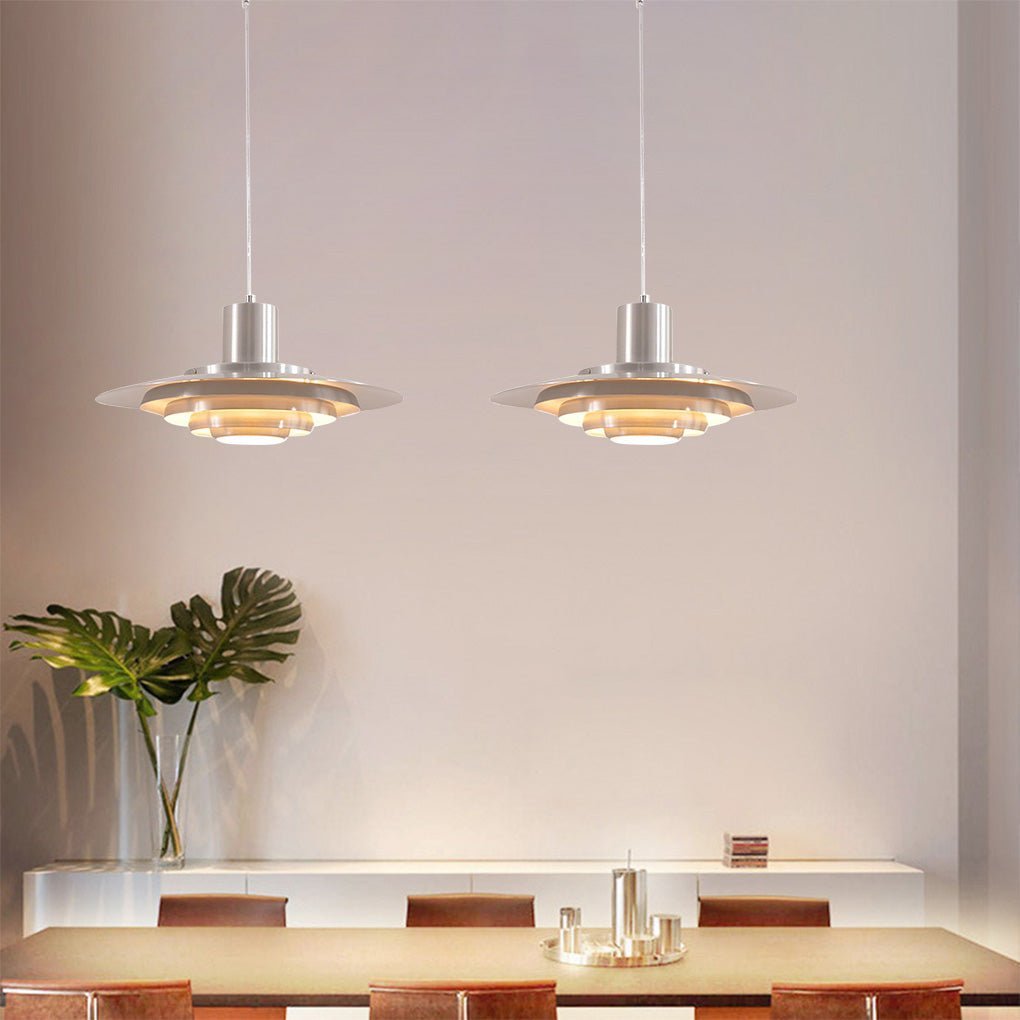
A multi-layer aluminum pendant light is a single-socket hanging fixture built from stacked, hot-bent aluminum layers that break the beam apart instead of firing it straight down. That layered shade is the whole point: light bounces between the plates and leaves the fixture at many angles, so a dining table gets a soft, even glow rather than one bright circle in the middle and dark chairs on the ends. This MiniHouzz pendant carries that idea in two sizes — 14″ (35.56 cm) and 19″ (48.26 cm) — with a 7.48″ (19 cm) body height, a 59″ (149.86 cm) adjustable chain and a recommended coverage area of 54–108 sq ft (5–10 sq m).
Below is how the construction actually behaves in a room, how to pick between the two diameters, and the numbers worth having on hand before you drill a ceiling hole.
What the layered aluminum shade does to the light
Both the lamp body and the lampshade are listed as aluminum, formed through a hot-bending process. Practically, that gives you three things worth caring about:
- Directional softness. The stacked plates interrupt the bare bulb’s cone of light. Instead of a hard-edged pool directly under the fixture, you get a wider, gentler fall-off toward the edges of the table.
- Low visual weight. Aluminum keeps the shade thin. A 14″ unit is listed at 1,500 g and the 19″ at 2,200 g — light enough for standard ceiling boxes, heavy enough to hang dead straight on a chain.
- Finish consistency. A metal shade holds its surface across the whole visible face, so the fixture reads as one object from across the room rather than as a diffuser plus a frame.
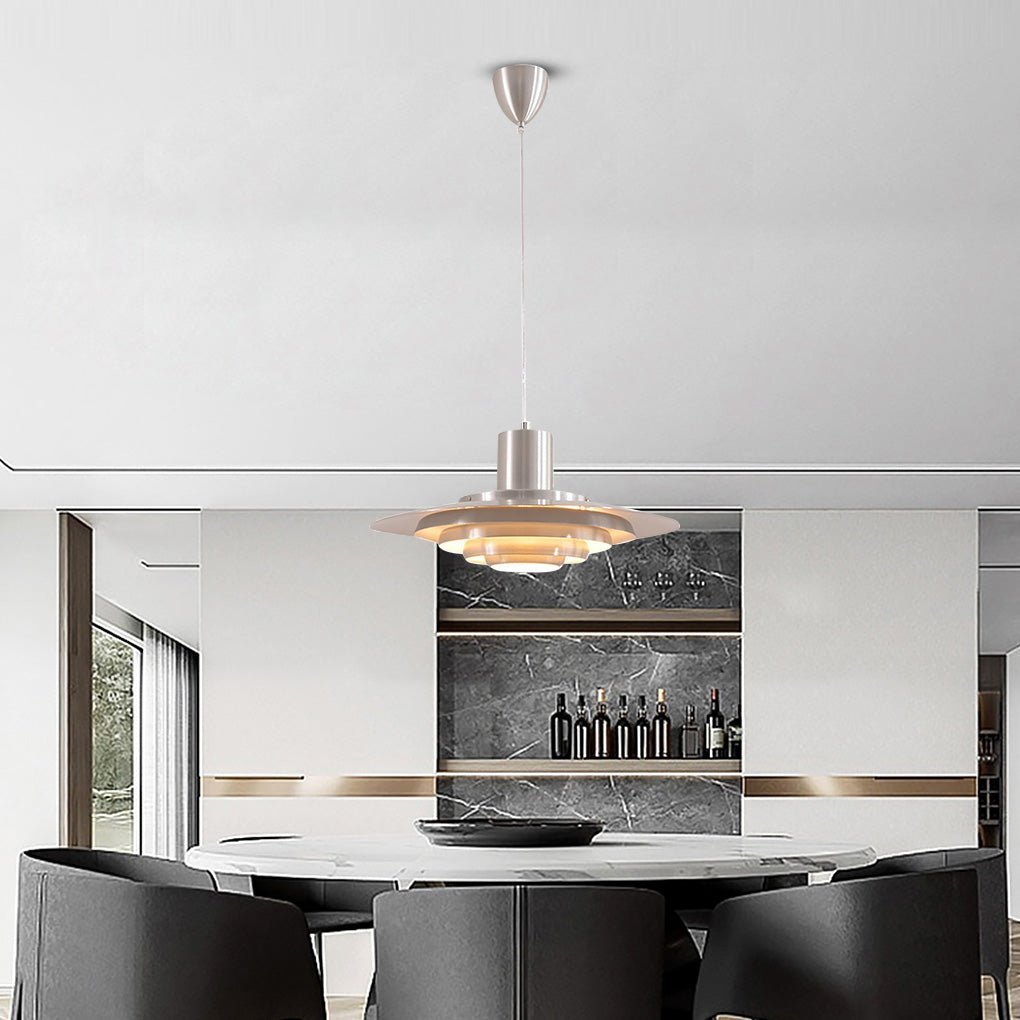
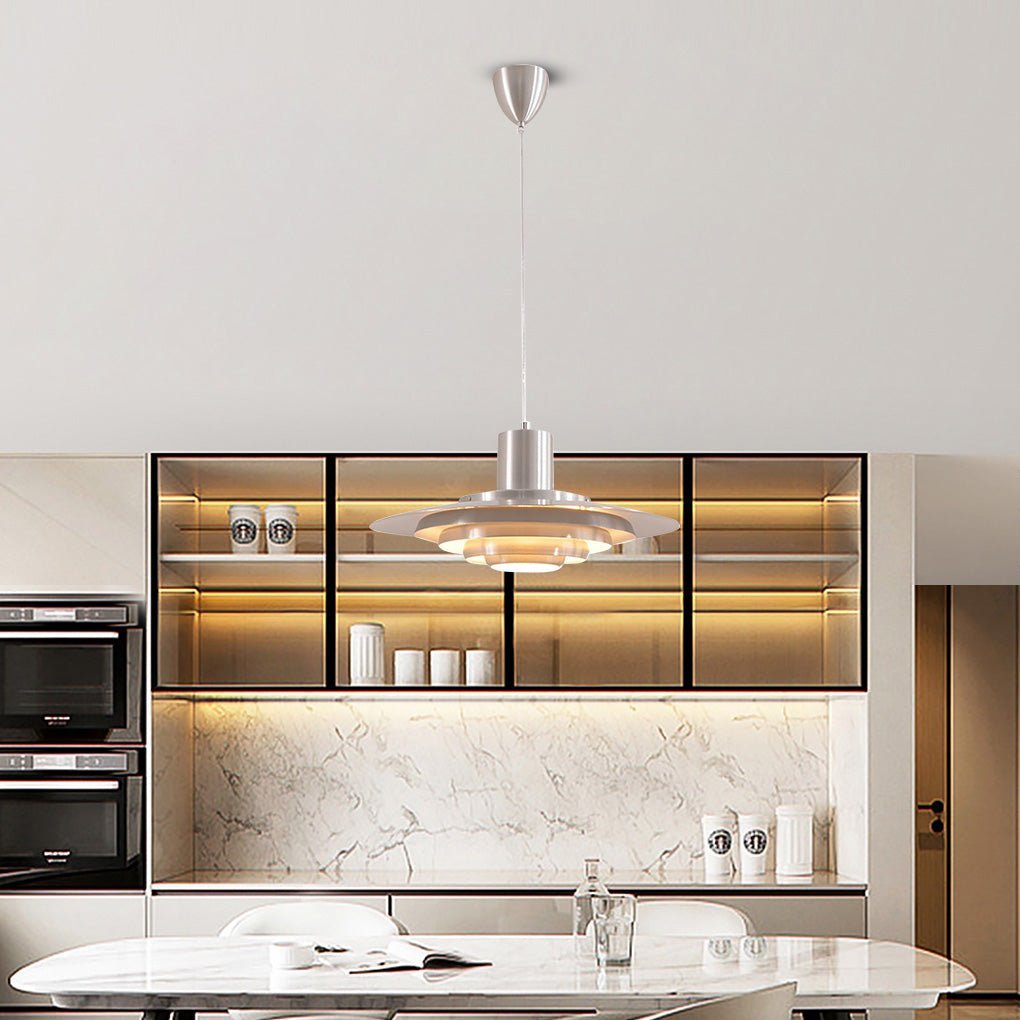
The styling language is Nordic and contemporary — clean planes, no ornament. It sits easily over a walnut table, a marble waterfall island or a matte-black kitchen, and it is equally at home in a coffee bar or a small restaurant where the fixture is part of the décor rather than just illumination.
14″ or 19″: pick the size from the table, not the ceiling
Both diameters share the same 7.48″ body height and the same 59″ chain, so this is not a “big room, big fixture” decision. It is a decision about how much of your table you want the shade to visually claim.
| Diameter | Usually the better fit | Listed weight | Notes |
|---|---|---|---|
| 14″ / 35.56 cm | Tables seating 4, compact islands, foyers, bedrooms | 1,500 g | Leaves more air around the shade; pairs well in twos over a short island |
| 19″ / 48.26 cm | Tables seating 6, long islands, double-height entries, café counters | 2,200 g | Fills the frame when the ceiling is high and the table is wide |
A rule of thumb that holds up in practice: the shade’s diameter should land somewhere around one-third to one-half of the table’s width. A 40-inch round table is comfortable with the 14″; a 72-inch rectangular table wants the 19″, or two 14″ units spaced along the length.
Coverage is quoted at 54–108 sq ft (5.0–10.0 sq m), which brackets a four- to six-person dining zone. If your room is much larger than that, the fixture still works — but treat it as accent and task light over the table and let other fixtures carry the ambient load.
Hanging height and spacing that actually work
The chain gives you 59 inches (149.86 cm) of adjustment, which covers most residential ceilings. Work backwards from the surface you are lighting:
- Over a dining table: aim for the bottom of the shade 30–36 inches above the tabletop. Lower reads more intimate and gives a stronger pool of light; higher keeps sightlines open across the table. If people at the table are tall or the room is used for homework and paperwork, stay toward 36 inches.
- Over a kitchen island: the same 30–36 inches above the counter, measured to the bottom of the shade — not to the ceiling.
- Walkways and foyers: keep at least 78–80 inches of clearance from the floor so nobody walks into it.
- Multiple units: 24–30 inches between shade edges, centered on the island or table. Two units over a six-foot island, three over an eight-foot island, is the usual rhythm.
A worked example: a 9-foot ceiling (108″) over a 36″-high island, targeting 33″ above the counter, leaves 39 inches of drop for chain plus shade — comfortably inside the 59″ capacity, with roughly 32 inches of chain to spare once the 7.48″ body is accounted for.
Because the light comes out sideways as well as down, the fixture rewards you for centering it precisely. Off-center by a few inches and the asymmetry is visible in the gradient on the table. Mark the center point of the table first, then the ceiling position directly above it — not the center of the room.
Bulb, wattage and color temperature
The bulb is not included, and the listing is specific about what the fixture accepts: a single light source, incandescent, energy-saving or LED, in the 31W–40W range, on 110V. Recommended light color temperature is 3000K.
- Go 3000K. Warm white is what makes an aluminum shade read as elegant rather than clinical — it keeps the metal from looking gray and flatters skin tones and food. Cooler temperatures above 4000K will make the layered plates look harsher.
- Match the socket before you buy a bulb. The listing does not specify the socket type, so confirm it on the unit or with support before ordering an LED. Most of the range this fixture belongs to takes a standard screw-in lamp, but it is worth the thirty seconds.
- Stay inside 31–40W. A modern LED that draws far less but is labeled as a 40W-equivalent replacement gives you the output without heating the shade.
- Dimming is not stated. The listing does not confirm dimmer compatibility. If dimming matters for your dining room, ask MiniHouzz support before you buy the wall switch — do not assume it.
Where this pendant fits — and where it does not
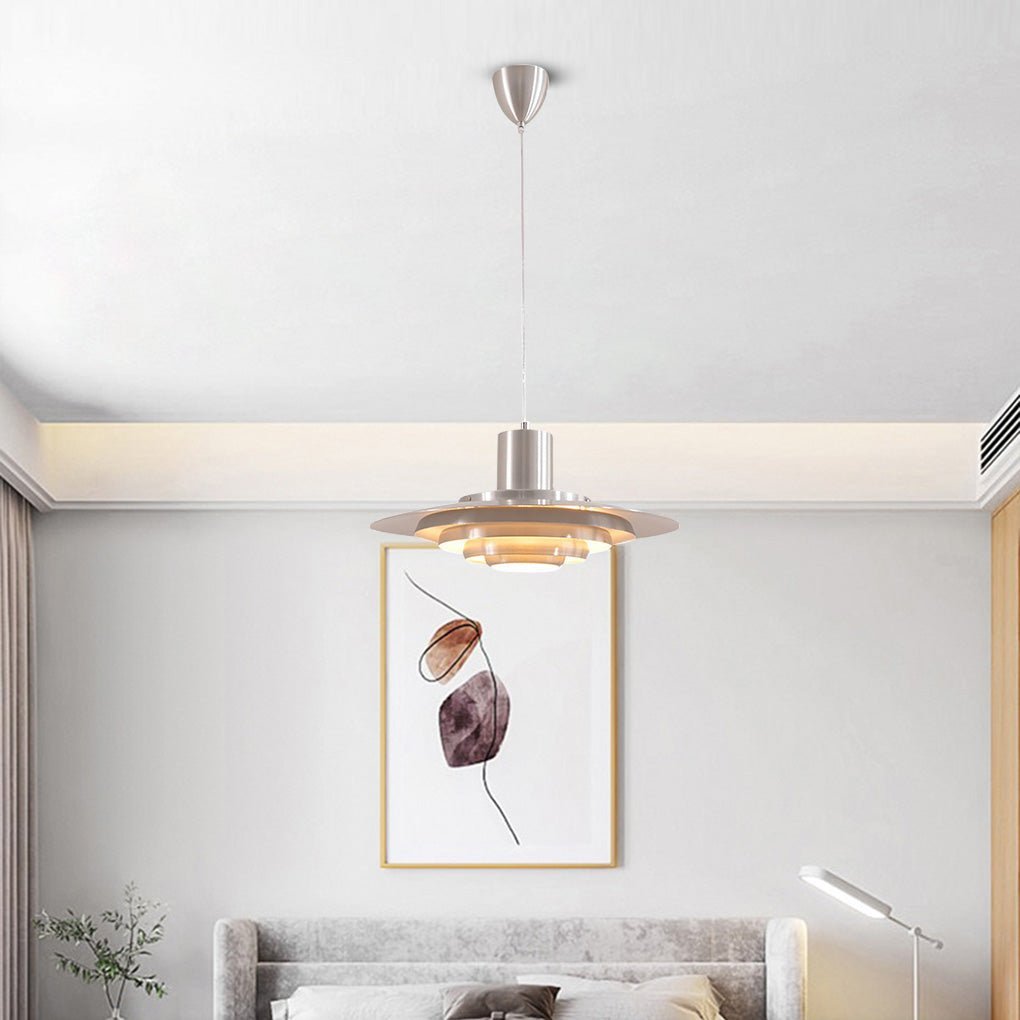
Strong fits: dining tables, kitchen islands and counters, entries and foyers, bedrooms, balconies, cafés, bars, small restaurants and retail displays. The listed applicable spaces are restaurant, coffee shop, bar and dining area, and the design brief behind it is Nordic, contemporary and art-led interiors.
Weaker fits: a home office desk that needs even task light across a keyboard; a bathroom or powder room, since the listing gives no damp or wet-location rating; and any outdoor covered patio for the same reason. It is also a single-source fixture, so a long hallway or an open-plan living room will need additional fixtures to avoid dark corners.
Specifications at a glance
| Brand | MiniHouzz |
|---|---|
| Fixture type | Multi-layer pendant lamp |
| Body & shade material | Aluminum (hot-bent process) |
| Diameter options | 14″ / 35.56 cm · 19″ / 48.26 cm |
| Height | 7.48″ / 19 cm |
| Hanging chain | 59″ / 149.86 cm, adjustable |
| Weight | 1,500 g / 2,200 g |
| Number of light sources | 1 |
| Bulb types accepted | Incandescent, energy-saving, LED |
| Power range | 31W – 40W |
| Color temperature | 3000K recommended |
| Bulb included | No |
| Voltage | 110V |
| Recommended coverage | 54–108 sq ft / 5.0–10.0 sq m |
| Certifications (as listed) | UL Certified, ETL Listed, CE Approved, RoHS Compliant, FCC Certified |
Dimensions may vary slightly from manual measurement, and color temperature and finish can shift a little between production batches and monitors — normal for metal fixtures at this scale.
Frequently asked questions
Is a light bulb included?
No. The fixture ships without a bulb and accepts incandescent, energy-saving or LED sources in the 31W–40W range. For a warm dining-room look, choose a 3000K bulb.
Should I pick the 14-inch or the 19-inch?
Use the table width. The 14″ suits four-person tables and compact islands; the 19″ suits six-person tables, long islands and high-ceilinged foyers where a smaller shade would look undersized. Both share the same 7.48″ height and 59″ chain.
Can I shorten the chain for a low ceiling?
Yes. The chain is 59 inches (149.86 cm) and adjustable, so you can remove links to suit anything from an eight-foot ceiling down to an over-table drop of roughly 30–36 inches.
Can it be installed on a dimmer?
The listing does not specify dimmer compatibility, so confirm with MiniHouzz support before wiring a dimmer switch. If dimming is essential, ask first — it is a five-minute question that saves a return.
Will one fixture light a whole dining room?
It lights the table zone. The recommended irradiation area is 54–108 sq ft (5–10 sq m), which covers a four- to six-seat dining set. For the rest of the room, plan on separate ambient lighting.
Getting it right the first time
The two decisions that matter are diameter and drop height: match the shade to the table’s width, then set the bottom of the shade 30–36 inches above the surface and center it on the table rather than the room. Everything else — 3000K bulb, 31–40W, adjustable chain — follows from the spec sheet, and the aluminum layering does the rest of the work by spreading light instead of dumping it.
Available in both diameters with the full specification list, expedited shipping options and custom-dimension support through MiniHouzz: see the Multi-Layer Aluminum Pendant Light. If you are planning a row of them over a long island, check the size and chain details before you order, and compare the 14″ and 19″ options against your table plan.