
A flexible curve LED pendant light is a linear fixture made from a pliable silicone-sheathed rope that holds whatever shape you bend it into — a soft wave above a kitchen island, an S-curve in a stairwell, or a clean straight run over a dining table. In this gold-finished version, the integrated LED strip runs continuously inside the rope, so what you see is one unbroken line of diffused light instead of a row of separate bulbs.
That single design decision is what makes it useful. Rigid linear pendants force the room to fit the fixture. A bendable rope lets the fixture fit the room — around a beam, down a sloped ceiling, or across a long island where a straight bar would look heavy.
See the Flexible Curve LED Pendant Light in gold →
Why a bendable pendant solves problems fixed fixtures can’t
Most linear pendants are built on a rigid aluminum channel. They read as architecture: confident, but inflexible. A curve pendant reads as sculpture, and it can be tuned on site.
- It adapts to the ceiling you actually have. Sloped ceilings, beams, soffits and uneven suspension points can all be absorbed into the curve rather than fought with extensions and swivels.
- It fills a long sightline without a long bar. A 250–400 cm run over an island gives you continuous light while keeping visual weight low.
- It hides the light source. The silicone diffuses the LED, so you get an even glow and no glare from a bare diode array at eye level.
- It’s adjustable after installation. You can re-shape the run later — after furniture moves, or after you decide the wave should sit higher — without new hardware.
Design and materials: silicone rope, metal body, gold finish
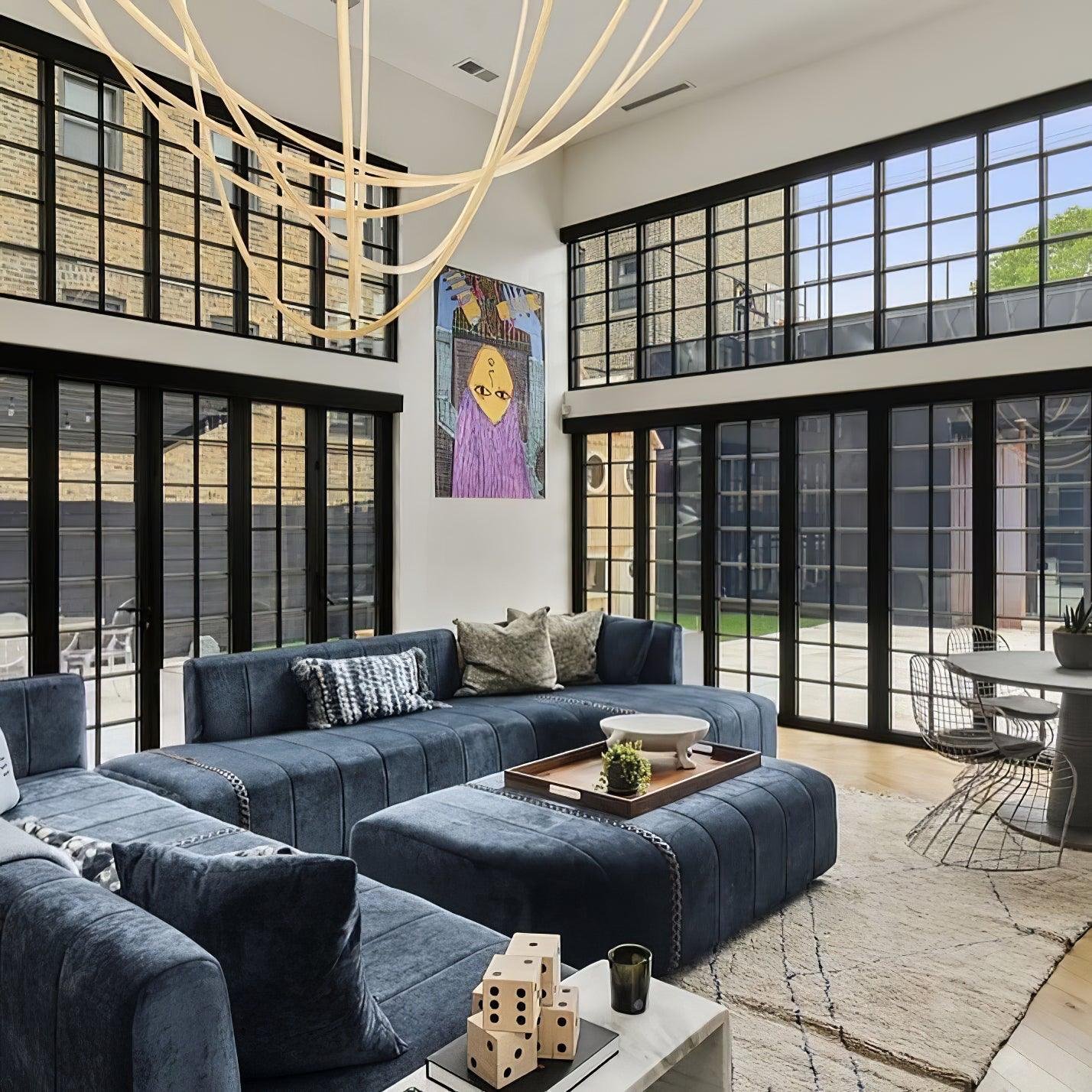
The fixture is specified as rope, silicone and metal, with a gold body finish and a white shade finish. In practice that means a metallic structure that carries the suspension and wiring, wrapped in a soft white silicone sheath that both diffuses the light and gives the piece its flexibility.
The gold finish is the part that decides the room. Gold reads warm and slightly formal against dark cabinetry, walnut, plaster and stone; against all-white Scandinavian interiors it becomes the single deliberate accent. Because the light itself is warm-neutral rather than amber, the metal doesn’t turn brassy under its own glow.
One thing worth being clear about up front: the LED is integrated and not user-replaceable. That is normal for this fixture type — the strip is sealed inside the diffuser for even output and a clean profile — but it does mean you should buy the right length and color temperature once, rather than planning to swap the light engine later.
Sizing: match the run to the island or table
The fixture is offered in 200, 250, 300, 350, 400, 450, 480 and 600 cm lengths (roughly 78.7 in to 19.7 ft), and custom lengths up to 870 cm are available through the brand’s support team. Wattage scales with length, from about 24 W at 200 cm to about 54 W at 450 cm.
| Length | Approx. imperial | Power | Typical use |
|---|---|---|---|
| 200 cm | 78.7 in | ~24 W | Small dining table, breakfast nook, entry |
| 250 cm | 98.4 in | ~30 W | Standard 6–8 ft island |
| 300 cm | 9.8 ft | ~36 W | Long island, open-plan dining |
| 350 cm | 11.5 ft | ~42 W | Large island with seating |
| 400 cm | 13.1 ft | ~48 W | Great room, double-height void |
| 450 cm | 14.8 ft | ~54 W | Very long runs, commercial dining |
| 480 / 600 cm | 15.7 / 19.7 ft | — | Stairwells, atriums, hotels |
As a working rule for residential layouts: aim for a run roughly half to two-thirds the length of the island or table below it, then use the extra length for the curve itself. If your island is 8 ft (244 cm), a 250 cm fixture leaves room for one gentle wave; a 200 cm fixture will look underscaled if you want a pronounced S.
Remember the curve eats length. A 300 cm rope bent into a deep wave can lose 20–30 cm of horizontal span to the arc. If your run needs to clear a specific span, size up rather than planning to flatten the curve.
Check available lengths and current pricing →
Hanging height, offsets and layout
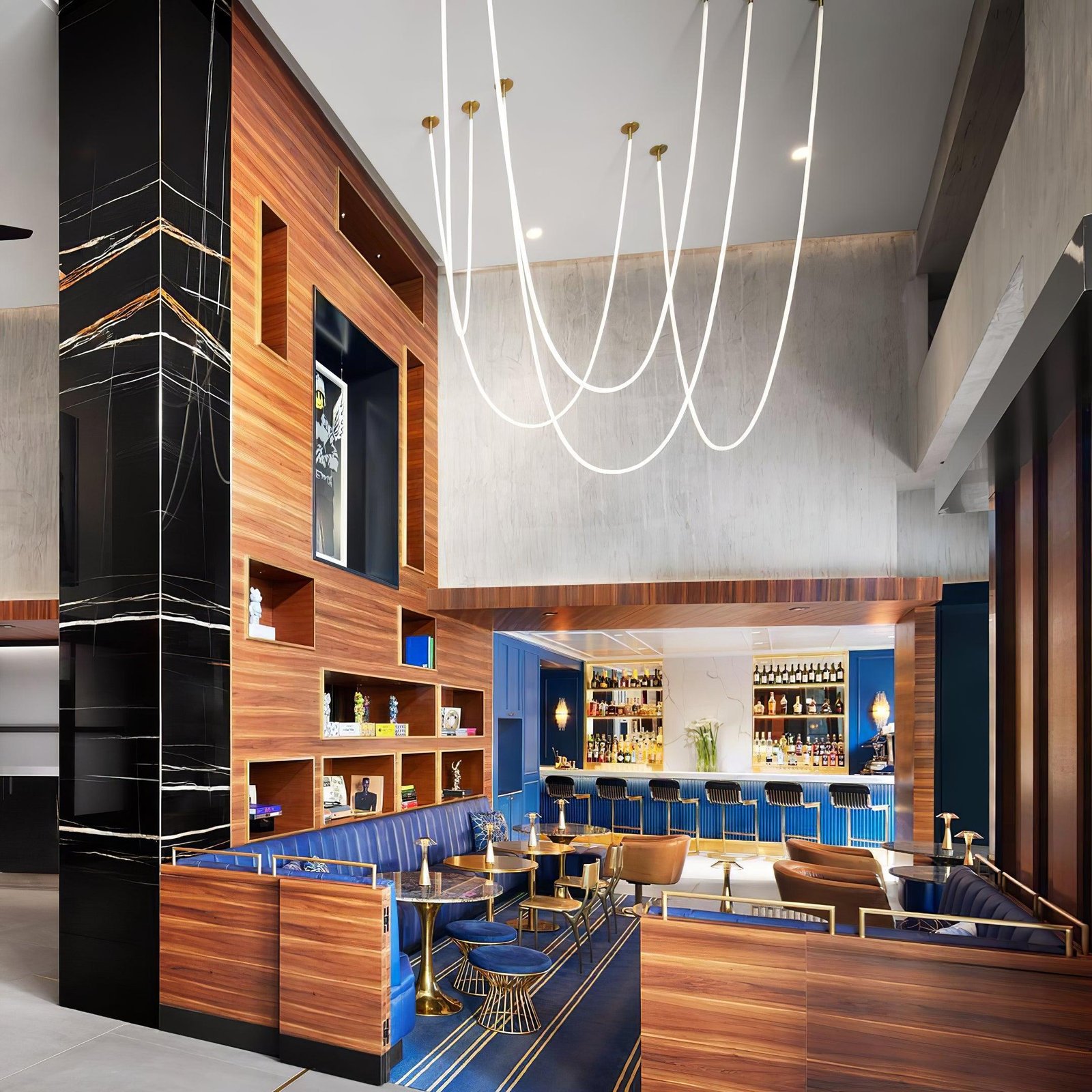
These are conventional interior-design ranges rather than product specifications, so treat them as starting points and adjust for sightlines and ceiling height.
- Above a kitchen island or counter: bottom of the fixture about 30–36 in (76–91 cm) above the countertop. Higher if people stand and talk across the island; lower if the fixture is the main light and you want it to feel intentional.
- Above a dining table: bottom of the fixture about 30–34 in (76–86 cm) above the tabletop. This keeps the light source out of seated eyelines while still pooling light on the surface.
- Above a hallway or stair void: there is no table to measure from, so work in the opposite direction — set the lowest point of the curve above head height (at least 6 ft 8 in / 203 cm of clearance on a walking path).
- Off-center is fine. One advantage of a curve is that the visual mass can sit off the centerline of the island while the light still lands where you cook. Decide where the light should fall first, then shape the rope around it.
- Keep IP 20 in mind. The fixture is rated IP 20 and intended for indoor use where it isn’t exposed to moisture. That makes it right for dining rooms, kitchens, entries and home offices — not for a shower zone or a covered porch.
3000K, 4000K or 6000K: picking the light color
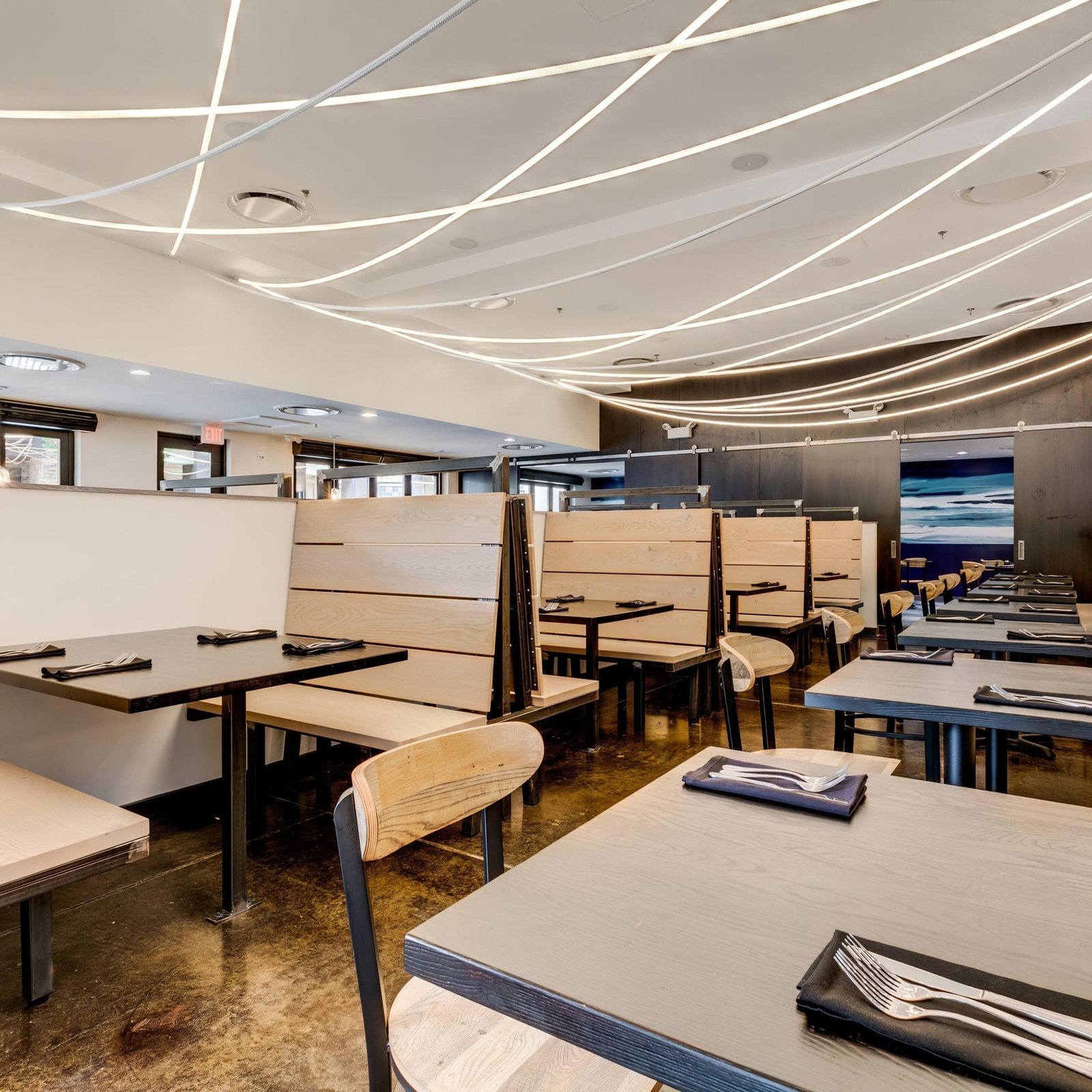
The fixture is offered in three color temperatures, and this choice matters more than most buyers expect because the LED cannot be changed later.
- 3000K warm light — the safe, flattering choice for dining rooms, bedrooms and living spaces. Wood and brass/gold tones look richest under it. If the fixture hangs over a table where people eat and talk, start here.
- 4000K neutral light — the practical middle. Good over a kitchen island where you also prep food, and in home offices where 3000K can feel too amber for task work. It reads clean without going clinical.
- 6000K cool light — crisp and slightly blue. Best reserved for utility spaces, modern white-on-white interiors, or commercial settings where a bright, high-contrast look is the goal. Over a warm wood dining table it usually looks out of place.
If the room has other fixtures, match or stay within one step of their color temperature. Mixing 3000K and 6000K in the same sightline is the most common reason a well-chosen fixture still looks wrong.
Installation: hardwired, sloped ceilings, wall switch control
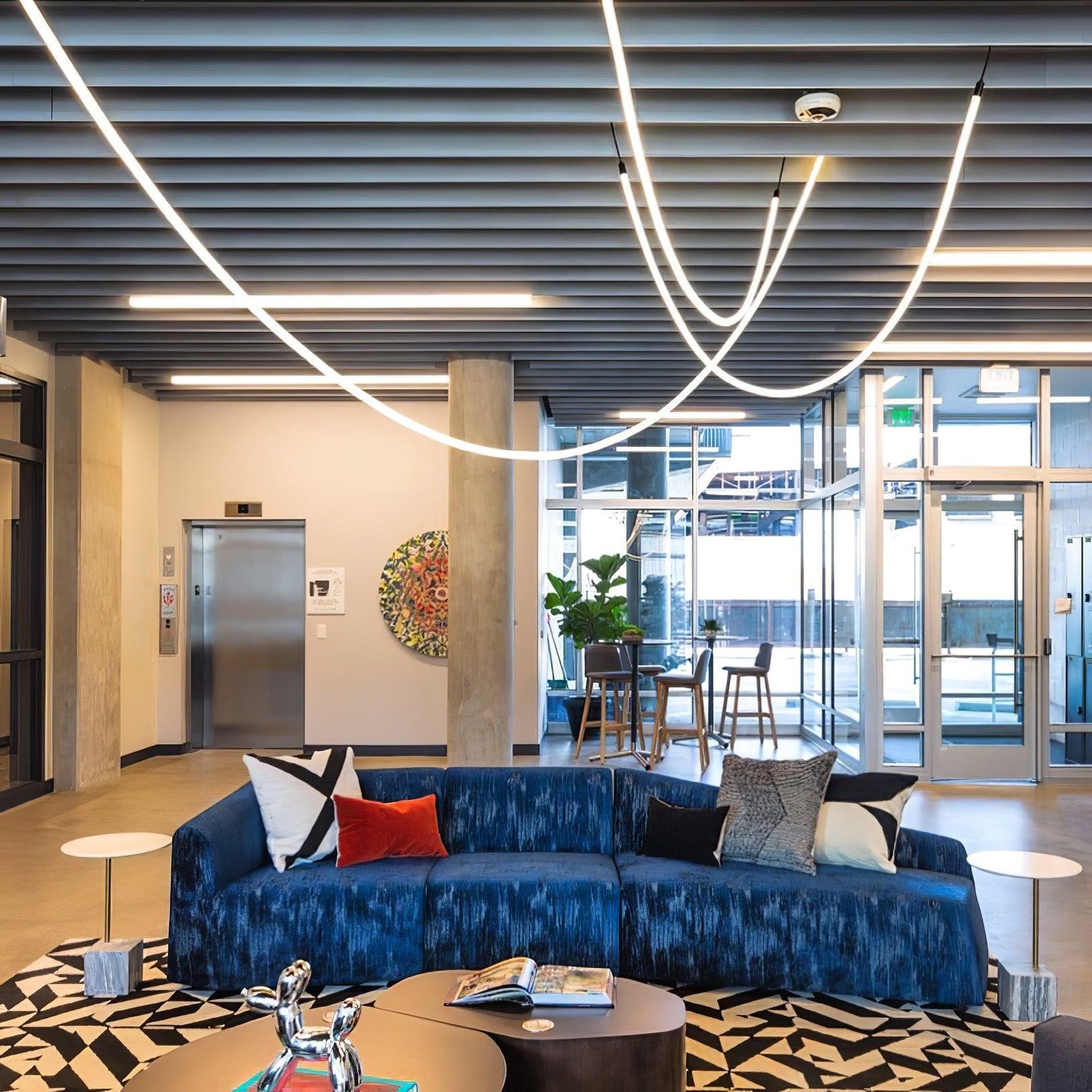
A few practical points from the spec sheet that affect planning:
- Hardwired. This is not a plug-in fixture. It needs a switched ceiling junction box, which means an electrician unless you already have a suitable feed in place.
- Sloped ceiling compatible up to 30°. Beyond that angle, confirm with the brand before ordering — the suspension geometry changes.
- Wall switch control. The fixture is listed as compatible with common wall switches (not included) and should be connected to an external wall light switch. Dimming is not listed in the specification, so plan on a standard switched circuit unless the brand confirms otherwise for your order.
- Voltage AC 110–240V, which means it works on North American 120V circuits as well as 220–240V regions without a separate version.
- Shape it before final tightening. Bend the rope to its final curve with the fixture hanging at working height, check it from the room’s main entry point, then lock everything down. Curves that look right from a stepladder often look different from the doorway.
Specifications at a glance
| Material | Rope, silicone, metal |
|---|---|
| Light source | Integrated LED (not replaceable) |
| Color temperature | 3000K warm / 4000K neutral / 6000K cool |
| Voltage | AC 110–240V |
| Lengths | 200–600 cm standard; custom up to 870 cm |
| Power | ~24 W (200 cm) to ~54 W (450 cm) |
| Mounting | Ceiling, hardwired; sloped ceiling adaptable under 30° |
| Finishes | Gold body / white shade |
| Rating | IP 20, indoor use |
| Certification | UL certified, ETL listed, CE approved, SAA listed, RoHS compliant, FCC certified |
Frequently asked questions
Can the pendant be bent into any shape?
It’s designed to be reshaped to suit different spaces and styles, and the silicone rope holds its form once positioned. It is a flexible line, not a wire you can knot — keep bends smooth and generous rather than sharp, and avoid tight kinks where the internal LED sits.
Is the LED replaceable if it fails?
No. The LED is integrated into the fixture and is not user-replaceable. This is a deliberate trade-off for an even, seamless light line with no visible diodes.
Will it work on a vaulted or sloped ceiling?
Yes, up to an adaptable angle of less than 30 degrees. For steeper pitches, contact the brand before ordering so the suspension can be planned correctly.
Can I get a custom length?
Yes. Standard lengths run from 200 cm to 600 cm, and custom lengths up to 870 cm (342.5 in) are available by contacting MiniHouzz support with your project dimensions.
Is it suitable for a bathroom?
The fixture is IP 20 rated for indoor use where it isn’t exposed to moisture. It suits dining rooms, kitchens, entries, hallways and home offices; for wet or steamy zones, a higher IP-rated fixture is the appropriate choice.
The short version
If your room has a long sightline, an awkward ceiling, or an island that no straight pendant seems to fit, a flexible curve LED pendant is the pragmatic choice: you size the run to the space, shape it to the architecture, and get a continuous diffused line instead of a row of glare. Pick the length generously, choose 3000K for dining and 4000K for a working island, and confirm the LED color before you order — because that decision stays with the fixture.