
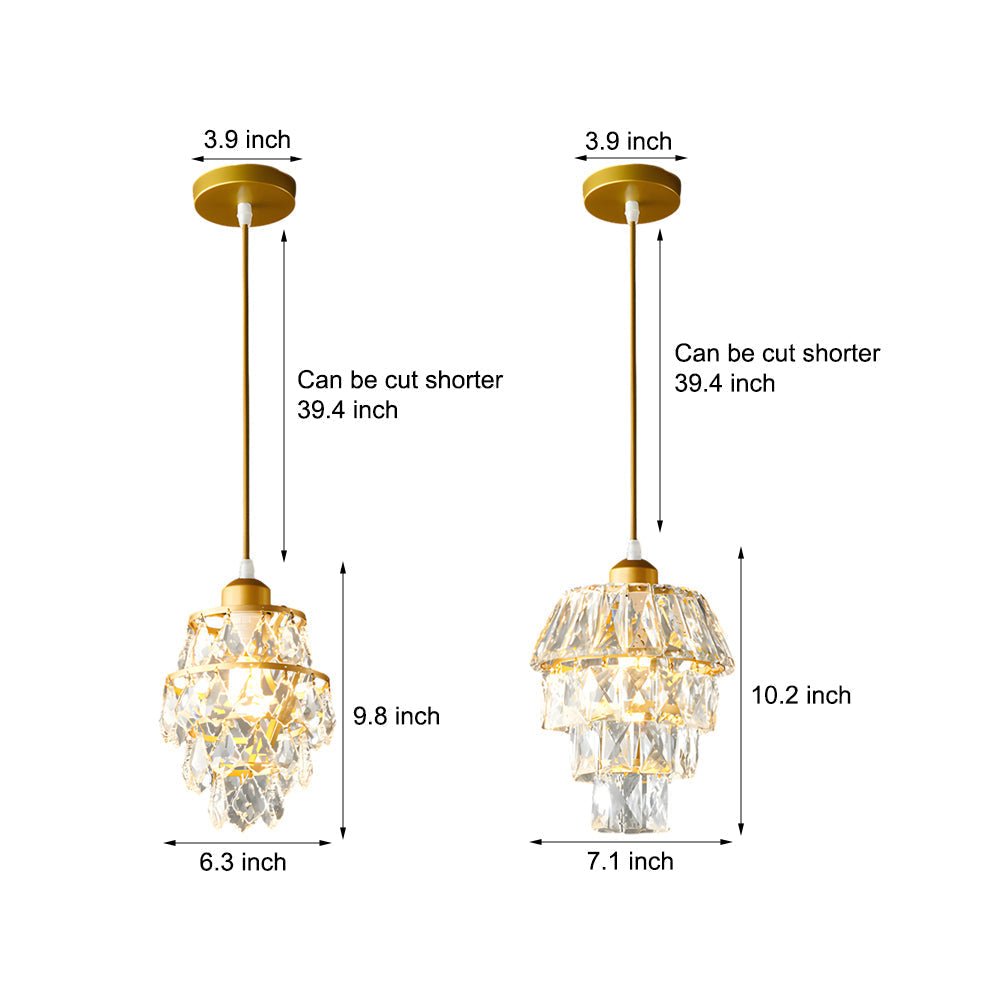
A crystal mini pendant light is a small single-bulb fixture — in this case 6.3 inches in diameter and 9.8 inches tall — hung from an adjustable cord so the shade sits at eye level or just above it. It is the right choice when you want sparkle and a focal point without a chandelier’s footprint: over a nightstand, a small dining table, a pair flanking a bed, or three in a row over a kitchen island. Because the shade is crystal and the bulb is a single E14, the light reads as refracted and layered rather than flat.
The details below are the ones that actually decide whether the install looks intentional or awkward: how much cord you have to work with, how low to hang it, how far apart to space multiples, and which bulb makes crystal look good instead of harsh.
What “mini” really means: the numbers that matter
This fixture is sold in two sizes, and the difference is small but worth checking against your space before ordering.
| Spec | Size A | Size B |
|---|---|---|
| Diameter | 6.3 in (16 cm) | 7.1 in (18 cm) |
| Height (shade) | 9.8 in (24.9 cm) | 10.2 in (25.9 cm) |
| Hanging cord | 39.4 in (100 cm), adjustable | |
| Weight | 4.93 lb (2.24 kg) | |
| Bulb | 1 × E14, not included | |
| Voltage | 110V, hardwired, indoor | |
| Coverage | 54–86 sq ft (5.0–8.0 sq m) | |
A 6-to-7 inch shade is genuinely small. On a 60-inch dining table it disappears; over a 36-inch breakfast table or a pair of nightstands it holds its own. Use the 54–86 sq ft coverage figure as a guide for what the fixture can illuminate as ambient light — it is not a task-lighting number, so treat it as mood lighting for a defined zone rather than the only light in a large room.
Mounting is hardwired at 110V, so this is a ceiling-canopy install, not a plug-in. If your ceiling has no existing junction box at the spot you want, budget for an electrician.
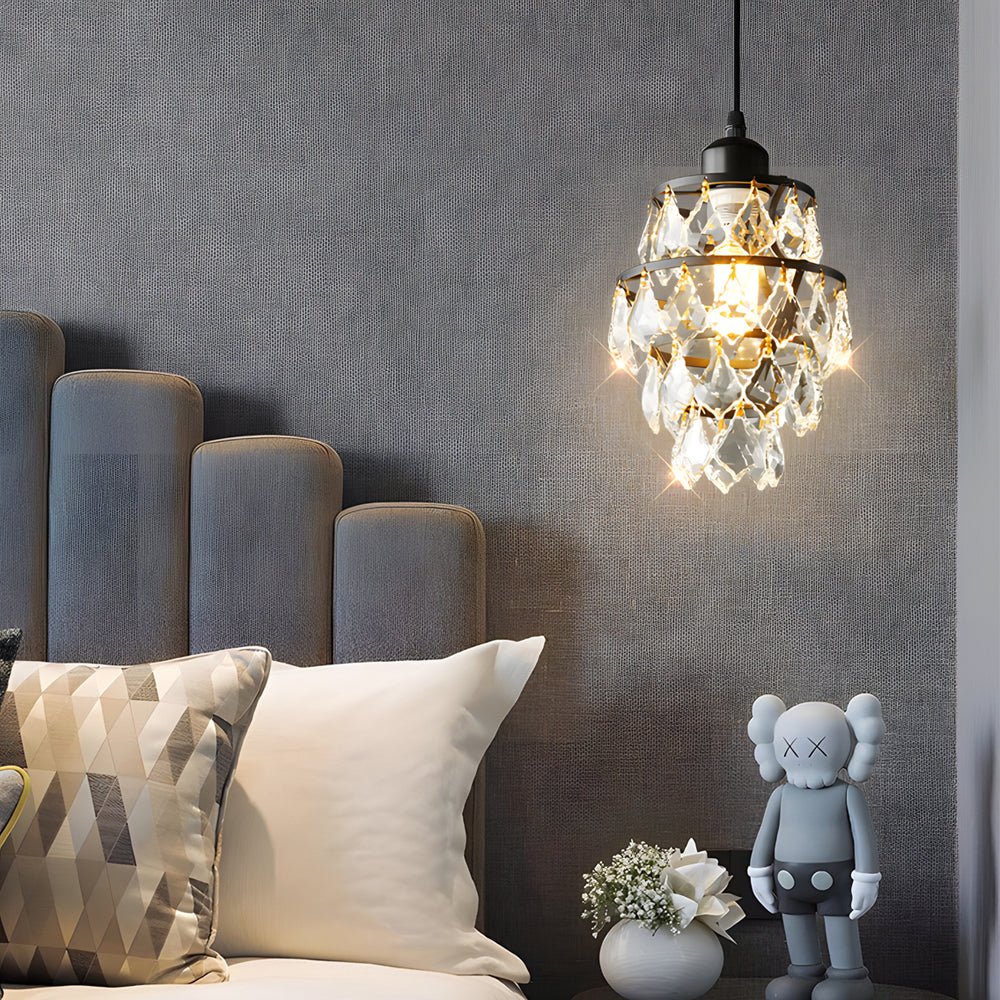
Crystal and metal: how the light actually behaves
The fixture is built from metal hardware and a crystal shade, and the shade is the light source’s whole personality. Light entering faceted crystal splits, bends, and exits at slight offsets, which is what produces the shimmer rather than a single bright pool. The practical consequence is that placement matters more than bulb wattage: put crystal near a wall or a reflective surface and you get visible sparkle; hang it in the middle of a dark open ceiling and you mostly get a bright small ball.
Two installation choices push the effect in your favor:
- Hang it where the shade is inside your field of view. Crystal does its best work when you can see it — at seated eye level over a table, or roughly 30–36 inches above a nightstand surface.
- Keep some distance from a matte ceiling. Crystal close to a flat white ceiling reads as glare from below; a longer drop lets the refraction spread.
The finish is offered in gold or black. Gold warms the light and pairs naturally with brass plumbing fixtures, oak, travertine, and cream textiles. Black reads sharper and disappears against dark cabinetry or a painted accent wall, letting the crystal be the only ornament. Both are the same fixture mechanically, so the decision is purely about the room’s metal palette — pick the one that matches the door hardware and faucet, not the one that matches the sofa.
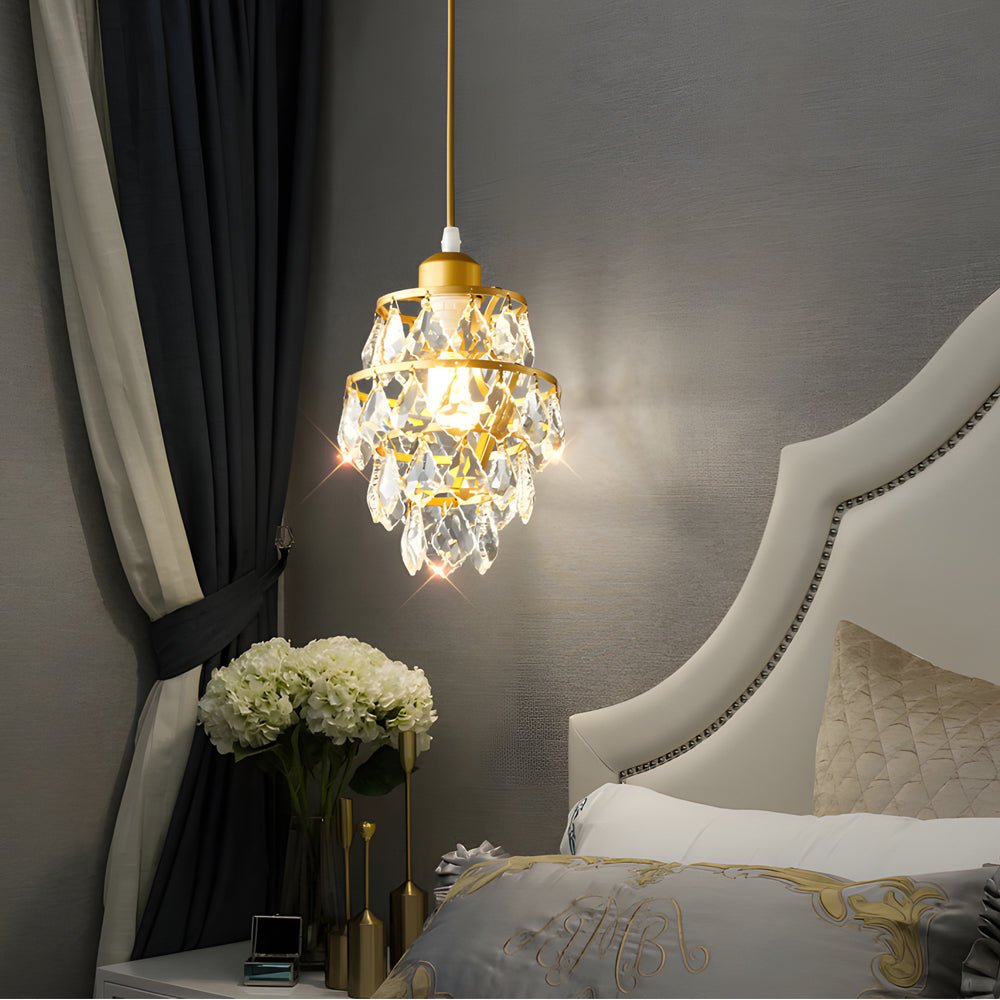
Hanging height: the numbers to start from
Hang height is the single most common mistake with mini pendants. These are starting points, then adjust by eye:
- Over a dining table: 30–36 inches from the tabletop to the bottom of the shade. For an 8-foot ceiling with a 30-inch table, that usually means 30–34 inches of drop is comfortable; go toward 36 inches if the table is wide or people lean in.
- Beside a bed (in place of a table lamp): 30–36 inches above the nightstand surface, or roughly 55–60 inches above the floor. High enough that a seated person isn’t staring into the bulb, low enough to read by.
- Over a kitchen island or counter: 30–36 inches above the counter, and 30–36 inches between fixtures if you hang more than one.
- In an entry or hallway: bottom of the shade at least 78 inches above the floor — the standard clearance for a door swing and a tall guest.
With a 39.4-inch adjustable cord, all of these are reachable from a standard 8-foot ceiling. If you have 9- or 10-foot ceilings, you can still hit the dining-table numbers by hanging the canopy normally and letting the cord out — you just lose the option of a very low, dramatic drop. In a room with a sloped or vaulted ceiling, measure the drop at the attachment point, not at the ridge.
How far apart should multiples be?
For two pendants over a table or island, space them so each one sits about one-third of the way in from the table’s edge, and keep 30–36 inches between them. For three in a row, divide the counter length into quarters and place fixtures at the quarter points. A quick check: if the shades are closer together than one shade-width apart, they will merge into a single bright mass and you lose the individual silhouettes.
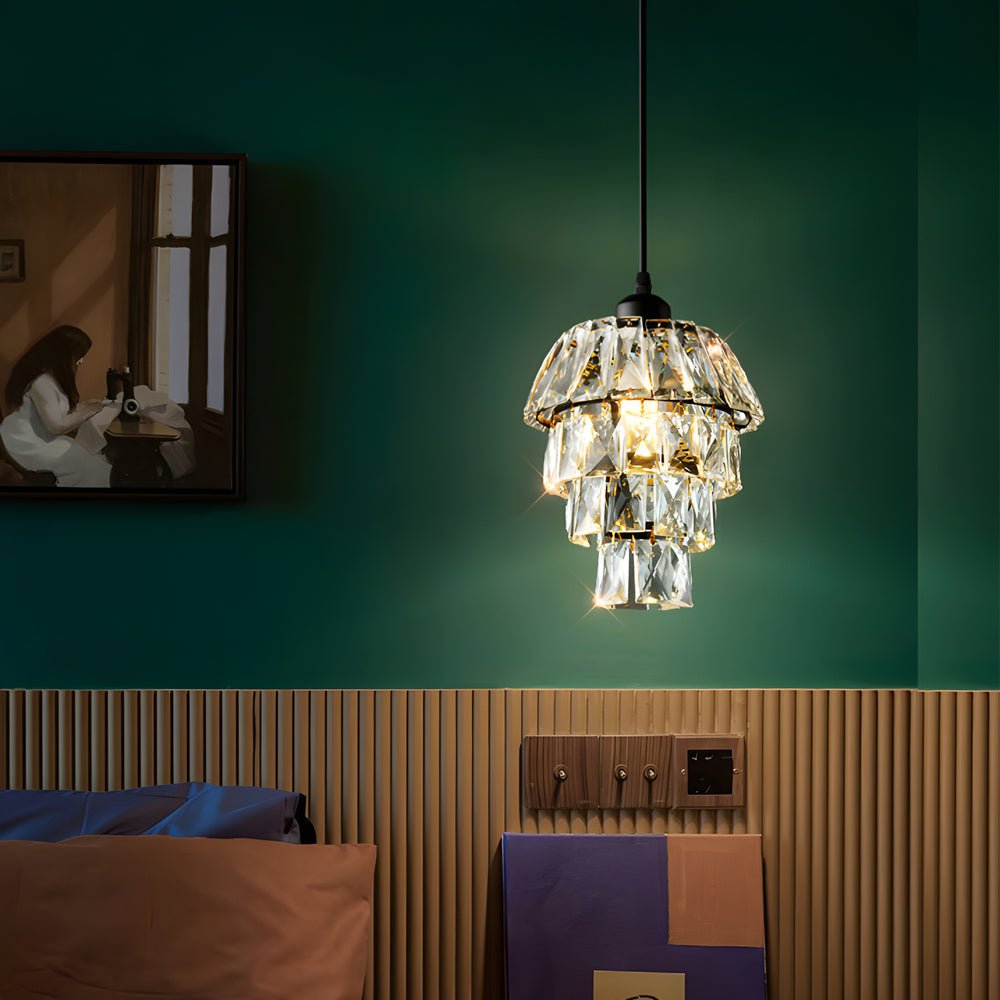
Bulb choice: where crystal looks best
The fixture takes one E14 bulb and ships without one, so the bulb is a real decision rather than an afterthought. Two variables matter:
- Color temperature. Around 2700K keeps crystal warm and flattering in bedrooms and dining rooms. 3000K is a reasonable middle for kitchens. Above 3500K the refraction starts to look clinical, and the metal finish — especially gold — reads greenish.
- Shape and clearance. Crystal shades work best with a bulb that doesn’t press against the glass. Check the shade’s internal clearance before choosing a long decorative bulb; a compact candle or globe style is the safe default for E14 fittings.
If you want the fixture to function as reading light next to a bed, favor output over decoration — the shade diffuses and refracts, so a decorative filament bulb that looks charming unlit can end up too dim for reading. If it’s purely atmospheric, a lower-output warm bulb is plenty.
One note on dimming: the fixture’s dimmability depends on the switch and the bulb you install, not on the fixture alone. If dimming matters, confirm both before buying — a dimmable bulb on a non-dimming wall switch will not dim.
Where it works, and where it doesn’t
Strong fits: bedrooms (one centered, or a pair flanking the bed), dining rooms with small-to-mid tables, breakfast nooks, kitchen islands in multiples, powder-room-adjacent vanity zones with adequate ceiling height, and reading corners where a floor lamp would crowd the floor.
Weak fits: large living rooms as the only light source — 54–86 sq ft of ambient coverage won’t carry a 300 sq ft room; tall two-story foyers, where a 9.8-inch shade looks like a dot; and anywhere outdoors or in a wet zone, since this fixture is rated for indoor use.
If you want the crystal look at larger scale, the honest move is more fixtures rather than a bigger one: three minis at 30–36 inch spacing read as a deliberate lighting scheme, while one oversized pendant in the same room reads as furniture.
Install checklist
- Confirm a junction box exists at the ceiling location and that the circuit is 110V and switched.
- Cut power at the breaker before wiring — not just at the wall switch.
- Set the cord length before hanging: measure tabletop-to-shade-target, add the shade height, and trim or coil the excess.
- Have the bulb on hand. Installing without one means a second trip up the ladder.
- Check level from two angles once the canopy is tight; a small bubble level on the canopy edge catches tilt that the eye misses.
- Clean the crystal with a dry cloth only. Damp cleaning and sprays can leave residue in the facets that dulls the refraction.
Because the fixture is hardwired and weighs just under 5 lb, standard box mounting is straightforward for a competent DIYer, but a licensed electrician is the right call if the box is old, ungrounded, or you’re unsure of the circuit.
Safety and compliance
This fixture is listed as UL Certified, ETL Listed, CE Approved, RoHS Compliant, and FCC Certified, and it is rated for indoor use at 110V. For a US installation, the UL listing and ETL listing are the two marks an inspector will look for.
FAQ
Can this pendant be used on a 220V circuit?
No. The fixture is specified at 110V. For 220–240V regions, look for a version rated for that voltage rather than using a converter on a hardwired fixture.
Is the bulb included?
No. It requires one E14 bulb, sold separately. Order the bulb with the fixture so the install isn’t blocked.
How low can the shade hang?
The cord adjusts up to 39.4 inches (100 cm). That’s enough for a 30–36 inch drop over a standard dining table in a room with an 8-foot ceiling, with cord to spare.
Will one of these light a bedroom?
As ambient light in a small bedroom, yes — the stated coverage is 54–86 sq ft. In a large primary bedroom it works better as accent or bedside lighting alongside another source.
Can it go in a bathroom?
The fixture is listed for indoor use but is not specified as damp- or wet-rated, so it’s not the right choice for a shower or a steamy bathroom zone.
Bottom line
This crystal mini pendant earns its place when the goal is a small, deliberate point of sparkle rather than general illumination. Decide in this order: the room’s metal finish (gold or black), the drop height from the table or nightstand, the bulb’s color temperature, and how many you need at 30–36 inch spacing. Get those four right and a 6-inch shade reads as a design decision instead of an undersized light.