
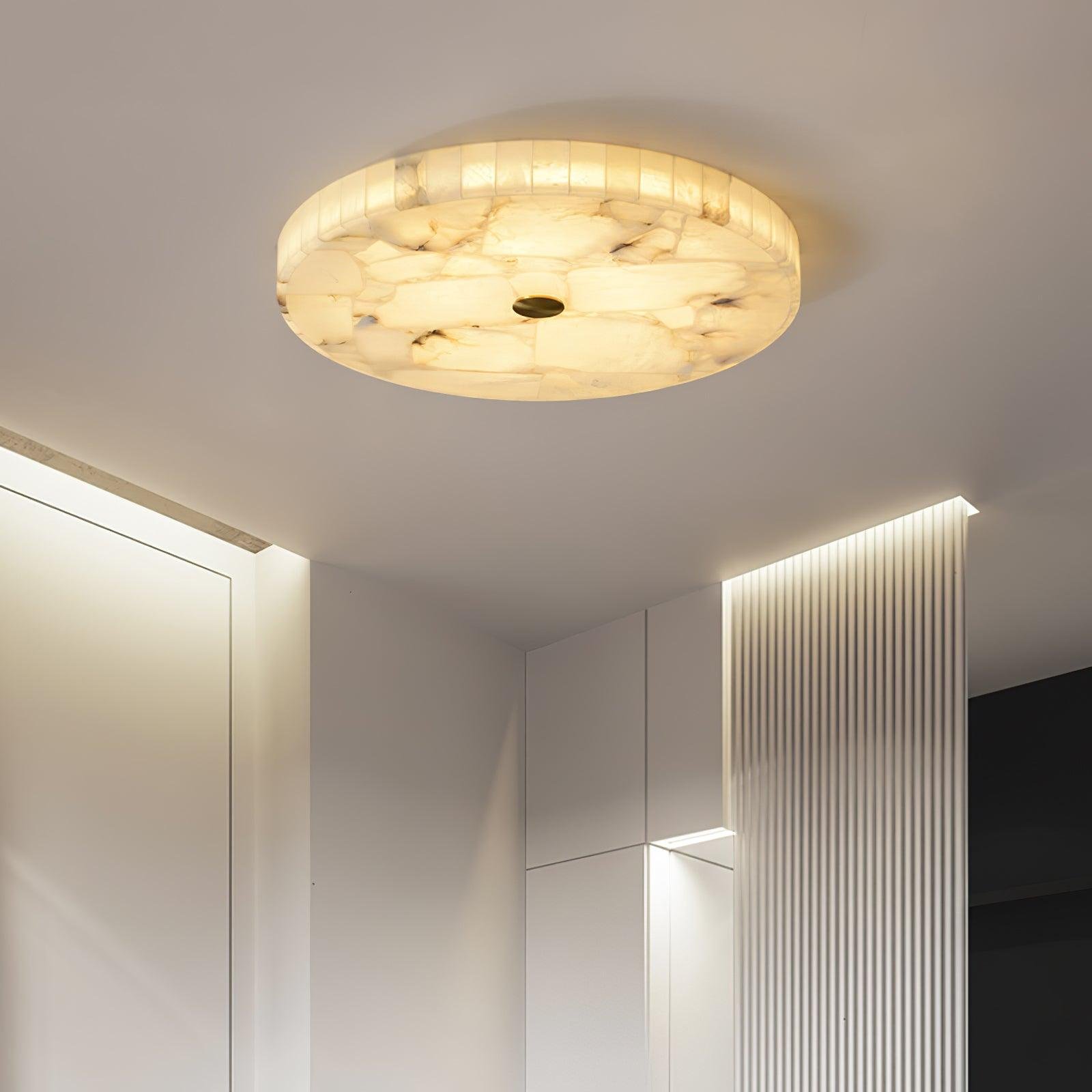
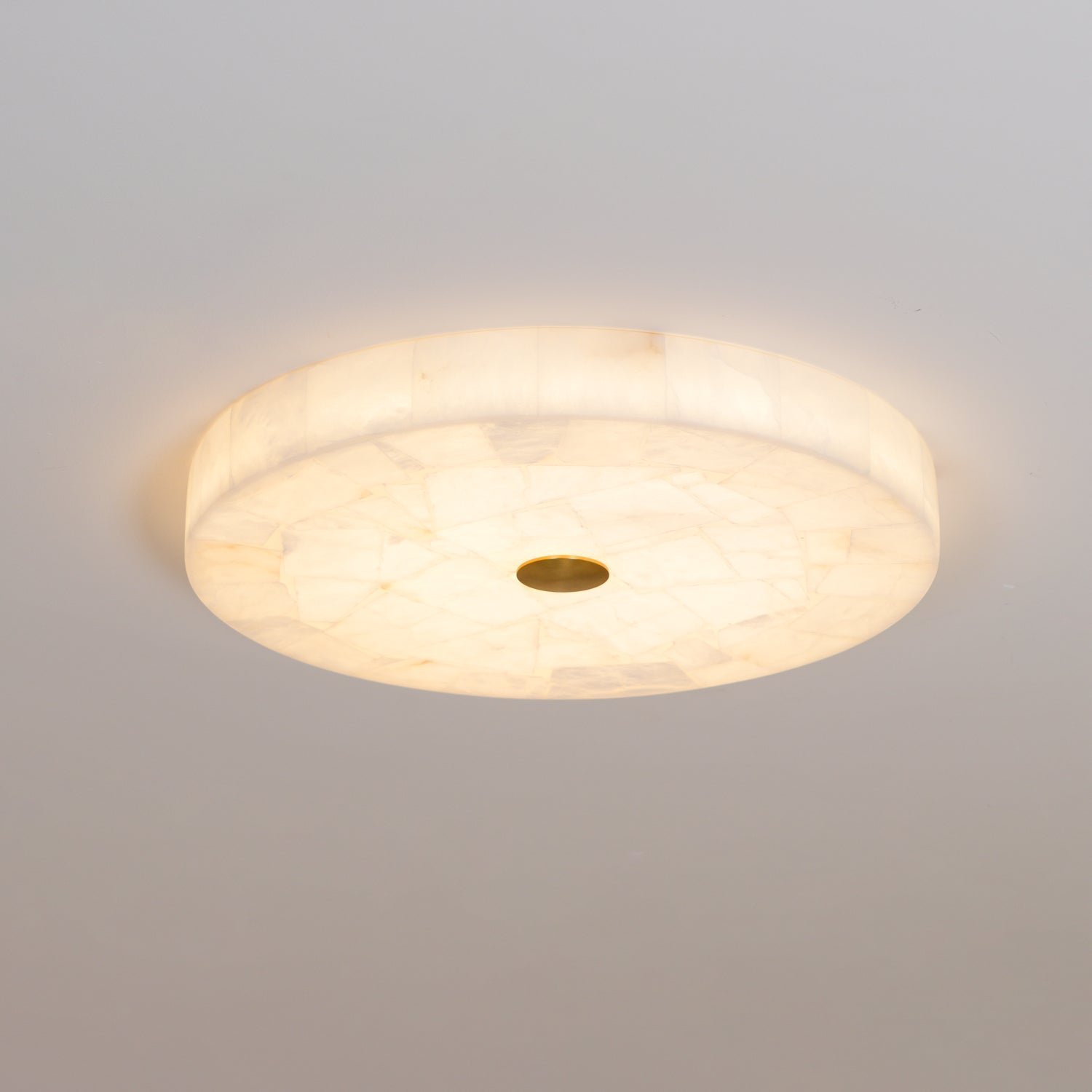
Real alabaster is the difference you notice before you can name it. A round alabaster ceiling light sits about two inches off the ceiling, glows through solid stone instead of frosted glass, and carries veining that no two pieces share. If you want a bedroom or hallway to feel expensive without a chandelier’s drama, this is the quietest way to do it. The Round Alabaster Ceiling Light is offered in 15.7″, 19.7″ and 23.6″ diameters with integrated LED at 24W, 36W and 48W, so the same design works from a walk-in closet to a primary bedroom.
Why alabaster changes a ceiling
Alabaster is a natural, softly translucent stone. Light does not bounce off its surface the way it bounces off painted metal or clear glass — it enters the stone, scatters inside the material, and leaves as a broad, even glow. That is why an alabaster fixture tends to read as lit stone rather than as a lamp with a shade.
Two practical consequences follow:
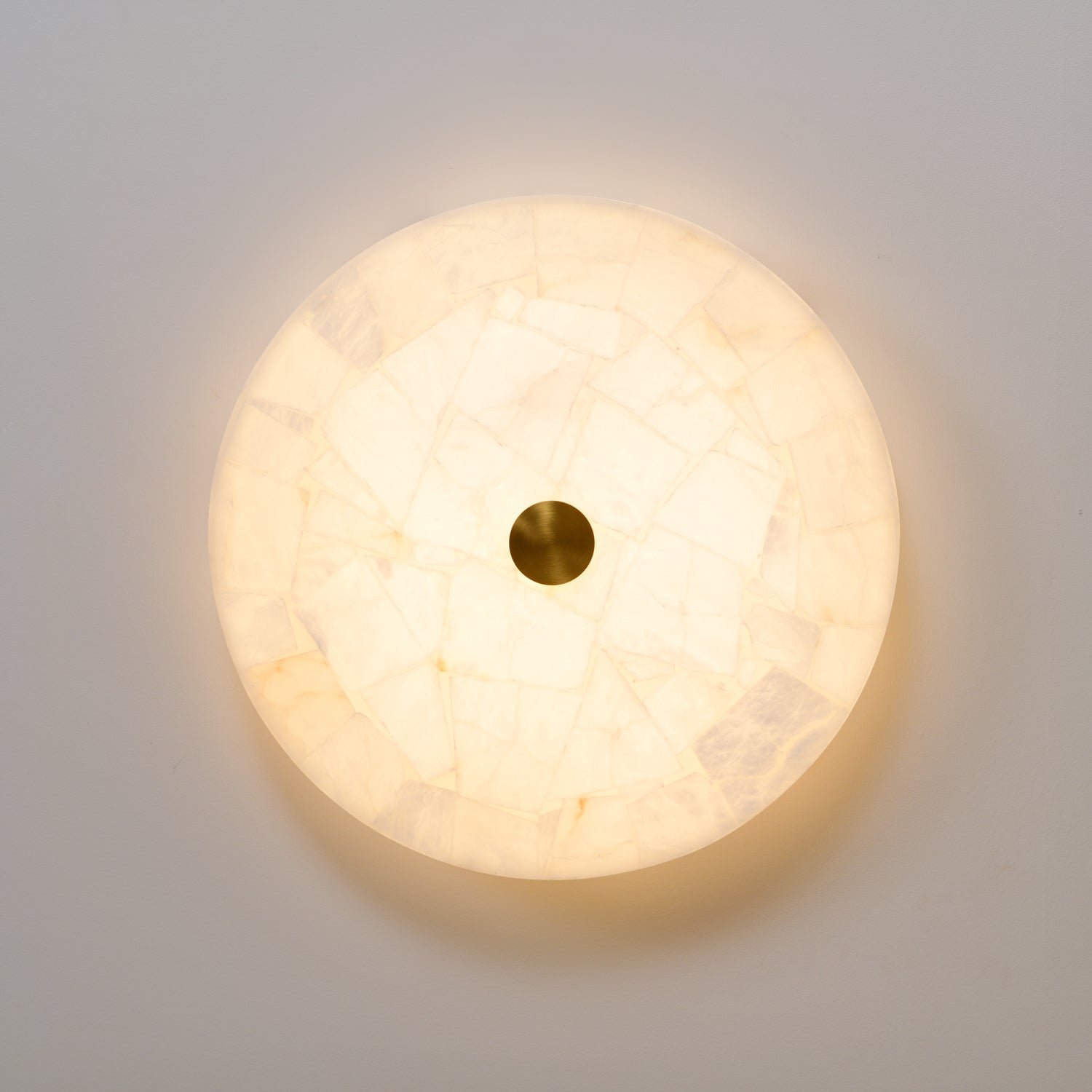
- You see the material, not a bulb. Because the diffuser is the stone itself, there is no visible light source when the fixture is on. The surface stays soft across the whole disc, with the brightest area near the centre.
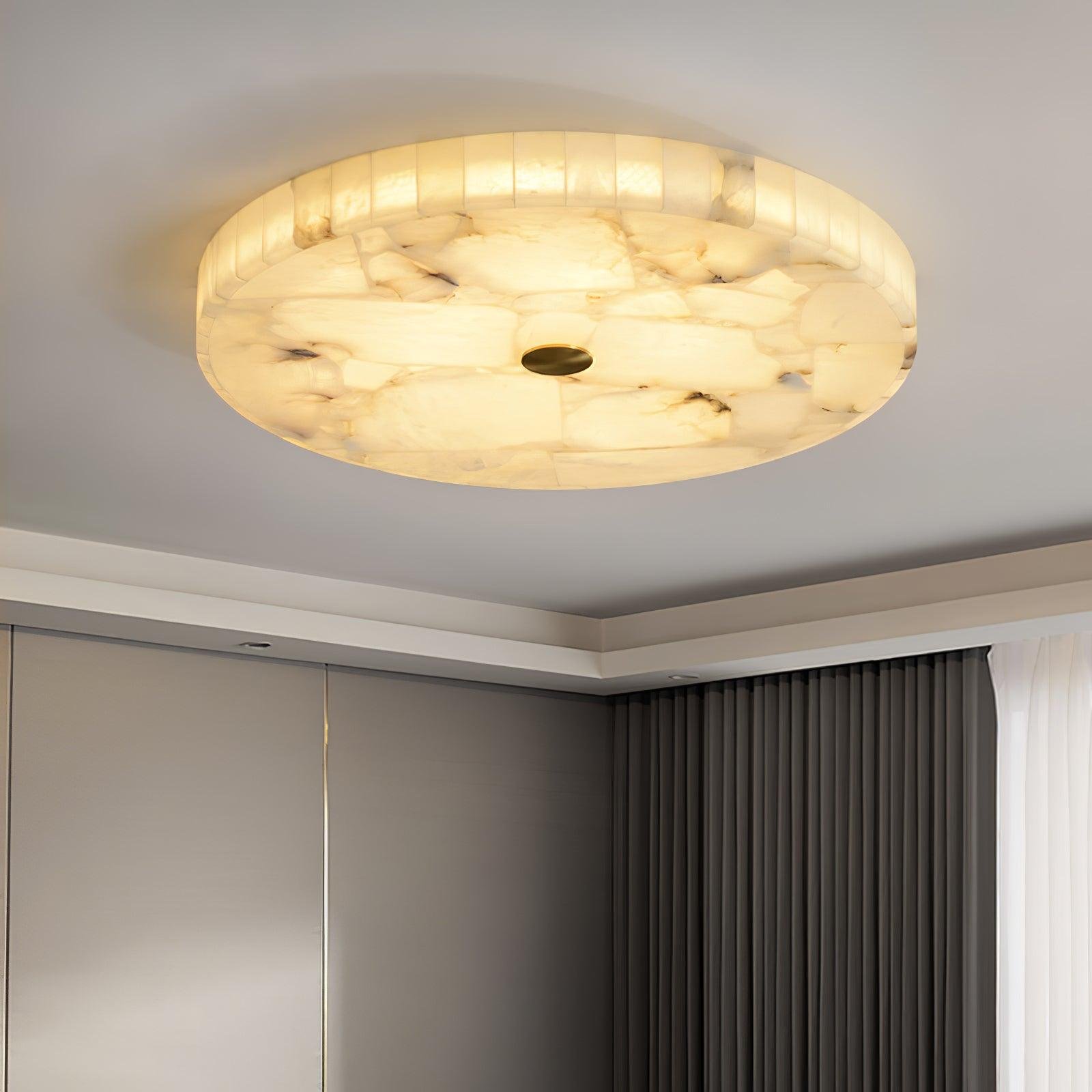
- Every fixture is slightly different. Veining and density vary from piece to piece, so the lamp you receive will not be a pixel-perfect match for the photograph. The manufacturer notes this explicitly on the product page. Treat that as part of the material, not a defect — it is the same reason stone counters are never uniform.
Where this matters most is in rooms where a bare bulb would feel clinical: bedrooms, hallways, dressing areas, small dining nooks. In a large living room a flush mount of this depth can look underscaled, and a pendant or chandelier usually earns the ceiling better.
Which diameter belongs in which room
The fixture is only 5 cm (2″) deep, so it clears an 8-foot ceiling without crowding headroom. The variable that matters is the diameter. Here is how the three sizes map to real rooms:
| Diameter | Power | Suits |
|---|---|---|
| 15.7″ / 40 cm | 24W | Bedrooms up to roughly 120 sq ft, hallways, walk-in closets, powder rooms |
| 19.7″ / 50 cm | 36W | Bedrooms of roughly 120–180 sq ft, small living rooms, dining nooks |
| 23.6″ / 60 cm | 48W | Primary bedrooms, living rooms and open hallways above roughly 180 sq ft |
A rule of thumb that holds up well for flush mounts: add the room’s length and width in feet and use that number as your target diameter in inches. An 11 x 13 ft bedroom gives you 24 — put the 23.6″ on the shortlist. A 9 x 10 ft guest room gives 19, which points at the 19.7″.
Wattage is where the ceiling gets less forgiving. Because the LED is integrated, output is fixed at purchase; you cannot swap in a brighter module later. If a room already feels dim under an old 60W fixture, size up rather than hoping the smaller disc will keep up. You can compare the three sizes and current pricing here.
3000K, 4000K or 6000K: choosing the colour temperature
The spec sheet lists three options — warm light (3000K), neutral light (4000K) and cool light (6000K). They change the room far more than the fixture’s shape does.
- 3000K warm. The safest choice for bedrooms and living rooms, and the one that flatters alabaster most: the stone reads creamy and the gold detail warms up rather than glaring. If the fixture is on in the evening, this is usually the right answer.
- 4000K neutral. Better where the light has a job to do — dressing areas, hallway closets, kitchens, a bedroom that doubles as a home office. It keeps whites reading white and skin tones less amber than 3000K.
- 6000K cool. A utility temperature. It makes the stone look whiter and colder, and it will fight a warm-toned room. Choose it deliberately for a bathroom-adjacent dressing area or a workspace, not as a default.
One practical note: keep the colour temperature consistent within sightlines. Two ceiling lights of the same design at 3000K and 6000K in one open hallway will look like a mistake, even though nothing is broken.
Installation: what the electrician needs to know
This is a hardwired ceiling fixture, not a plug-in. It mounts to a standard ceiling box and is controlled by a common push switch, which is not included. Three things are worth sorting out before the fixture arrives:
- Confirm the ceiling box. A disc this size is light for its footprint, but it still needs a securely anchored box. If the existing box is loose or was installed for a lightweight pendant, fix that first.
- Plan the switch. On/off is straightforward. If dimming matters to you, confirm compatibility with the seller before ordering rather than after — this listing specifies push-switch control, and integrated LED drivers are not universally dimmable.
- Respect the IP rating. At IP20 damp-rated, the fixture is fine in a bedroom, hallway or dining area but should not go in a shower, directly over a tub, or outdoors. Steam and direct water contact are outside what it is built for.
Because the fixture sits only 2″ deep, it is one of the few statement fixtures that works on a low ceiling without eating headroom — a real advantage in older homes and basement conversions. On a sloped or vaulted ceiling, check with the seller about mounting before you commit.
Specifications
| Material | Metal and alabaster |
| Light source | Integrated LED |
| Colour temperature | 3000K / 4000K / 6000K options |
| Voltage | AC 110–240V |
| Finishes | White and gold body, white alabaster shade |
| Mounting | Ceiling, hardwired |
| Rating | IP20 damp-rated, indoor use |
| Certification | Listing states UL, ETL, CE and SAA; also RoHS and FCC |
The product page carries the full specification table, finish options and the seller’s own FAQ if you need to confirm a detail before ordering.
Alabaster vs glass vs acrylic
| Diffuser | What you get | Trade-off |
|---|---|---|
| Alabaster | Soft, dense glow with visible natural veining; reads as stone | Heavier than acrylic, and pattern varies by piece |
| Frosted glass | Even, uniform diffusion; familiar and easy to match | Visually flatter; little material character |
| Acrylic | Light, inexpensive, resistant to casual knocks | Plastic sheen up close; the one that most often looks cheaper than the photo |
If your room already has stone, marble or limewash textures, alabaster continues that conversation. If everything else is glossy and synthetic, frosted glass will look more coherent. You can see the alabaster version in both sizes and finish options before deciding.
Living with natural stone
- Dust dry, not wet. A dry microfibre cloth is enough. Alabaster is softer than quartz or granite, and abrasive or acidic cleaners can dull the surface.
- Keep sprays off the stone. Glass cleaner, degreaser and aerosol polish belong on the metal trim only, applied to the cloth — never sprayed onto the shade.
- Inspect on arrival. Stone travels; open the crate and check the disc before the electrician mounts it, while a replacement is still simple.
- Expect the glow to shift. Alabaster varies in density, so brightness can differ subtly across the surface. That variation is the material behaving normally.
Frequently asked questions
What sizes and wattages are available?
Three: 15.7″ (40 cm) at 24W, 19.7″ (50 cm) at 36W and 23.6″ (60 cm) at 48W. All three are 5 cm (2″) deep, so size changes the footprint on the ceiling, not the clearance below it.
Can it go in a bathroom?
Only with care. It is IP20 damp-rated, which suits indoor rooms that see occasional humidity, but it is not waterproof and should not be installed over a shower, directly above a tub, or outdoors. A powder room or dressing area is fine; a wet zone is not.
Will my lamp look exactly like the photos?
No. Alabaster is a natural material, so veining, density and tone differ from piece to piece. The seller states this on the product page. Sizing, finish and hardware are consistent; the stone pattern is not.
Is it dimmable?
The listing specifies control by a common push switch, and the LED is integrated. If dimming is part of your plan, confirm with the seller before ordering — do not assume a standard wall dimmer will behave.
Do I need an electrician?
Yes. It is hardwired to a ceiling box and controlled by a wall switch (not included). A licensed electrician should handle the connection and confirm the box is properly anchored for the fixture’s weight.
The short version: choose 15.7″ for a small bedroom or hallway, 19.7″ for a standard bedroom, 23.6″ for a primary suite or living room. Stay at 3000K unless the room needs task light. Then let the stone do the work.