
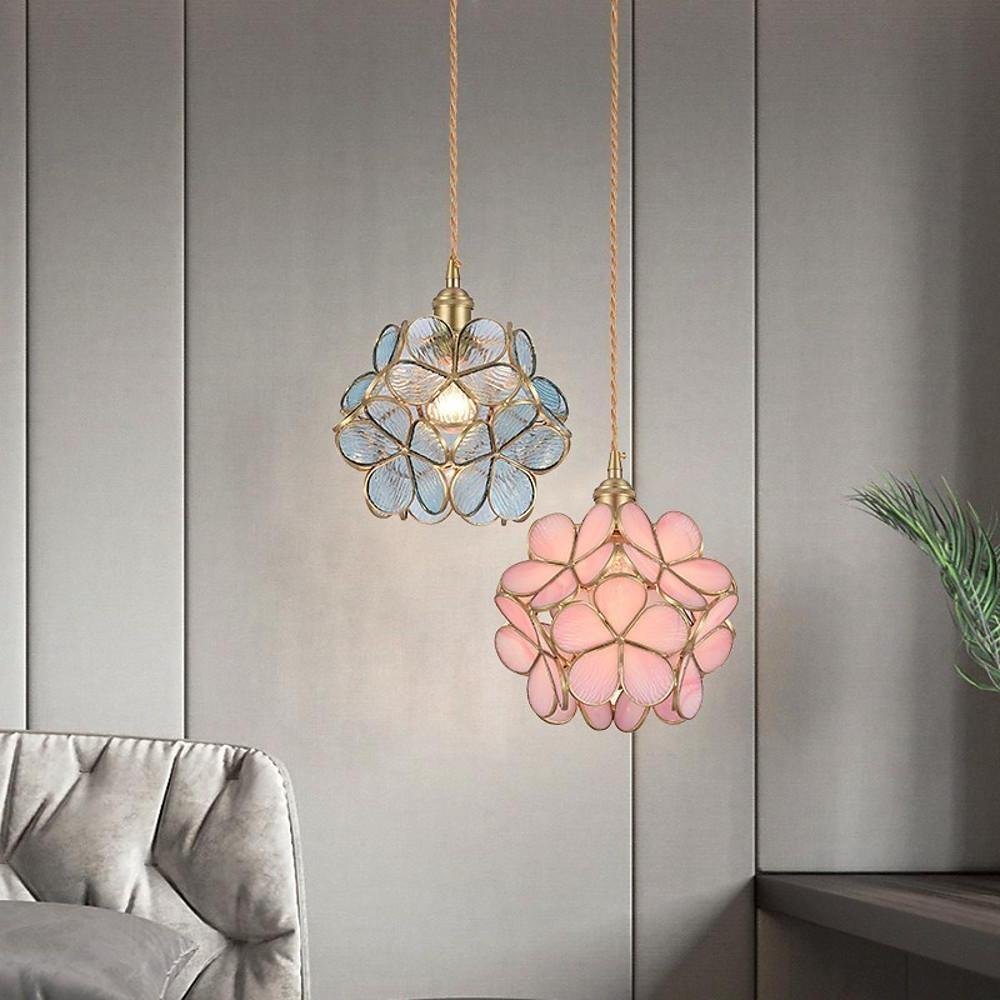
The copper glass pendant light is a single-socket fixture with a brass-finished copper body and an artistic flower-shaped glass shade, wired for one E26 or E27 LED bulb at 110–120V. It ships without a bulb on purpose: the shade is glass, so the bulb you choose decides whether the room reads warm and amber or clean and bright. Hung over an island or a dining table, it is a decorative layer that looks handmade rather than mass-produced.
Below: what the fixture is made of, which bulb to buy, how many you need over an island, the hanging heights that work, and the one spec you should confirm before ordering.
Copper body, brass finish, glass flower shade
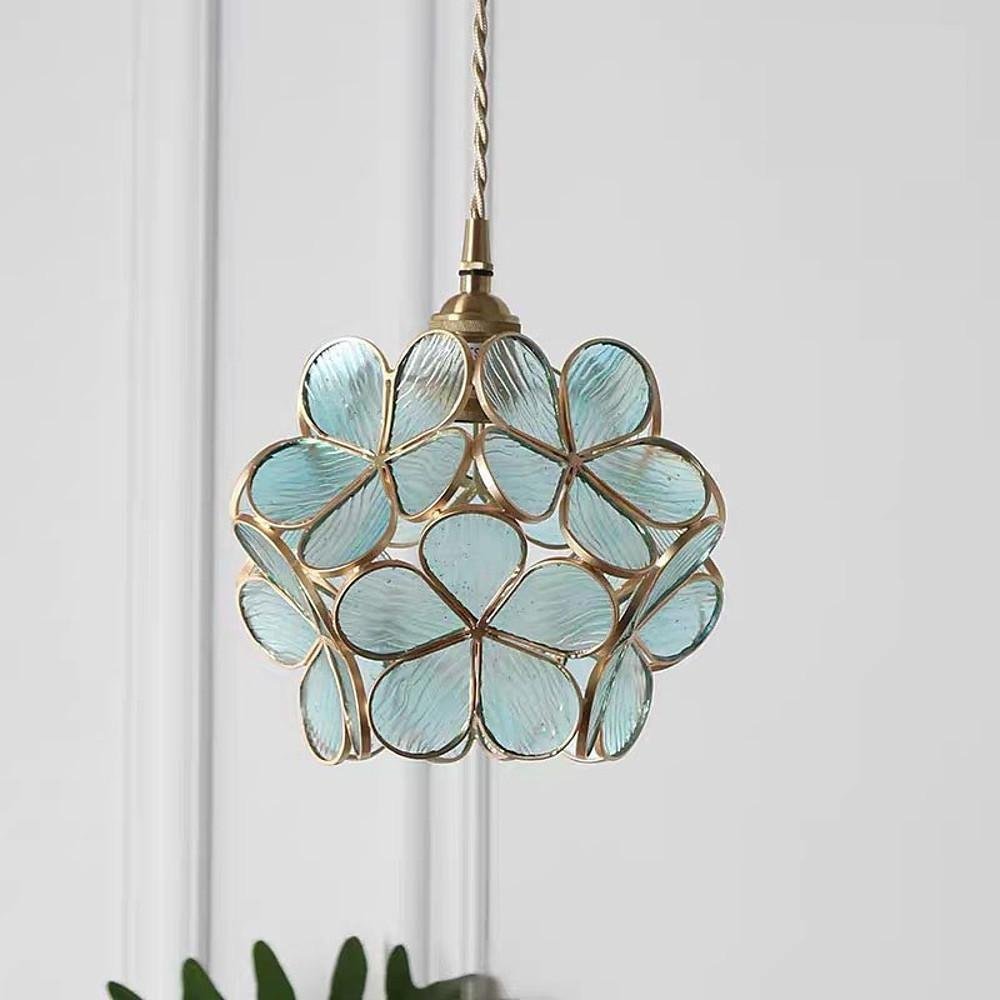
The build is a hybrid of two materials that age differently, and that is the appeal. The primary fixture material is copper with a brass finish, so the metal warms over the years rather than going flat. The shade is glass, shaped into a flower form that pushes the light outward in petals instead of straight down.
Practically, that means two things. First, the light is ambient rather than task — the listing describes it as ambient light covering roughly 0 to 54 square feet (0 to 5.02 square metres) per fixture, which is the scale of a dining nook or one side of a kitchen island, not an open-plan living room. Second, a glass shade shows dust, so plan on wiping the inside of the petals occasionally; a microfiber cloth and a dry brush reach the curves without scratching.
Choosing the bulb (this is where the look is decided)
The fixture takes one LED bulb with an E26 base (US/Canada) or E27 (elsewhere), and the bulb is not included. Three decisions matter:
- Colour temperature. 2700K–3000K over a dining table or island keeps food and skin tones looking right and pairs naturally with aged brass. 3500K–4000K is the better call in a butler’s pantry or a workspace where you actually need to see.
- Shape. A standard A19 is the safe choice. A globe or a vintage-style filament bulb leans into the retro-industrial character of the flower shade — and because the shade is open, the bulb itself is visible, so it becomes part of the design.
- Dimmability. The fixture has no stated dimming hardware of its own; dimming is a property of the bulb plus the wall switch. Use a dimmable LED and a compatible LED-rated dimmer if you want to take the light down for evening.
One honest caveat: the manufacturer’s spec sheet for this fixture does not list a maximum wattage. Modern LED A19s run 4–9W, which is comfortably in the normal range for a decorative socket, but if you intend to fit anything unusual, check the fixture details and confirm the limit with the seller before you buy.
How many over an island or a dining table
A useful planning rule is one pendant per 2 feet of island length, with a minimum of two on any island longer than 4 feet. Because each fixture is specified for roughly 54 square feet of ambient coverage, an island run of two or three takes care of the room’s decorative layer; you still want recessed or under-cabinet lighting for the work surface itself.
| Space | Typical count | Spacing between fixtures |
|---|---|---|
| Kitchen island, 6–8 ft | 2–3 | 24–30 in (61–76 cm) apart |
| Dining table, 4–6 seats | 2–3 in a row | 24–30 in on centre |
| Breakfast nook / bistro table | 1 | — |
| Entry or hallway | 1 as an accent | — |
Hanging heights that look intentional
Set the bottom of the shade 30 to 36 inches (76–91 cm) above a countertop or tabletop. Go to the lower end for a dining table where people are seated and the pendant is the mood; go to the higher end over an island where people stand, prep and lean.
In a hallway or entry, keep a minimum of 6 ft 8 in (203 cm) of clearance under the fixture, and on an 8 ft ceiling that usually means a 12 to 18 inch drop. The pendant uses adjustable wires, so the height is set at install rather than bought — measure from the finished floor up, not from the ceiling down, and you will get it right the first attempt.
The maker also states the fixture suits sloped ceilings provided the mounting hardware is compatible, which matters in attic conversions and vaulted kitchens: check the canopy against your ceiling pitch before the electrician arrives.
The one spec to confirm before ordering
The published specification for this fixture covers materials, bulb base, voltage and coverage, but it does not list the shade diameter or overall height. If you are fitting pendants into a narrow island run, or hanging two where the shades must not touch, ask the seller for the shade diameter first. It is a two-minute question that prevents a return.
Everything else on the sheet is concrete: one light, LED, E26/E27 base, bulb not included, 110–120V, copper fixture with glass shade in a brass finish, and compliance stated as UL, ETL, CE, RoHS and FCC.
Transparent, blue or pink glass
The shade comes in three glass colours, and they behave very differently once lit:
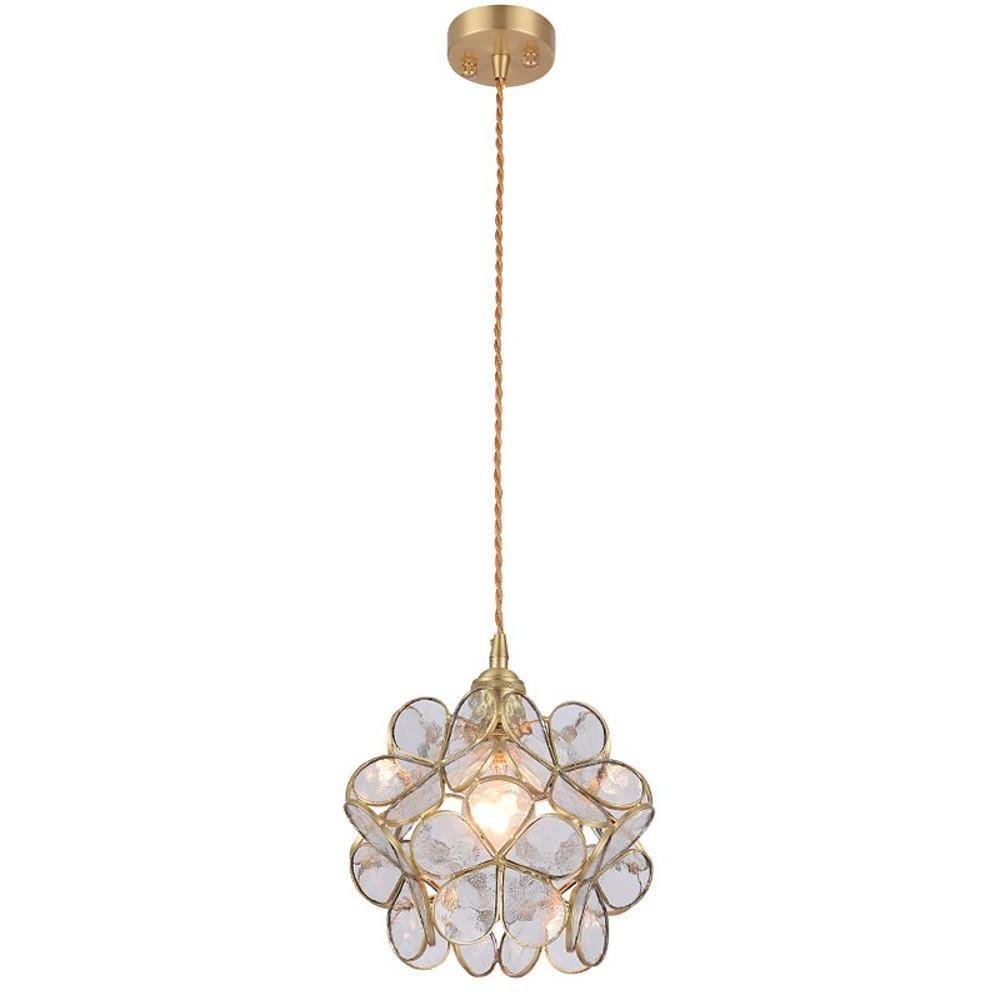
- Transparent is the most versatile. It lets the bulb read clearly, which suits filament bulbs, and it disappears against most wall colours.
- Blue cools the whole fixture. Best used as a single accent in a white or pale kitchen, where the colour is the point.
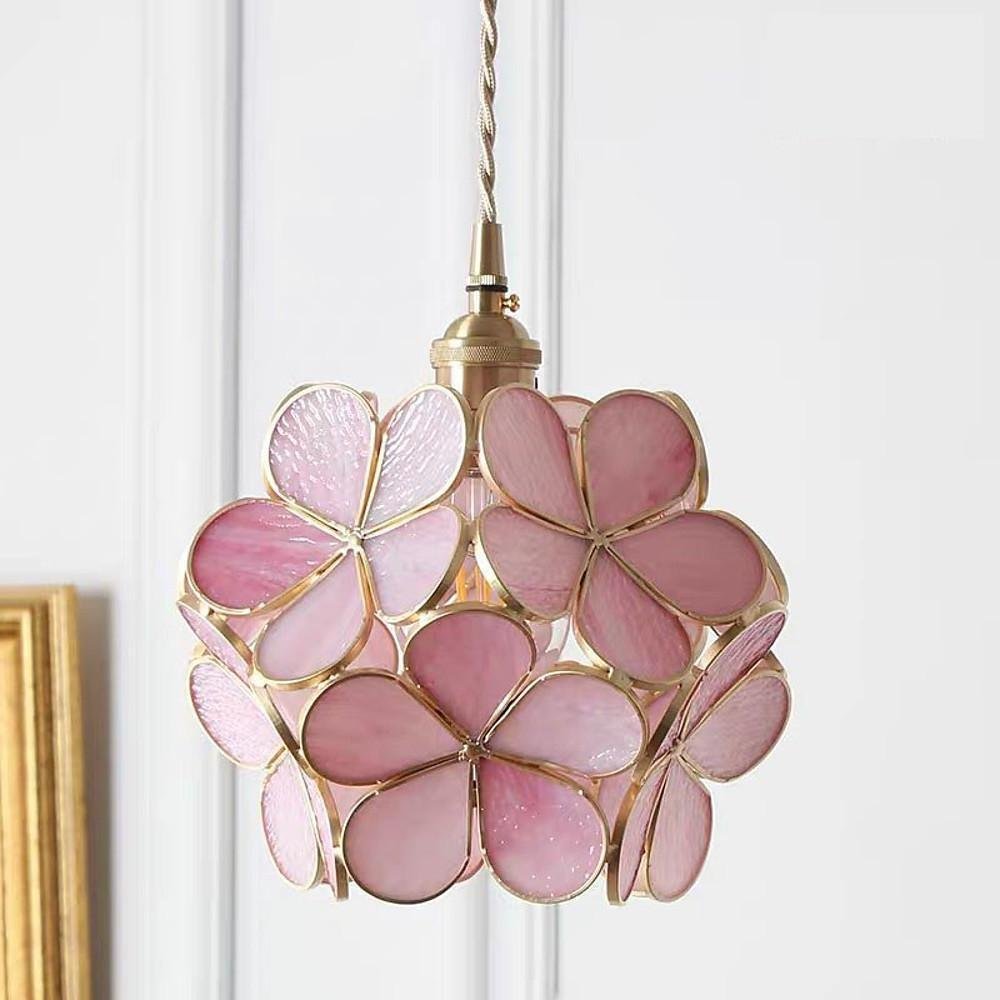
- Pink warms a room a second time on top of a 2700K bulb. Lovely over a small dining table or in a bedroom corner; harder to pair with strong wall colours.
If you are hanging three in a row, keep one colour across the run. Mixed colours over a single island tend to read as a mistake rather than a choice.
Where it fits — and where it doesn’t
| Works well | Think twice |
|---|---|
| Kitchen island and peninsula runs | Very low ceilings under 8 ft (the drop crowds headroom) |
| Dining tables and breakfast nooks | Large open-plan rooms as the only light source |
| Farmhouse, industrial and Nordic interiors | Ultra-minimal rooms where the flower form is too busy |
| Bedrooms and reading corners as an accent | Bathrooms and damp or outdoor locations |
Installation notes
- Cut the circuit at the breaker and test at the ceiling box before touching wires.
- Confirm the box is rated for a hanging fixture and mounted to structure — glass shades are heavier than they look and you do not want the weight on drywall alone.
- Set the drop before final assembly. Adjust the wires, hang, and check the height from the countertop with the shade fitted.
- Fit the bulb last, then power up and check the light pattern across the counter. If the pool lands behind you rather than on the work surface, the fixture is hung too far back — move the box or add a second pendant.
- Check the supply. The fixture is rated 110–120V, which matches North American residential circuits; confirm before installation in any other market.
Frequently asked questions
Does the bulb come with it?
No. The fixture is compatible with LED bulbs on an E26 or E27 base, and the bulb is deliberately excluded so you can pick the brightness and colour temperature for the room.
Can it go on a sloped or vaulted ceiling?
The maker states it is suitable for most ceiling types including sloped ceilings, provided the mounting hardware is compatible with your pitch. Verify the canopy against your ceiling angle before booking an electrician.
Is it dimmable?
The fixture itself has no dimming electronics; dimming depends on using a dimmable LED bulb with a compatible dimmer switch. A non-dimmable bulb on a dimmer will flicker or drop out.
How much area does one pendant light?
The listed illumination area is about 0 to 54 square feet (0 to 5.02 square metres) per fixture of ambient light — enough to define a dining nook or one island run, not to light an entire open-plan room on its own.
What is the shade size?
The published spec does not list the shade diameter or total height. If exact dimensions matter for your layout, request them from the seller before ordering — that is the only gap in an otherwise complete spec sheet.
Bottom line
This is a fixture you buy for character, then light deliberately. Brass-finished copper plus a glass flower shade gives a warm, slightly retro-industrial look that suits kitchen islands and dining tables; a 2700K dimmable LED filament bulb finishes the job. Confirm the shade diameter if your space is tight, plan two or three across a long island, and hang them 30 to 36 inches above the surface.