
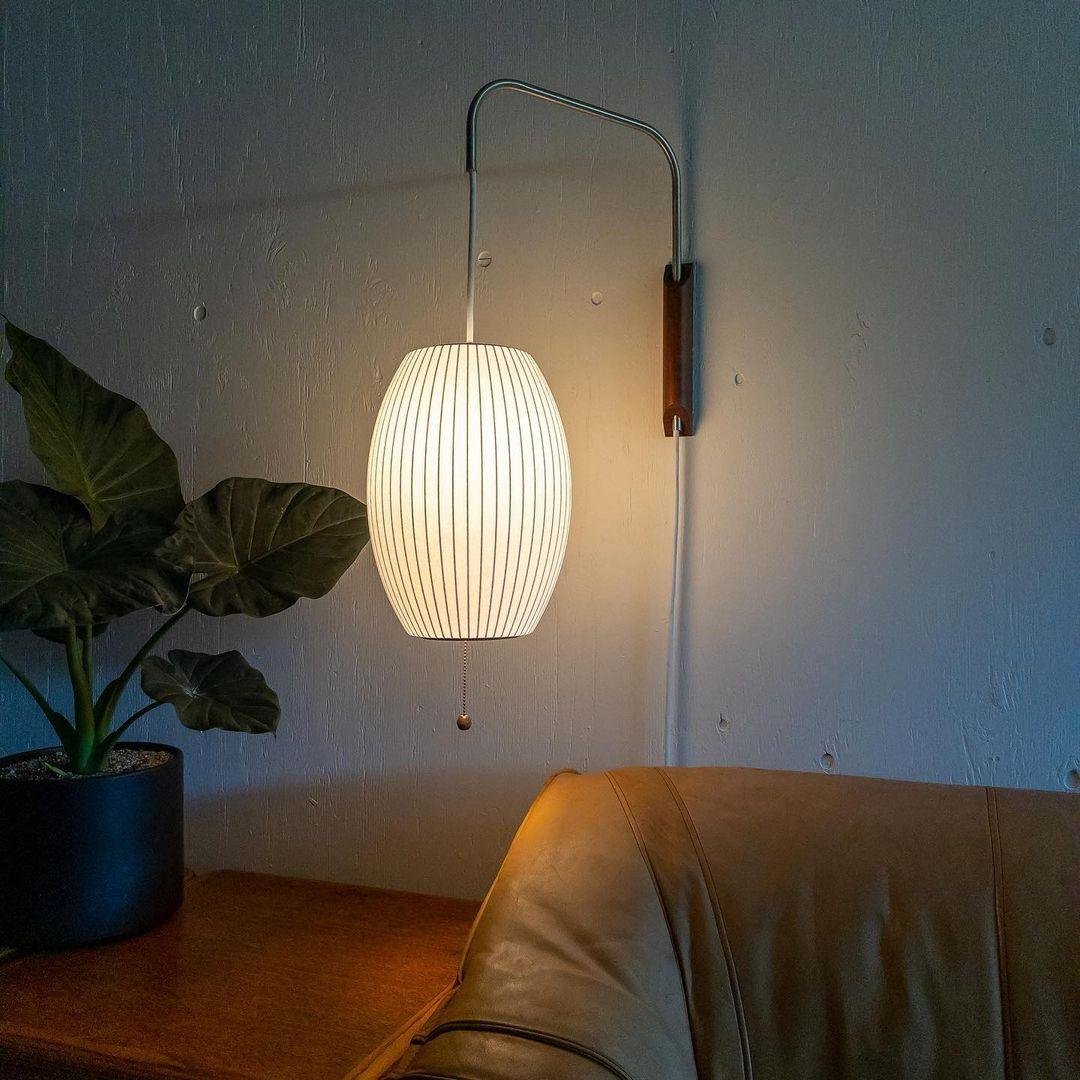
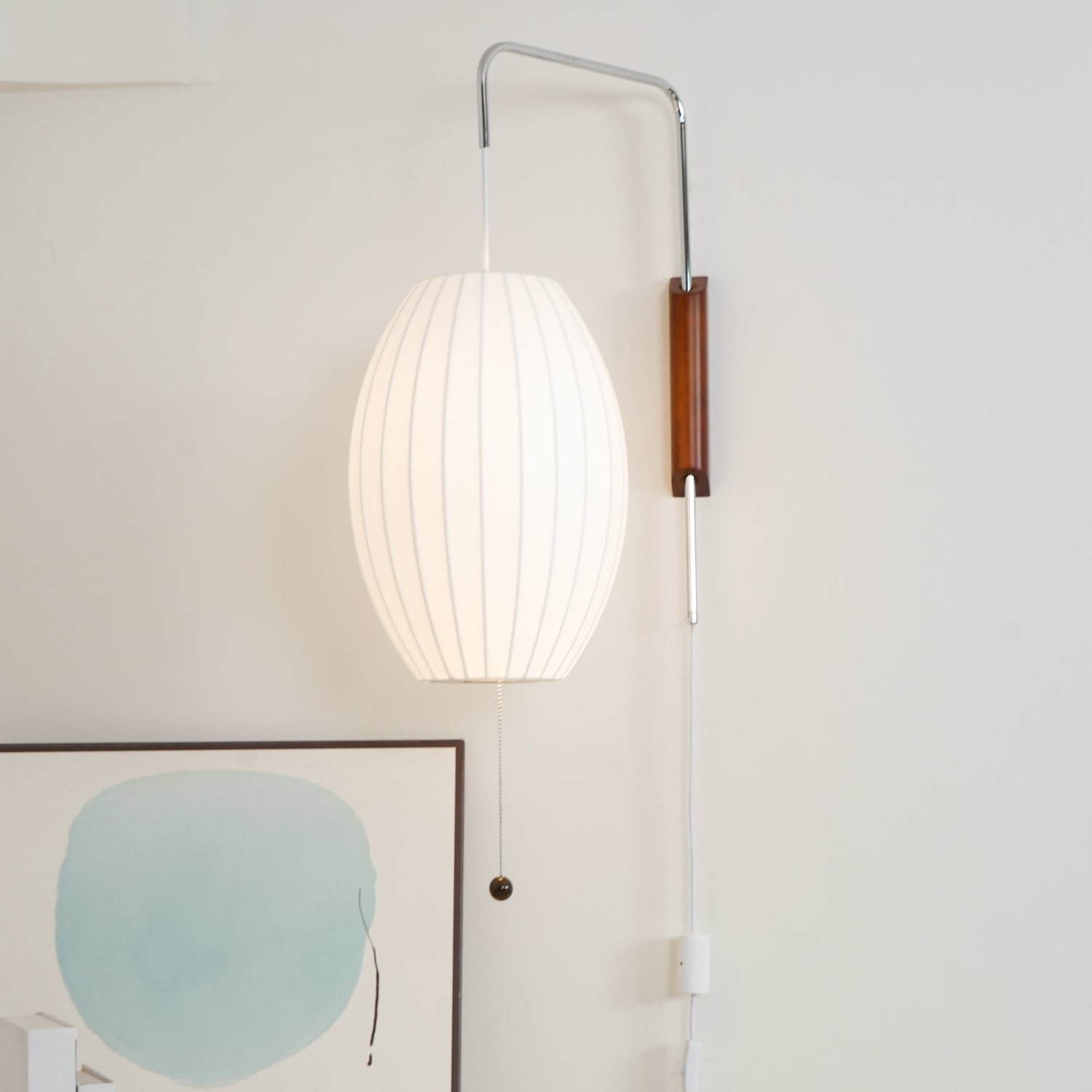
The Bubble Ball Wall Sconce solves a very specific problem: you want a real wall light on a wall that has no junction box. It runs on a plug-in cord, so it goes up with two anchors and an outlet, and its swivel hinge lets you rotate the spherical shade to throw light up, down or across the room. No electrician, no drywall surgery, no rewiring permit. If you are renting, staging a room, or simply not ready to open a wall, this is the fixture category that makes the project a Saturday afternoon instead of a contractor visit.
Why a plug-in swivel sconce earns its place
Hardwired sconces are permanent and beautiful, and they are also the reason so many bedrooms end up with a single overhead light and a lot of shadows. A plug-in fixture removes the wiring barrier entirely. That changes what is possible in three situations:
- Rentals and apartments. Nothing is cut into the wall beyond anchor holes you can patch with spackle.
- Bedrooms without overhead fixtures. Older homes often have switched outlets instead of ceiling lights. A plug-in sconce turns that outlet into proper layered lighting.
- Placement flexibility. The swivel hinge means the same fixture can wash a wall, light a reading position, or graze a piece of art depending on how you rotate it.
The trade-off is honest and worth stating up front: you are trading a hidden cord for installation freedom. A cord cover or a carefully routed cord along a baseboard handles most of that, and the payoff is lighting where a hardwired fixture was never going to be installed.
Design, materials and finish
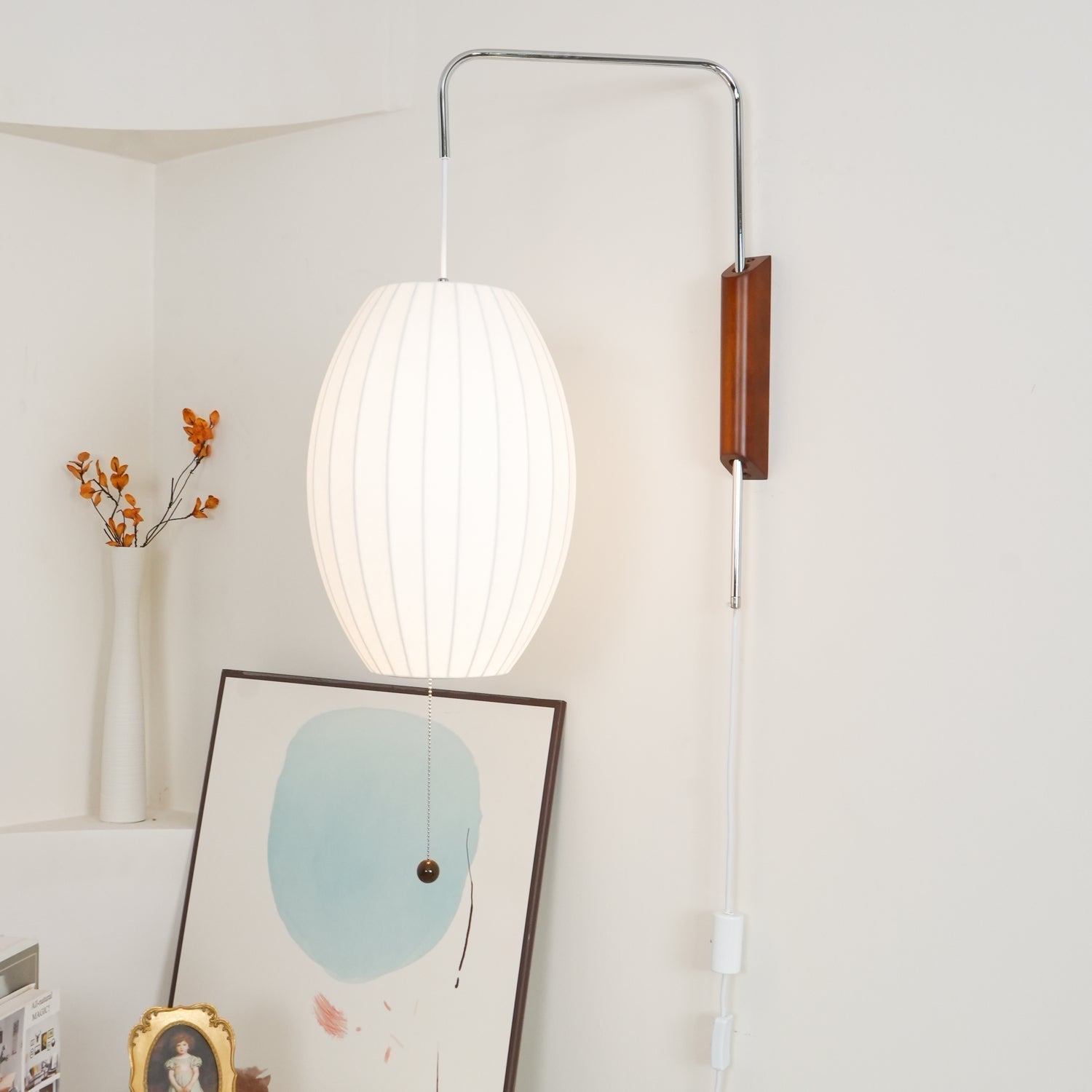
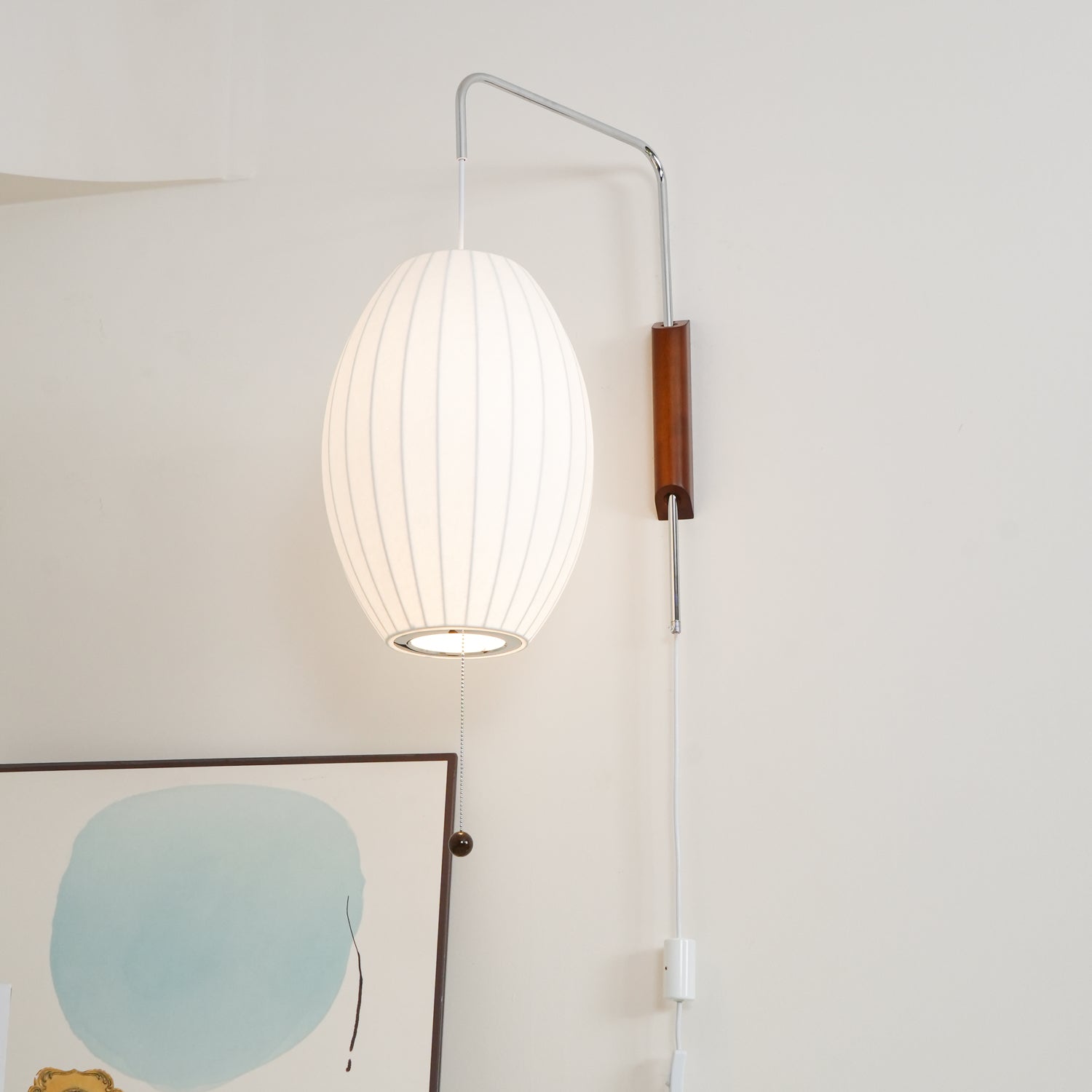
The silhouette is a clean sphere on a wall plate. Body finishes are chrome and walnut, with a white shade. The material build is polymer, steel, walnut and metal — steel and metal for structure, walnut for warmth against the cool chrome, polymer in the shade. That mix is why the fixture reads modern-architectural rather than purely industrial: the wood softens what would otherwise be a hard metallic ball.
Four geometric profiles are offered, and they are not cosmetic variations. The proportions differ enough to change the fixture’s role in a room. A tall, narrow globe reads as a vertical accent beside a doorway. A wide, shallow profile becomes almost a wall-mounted disc that throws light outward. Choosing between them is a composition decision as much as a sizing one.
Which size to choose
All four sizes share the same construction, bulb base and voltage. What changes is diameter, height and therefore visual weight.
| Size | Diameter | Height | Best used for |
|---|---|---|---|
| A | 28 cm / 11 in | 40 cm / 15.7 in | Narrow walls, bedside, tight hallway runs |
| B | 30 cm / 11.8 in | 30 cm / 11.8 in | Even, balanced pairing on either side of a bed |
| C | 30 cm / 11.8 in | 28 cm / 11 in | Slightly lower profile, good under artwork |
| D | 40 cm / 15.7 in | 22 cm / 8.6 in | Statement wall, large rooms, wide shallow wash |
Practical rule: the fixture diameter should stay under roughly one third of the wall width it sits on, or the sconce starts to feel like it is crowding the wall. On a standard eight-foot wall, Size D at 15.7 inches wide is a deliberate statement — appropriate in a primary bedroom, heavy in a narrow corridor.
Mounting height and spacing that actually look right
There is no single correct height, but there are starting points that consistently work:
- Bedside: roughly 48 to 60 inches from the floor to the center of the shade, or about 20 to 24 inches above the mattress top. The goal is that the shade sits slightly above eye level when you are propped up reading.
- Hallway: center the fixture around 60 to 66 inches from the floor. Higher than that and the light stops being useful; lower and it becomes an obstacle in a narrow run.
- Spacing: in a hallway, 6 to 10 feet between fixtures reads as an even rhythm. Pairing on either side of a bed, keep 4 to 6 inches of clearance from the mattress edge so the swivel has room to rotate.
Because the hinge allows rotation, the shade does not have to be aimed straight out. Rotating it upward produces an indirect wash that is far gentler at night than a direct beam — this is the single most useful thing about the design in a bedroom.
Bulbs and light quality
The fixture takes LED or Edison-style bulbs on an E26 or E27 base and works on AC 110-240V, so it is not region-locked. Two practical notes:
- Base and voltage: E26 is the North American base, E27 the European and most 220-240V markets. Confirm your bulb’s base matches your region before ordering.
- Bulb length: the shade is a closed sphere, so a shorter bulb seats better than an oversized decorative globe. If a bulb protrudes past the opening, it will be visible and will change the look.
- Color temperature: 2700K for warm, residential bedroom light; 3000K if you want a slightly cleaner, more modern feel in a hallway or home office.
- Output: for bedside reading, something in the 400-600 lumen range is usually comfortable; hallways and larger rooms benefit from 600-800 lumens.
One important limitation: the fixture is not designed for dimming. It uses an inline on/off push button and a pull cord switch, both standard on/off controls. If you want a softer level at night, the reliable approach is a lower-lumen bulb rather than a dimmer.
Where it should not go
The rating is IP 20, indoor use only and not waterproof. That rules out bathrooms in the shower zone, covered porches, and anywhere moisture or direct spray is possible. In a powder room away from the sink it is fine by rating, but in a full bath with a tub or shower, choose a fixture rated for damp or wet locations instead. Similarly, do not mount it where the cord would cross a walkway or run near a heat source.
Set of two, or one at a time
A Set of 2 option is available and ships as two individual fixtures packaged together. Symmetry is the reason most people choose it: a matched pair flanking a bed, a console or a pair of framed prints reads as intentional in a way a single sconce rarely does. Buying a single first is reasonable if you want to test the scale on a wall before committing to the second.
Frequently asked questions
Do I need an electrician to install it?
No. The fixture is wall-mounted with a plug-in cord, so it connects to a standard outlet rather than being hardwired into a junction box.
Can it be used in a bathroom?
It carries an IP 20 rating, which is indoor use only and not waterproof. Bathrooms in the shower or tub zone call for a damp- or wet-rated fixture instead.
Is it dimmable?
No. The fixture is not designed for dimming. It has an inline on/off push button and a pull cord switch for standard operation.
What bulb should I use?
Any LED or Edison-style bulb on an E26 or E27 base. For bedrooms, 2700K in the 400-600 lumen range is a comfortable starting point; hallways often suit 600-800 lumens.
Can I order custom dimensions?
MiniHouzz offers design consultation on lighting layout and custom requirements — contact their support team to discuss specifics before ordering.
The short version
If the wall you want to light has no wiring, this is the fixture that stops that from being a problem. Choose Size A or B for bedrooms and narrow runs, Size D when the wall can carry a statement. Mount bedside shades around 48-60 inches to center, rotate the swivel upward for evening indirect light, and fit a 2700K bulb in the 400-600 lumen range. Skip it for wet zones and skip the dimmer — it is an on/off fixture, and it is a very good one at that.
Shop the Bubble Ball Wall Sconce with Swivel Hinge & Plug-In Cord →