
If you are shopping for a long, low-profile fixture over a dining table, the short answer is: hang a linear chandelier so the bottom of the shade sits roughly 30 to 36 inches above the tabletop, and choose a fixture length around half to two-thirds of the table length. The Modern Brass Spanish Alabaster Linear Chandelier does that job with a specific character — real stone instead of glass, brass instead of painted steel, and an integrated LED source so there are no bulbs to re-spec later.
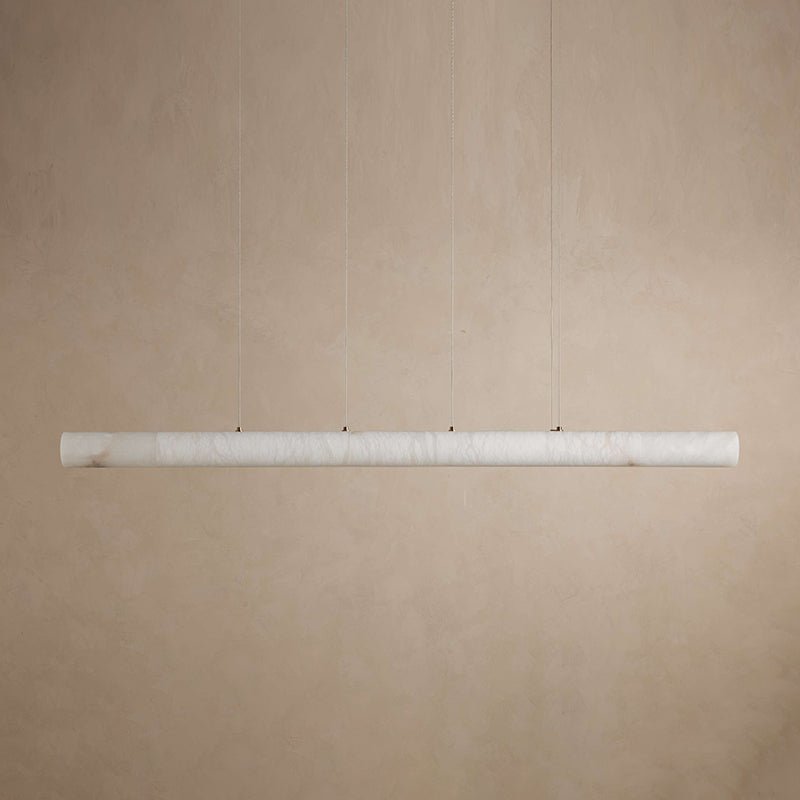
It comes in two lengths (64″ and 74″), hangs from minimalist cables with 59″ of wire, and is built from genuine Spanish alabaster with brass hardware. Below is what matters before you order: how the material behaves, how to size and position it, what the specs actually say, and where it loses to cheaper alternatives.
The short answer, if you are in a hurry
- Hanging height: 30–36″ from tabletop to the bottom of the fixture. Higher ceilings do not change this; the relationship to the table is what matters.
- Length: aim for a fixture 50–65% of the table length. The 64″ size suits tables from about 8 ft; the 74″ size suits 9–10 ft tables.
- Clearance: keep at least 36″ of open table between the ends of the fixture and the seats, so nobody is staring at a brass canopy.
- Light: integrated LED in warm white — a low-glare, diffused wash rather than a bright downlight.
- Expect variation: alabaster veining differs piece to piece. That is the point of the material, and it is also why no two units are identical.
Why alabaster reads as luxury and glass does not
Glass shades throw light. Alabaster passes it. Spanish alabaster is a dense, slightly translucent stone, and when an LED sits behind it the light diffuses through the mineral rather than refracting off a surface. The practical result is a soft, even glow with visible veining inside the shade — clouds and hairline streaks that only appear when the fixture is on.
That difference matters in a dining room, where you want people to look good rather than be lit like a showroom display. A glass chandelier puts a bright point source in the middle of the table and hard shadows on faces. A stone diffuser spreads the source across the whole length of the shade, so the light arrives from a large, low-intensity area.
The brass is doing the second half of the work. Polished brass reads warm against white stone, and over years it develops the slight patina that plated finishes never do. It also echoes cabinet hardware, faucets, and door levers in a way that black metal cannot in a warm-toned room.
Sizing: picking between the 64″ and 74″ lengths
The fixture is only 3.9″ tall, which is deliberate — a linear chandelier this shallow stays out of the sightline across the table. The variable is length. Use this as a starting point, then adjust for how much of the table you want covered:
| Fixture size | Overall dimensions | Table length it suits | Seats it usually serves |
|---|---|---|---|
| 64″ (162.5 cm) | L 162.5 cm × H 10 cm (64″ × 3.9″) | About 8 ft / 96″ | 6–8 |
| 74″ (188 cm) | L 188 cm × H 10 cm (74″ × 3.9″) | 9–10 ft / 108–120″ | 8–10 |
Both sizes, along with the current price and finish options, are listed on the Modern Brass Spanish Alabaster Linear Chandelier product page.
Two conditions change the recommendation. If your table is round or oval, a single linear fixture fights the shape — shorten to the 64″ and center it on the long axis, or use two smaller pendants instead. If the room is open-plan and the fixture also has to read from a living area 15 ft away, go one size up; a linear piece that looks generous over the table looks thin from across the room.
Height of the room is the other constraint. The fixture hangs from cables with 59″ of wire, so on a standard 8 ft ceiling you will be trimming cable rather than stretching it. On a 10–12 ft ceiling, 59″ is still enough to reach a comfortable hanging height above a 30″ table, but double-check the drop before ordering if your ceiling is vaulted and the canopy mounts high.
Hanging height and placement, in practice
The 30–36″ rule is a range because the right number depends on sightlines. Sit at the table, look across it: the bottom edge of the shade should sit just below eye level for a seated adult. That usually lands at 32–34″, and it keeps the light out of your guests’ eyes while still throwing a pool of light on the plates.
- Standard dining table (30″ high): bottom of fixture at 60–66″ from the floor.
- Counter-height table or island (36″ high): bottom of fixture at 66–72″ from the floor.
- Bar-height surface (42″ high): bottom of fixture at 72–78″ from the floor.
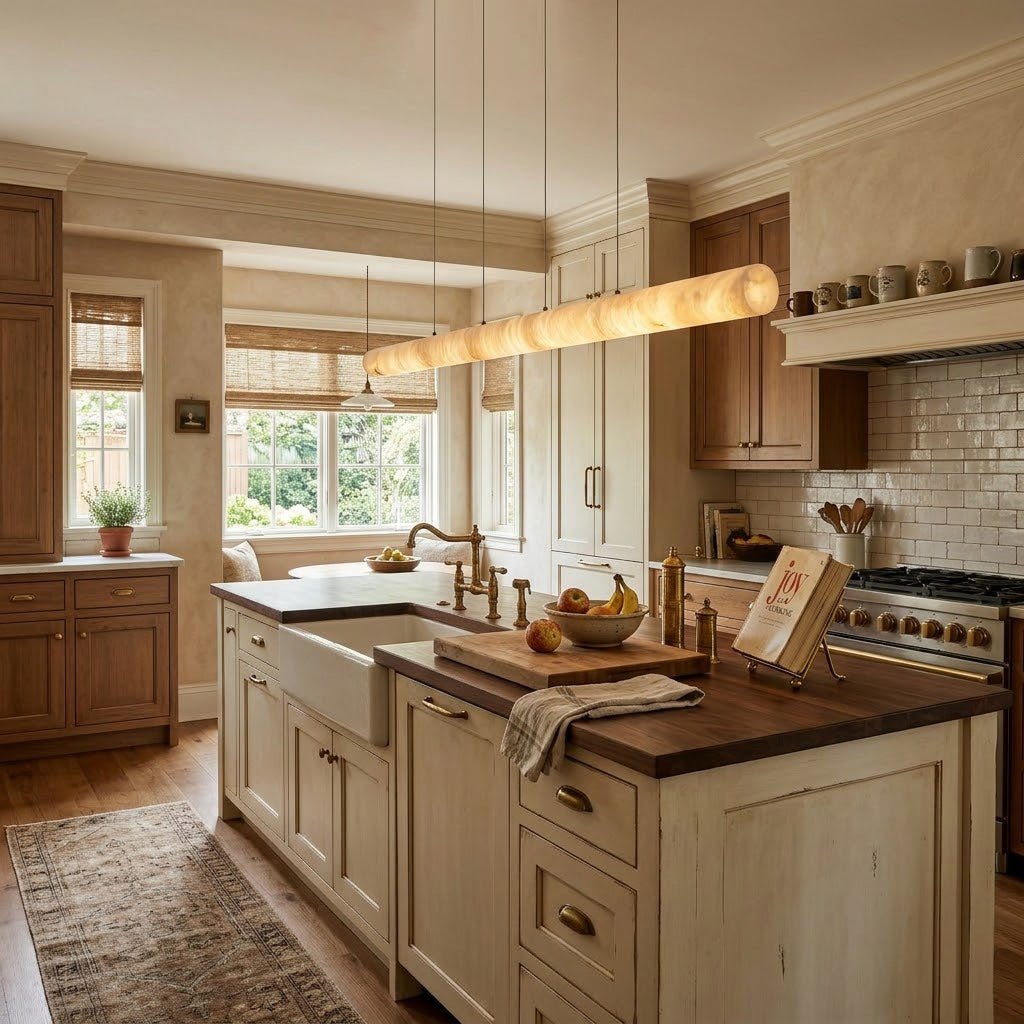
- Over a kitchen island: center the fixture on the island, not on the room; keep the ends at least 12–18″ in from the island edge.
- Sloped or beamed ceilings: mount the canopy at the ridge or parallel to the beam, and level the shade — the cables adjust independently, so a level shade is achievable even under a slope.
Horizontal placement is simpler than people make it. Center the fixture on the table, then verify it against the room: the fixture should sit on the room’s centerline when the table is centered, and it should follow the table when the table is not. If the room has a fireplace or a window wall as a focal point, align the fixture to the table and let the architecture be asymmetric.
Specifications as listed
| Product type | Linear alabaster chandelier |
|---|---|
| Materials | Spanish alabaster, brass |
| Finish | Brass hardware, white alabaster shade |
| Dimensions | L 162.5 cm × H 10 cm (64″ × 3.9″) or L 188 cm × H 10 cm (74″ × 3.9″) |
| Suspension | Minimalist cables, 59″ hanging wire, height adjustable at installation |
| Light source | Integrated LED, warm white by default |
| Installation | Suspended from cable; hardwired |
| Certification | UL, ETL, CE, RoHS, FCC |
Two notes on reading that table honestly. First, the LED is integrated, not replaceable with a standard bulb — that is what allows a 3.9″ profile, and it also means the light engine is a lifetime component rather than a consumable. Second, “warm white” is the factory default; if you are matching an existing 2700K or 3000K scheme, confirm the exact color temperature and dimming compatibility with the team before the order ships, because those details are easier to settle up front than after installation.
What warm white actually does in a dining room
Warm white integrated LED typically lands in the 2700–3000K range, which is the band that flatters wood, brass, and skin tones. In a dining room, that is the difference between a room that feels like a restaurant and a room that feels like an office.
Because the stone diffuses the source across the full length of the shade, you get an even band of light rather than hot spots. Practically, that means you can hang it lower than a glass fixture without glare — which is exactly what you want over a table, since light from directly above flattens faces while light from a large diffused area wraps them.
Layer it rather than crank it. A linear chandelier over the table, plus a floor lamp or two wall sconces at the perimeter, gives you a room that can go from homework-bright to dinner-dim without touching a dimmer. If you do want scene control, the wall switch is the place to solve it — plan for a dimmer-compatible circuit during rough-in and confirm the fixture’s driver compatibility before purchase.

Alabaster vs glass vs fabric: an honest comparison
| Alabaster (this fixture) | Glass shade | Fabric / linen shade | |
|---|---|---|---|
| Light character | Diffused, soft, even along the length | Bright, directional, visible bulb or LED | Warm and very diffuse, low output |
| Look when off | Solid stone with visible veining; reads as sculpture | Transparent; disappears or shows hardware | Soft volume; can look dated if poorly shaped |
| Cleaning | Dust with dry cloth; keep liquids off the stone | Glass cleaner, fingerprints show | Vacuum brush; stains are permanent |
| Variation between units | High — natural veining, each piece unique | Low | Low |
| Best for | Dining rooms and open-plan spaces where the fixture is part of the architecture | Kitchens, industrial and modern-farmhouse looks | Bedrooms and casual dining where cost matters |
The trade-off is straightforward. You pay for stone and brass, and you accept that your chandelier will not look exactly like the photograph. In exchange you get a fixture that behaves like a permanent architectural element rather than a decorative accessory — and one that is much harder to date, because veined stone and brass have been in dining rooms for centuries.

Installation and care
Plan for two people and a licensed electrician. The fixture is long and the shade is stone, so it should be supported while the canopy is fixed and the cables are leveled — do not hang it from one side and adjust later. Set the cable length before the shade goes up: measure from the ceiling to your target hanging height, cut or coil the excess wire inside the canopy, then hang and level.
Full dimensions and the two size options are on the product page if you want to measure the table before ordering.
Alabaster is a soft mineral. Dust it with a dry microfiber cloth, and if something does land on the shade, wipe with a barely damp cloth and dry immediately. Skip ammonia and abrasive cleaners entirely, and keep water from pooling at the seams. Brass hardware can be left to patina or polished with a soft cloth — the finish is meant to age, not to stay factory-bright forever.
Frequently asked questions
How high should this chandelier hang above a dining table?
30 to 36 inches from the tabletop to the bottom of the shade, which puts the fixture at 60–66 inches from the floor over a standard 30-inch table. Go to the lower end of that range in rooms with standard 8-foot ceilings, and to the higher end if your guests are tall or the table is used for standing conversation.
Is the LED replaceable?
No. The LED is integrated into the fixture — that is what allows the shallow 3.9-inch profile and the even wash through the stone. It is designed as a long-life component rather than a bulb you swap out.
Will my chandelier match the photos exactly?
No, and it should not. Spanish alabaster is a natural stone, so veining, density, and color vary from piece to piece. Your fixture will be a one-off; the overall look — white stone, brass hardware, warm diffused light — is consistent.
Can I hang it over a kitchen island instead of a dining table?
Yes, with adjusted numbers: 30–36 inches above the countertop, centered on the island, with 12–18 inches of clearance from each end. The 64-inch size fits islands roughly 7–8 feet long; the 74-inch size wants a longer run.
What ceiling height does it need?
It works on a standard 8-foot ceiling because the fixture itself is only 3.9 inches tall and the cables trim to length. On very high or vaulted ceilings, confirm the 59-inch hanging wire gives you the drop you need before ordering.
Who this fixture is for
Buy it if the light fixture is part of your design intent — if you have a long table, a warm palette, and you want the room to feel finished when the fixture is off. Skip it if you need dimmable scene control out of the box, or if you want a fixture that looks identical to a catalog photo. Stone does not work that way.
Sizes run 64″ and 74″, brass hardware with white alabaster shades, integrated warm-white LED, and it is listed as certified to UL, ETL, CE, RoHS, and FCC. See the current price and dimensions on the product page — and if you are specifying for a project, ask about trade pricing before you order.