
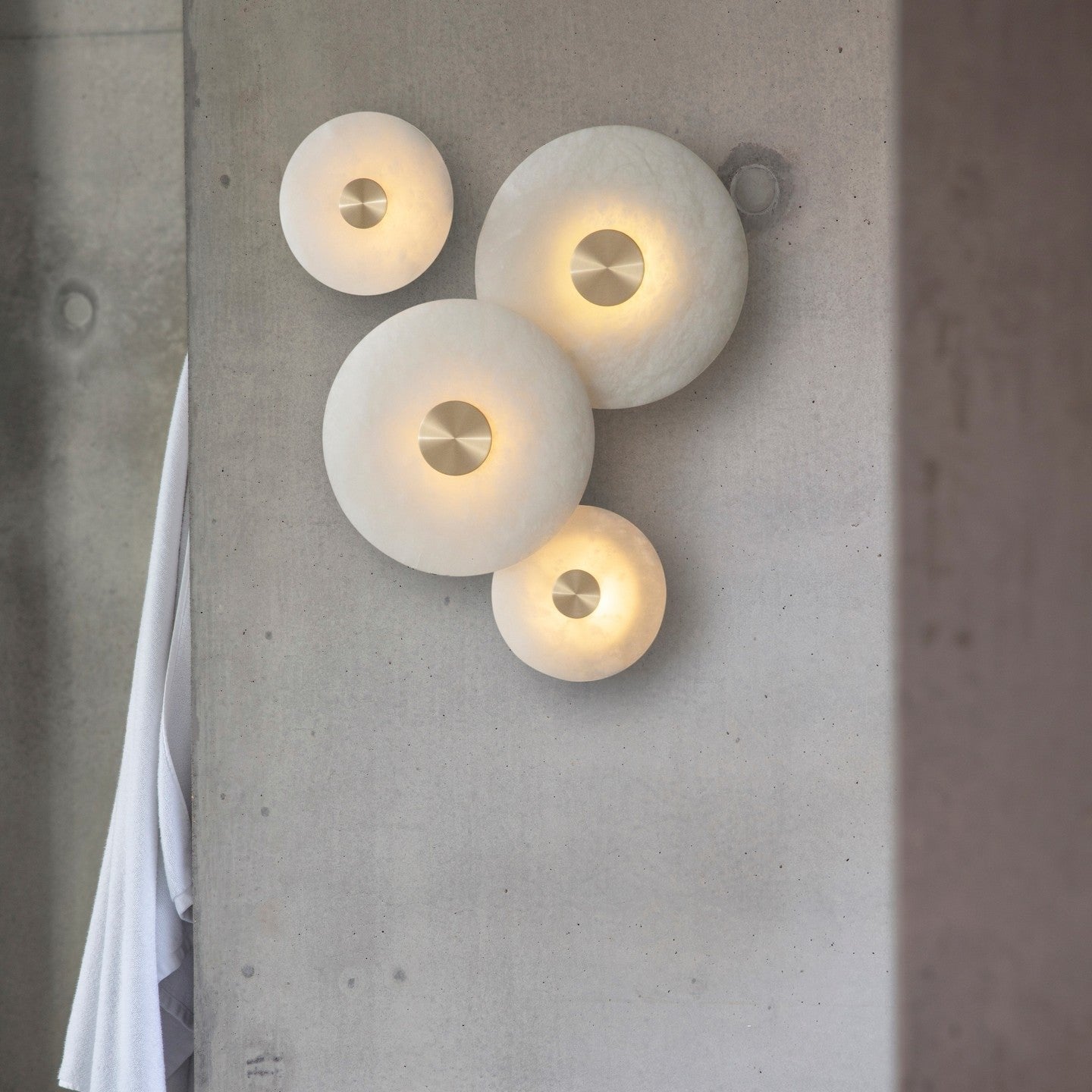
An alabaster wall sconce works because of one property no glass or acrylic shade can copy: alabaster is translucent stone. Light does not pass straight through it — it diffuses through the mineral structure, so the shade glows from the inside and reads as a lit object rather than a lamp with a bulb behind it. The disc alabaster wall sconce with brass finish takes that effect and reduces it to a single clean round form, 2.8 inches deep, in four diameters from 7.9 to 13.8 inches.
If you are deciding whether this type of fixture belongs in your room, the short answer is: yes for bedrooms, hallways, stairwells, dining rooms, and hotel-style bathrooms with good ventilation — and no for showers, covered porches, or anywhere it will take direct water. The rest of this guide covers the material logic, sizes, mounting heights, and light temperature choices so you can specify it confidently.
Design and materials: what you are actually buying
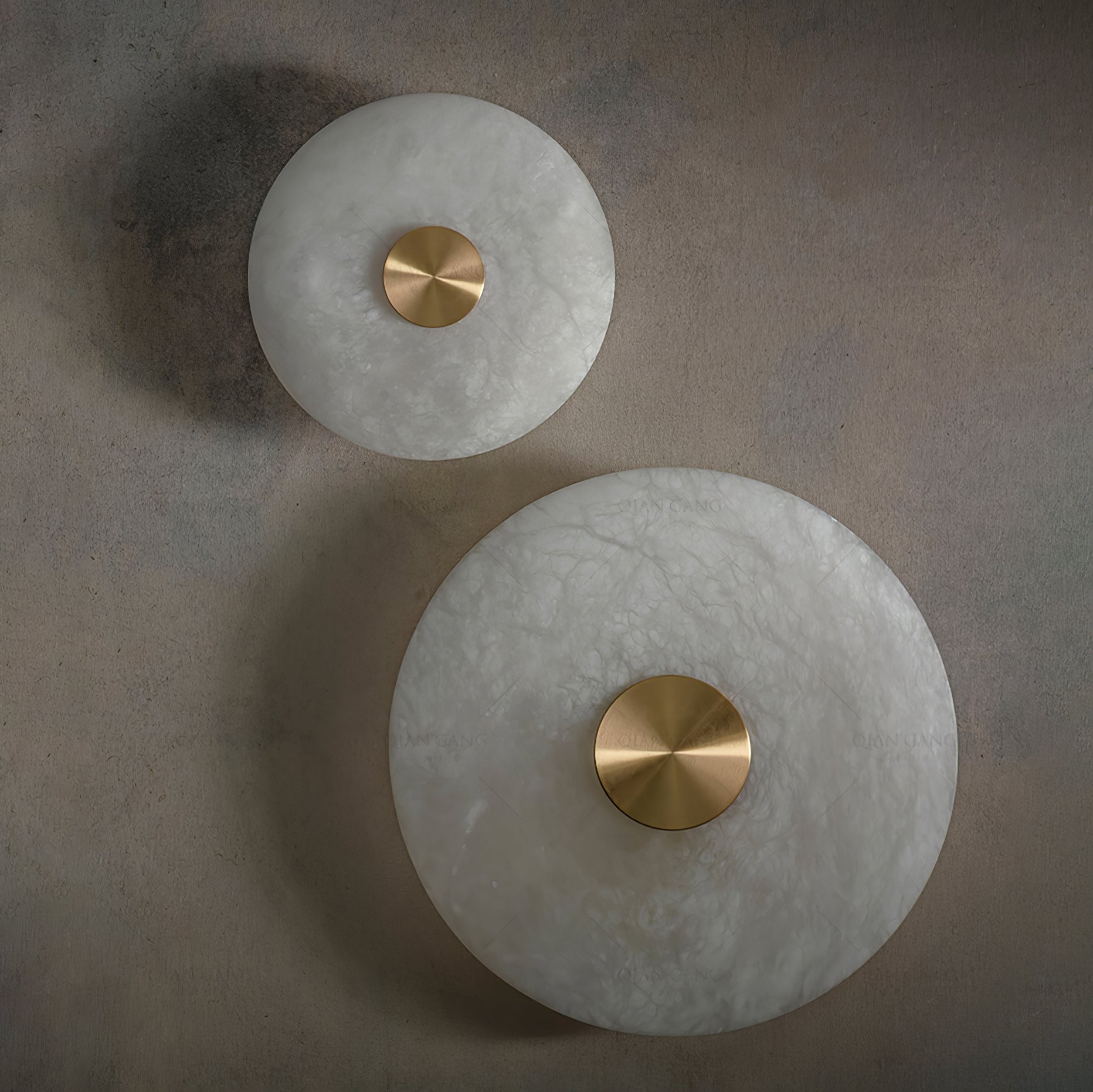
The fixture combines three materials, each doing a distinct job. The disc shade is alabaster, a form of fine-grained gypsum that has been used for lighting and ornament for centuries precisely because it transmits a warm, even glow. The body and mounting plate are brass, chosen for a warm metal tone that ages into patina rather than corroding. A metal backing structure holds the assembly and carries the wiring.
One thing to plan for up front: alabaster is a natural material, so the veining pattern differs from piece to piece. MiniHouzz states this explicitly in the product notes, and it is the same caveat every stone-lighting maker gives. If you are ordering a matched pair for either side of a bed, expect two discs that are siblings rather than twins — similar tone, different cloud patterns. Treat that as the character of the material, not a defect.
The light source is integrated LED, not a replaceable bulb. That matters for two reasons. First, there is no bulb to glare through the stone, which is what keeps the glow even. Second, you cannot swap the module later yourself — when specifying for a hospitality or multi-unit project, plan the fixture as a long-life component rather than a serviceable socket.
Where this sconce earns its place — and where it does not
Because the shade glows rather than throws a beam, this is accent and ambient lighting, not task lighting. Place it where you want a wall to feel warmer and more furnished, not where someone needs to read small print.
Strong applications
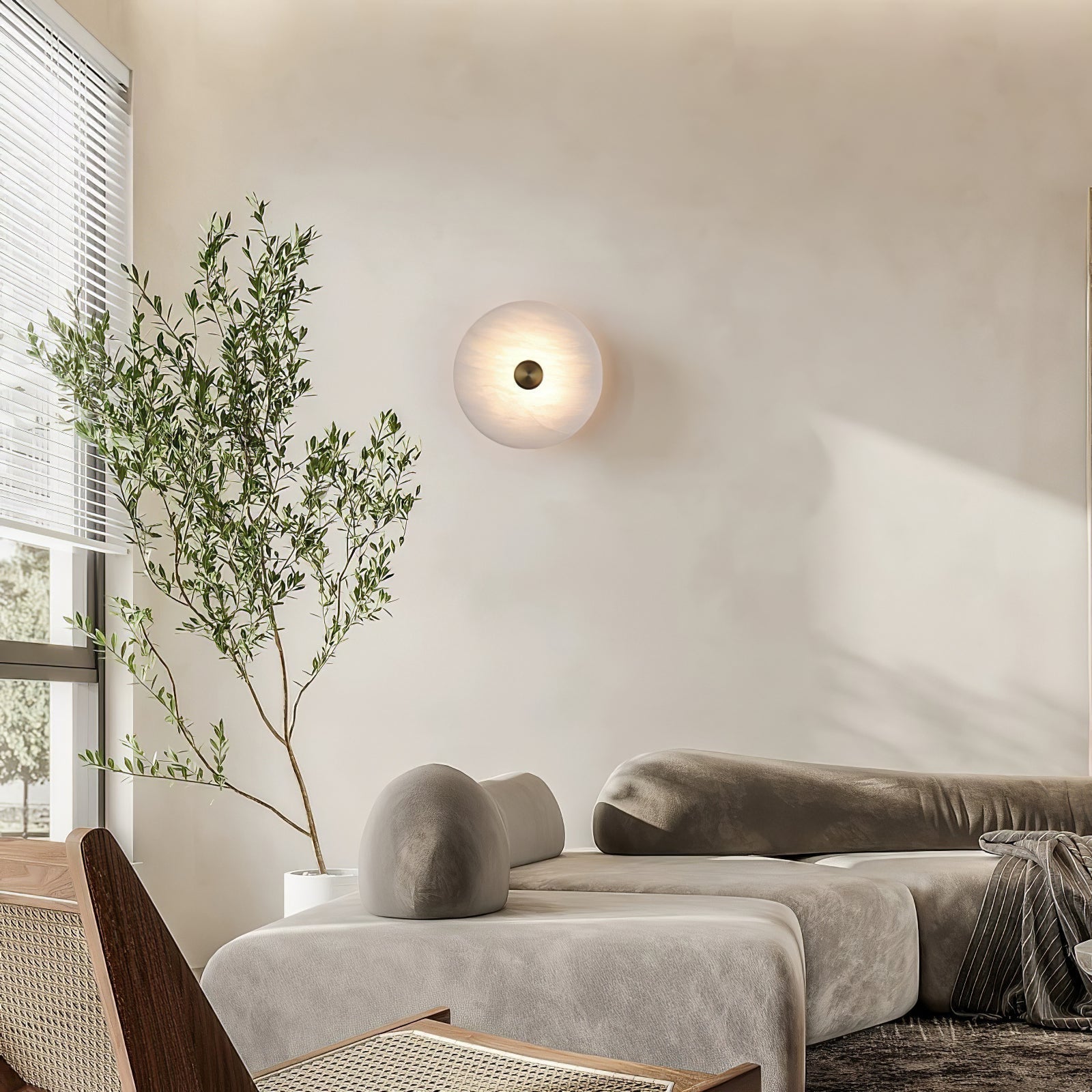
- Bedroom: flanking the bed instead of table lamps frees the nightstands entirely. A 7.9 or 9.8 inch disc is enough at bedside; the larger discs start to overpower a standard headboard wall.
- Hallway and stairwell: the flat 2.8 inch profile sits close to the wall, so it does not intrude into a narrow corridor the way a lantern or armed sconce does.
- Dining room: as a pair or a row on the long wall, at low output, to give the room a second layer of light below the chandelier.
- Bathroom vanity area: viable in a well-ventilated bathroom, with the caveat below.
- Commercial interiors: hotel corridors, restaurant walls, office reception — the tags on this fixture include hotel, restaurant, and commercial interior customization for good reason.
The moisture caveat, stated plainly
This sconce is rated IP20, damp-rated, indoor use only. In practice that means it tolerates the occasional humidity of a ventilated bathroom, but it is not protected against water jets or sustained steam. Do not put it inside a shower enclosure, directly over a tub, in a steam room, or on a covered porch where it will get rained on. If your bathroom has no extractor fan and the mirror fogs for ten minutes after every shower, choose a wet-rated fixture instead.
Sizing: choosing among the four diameters
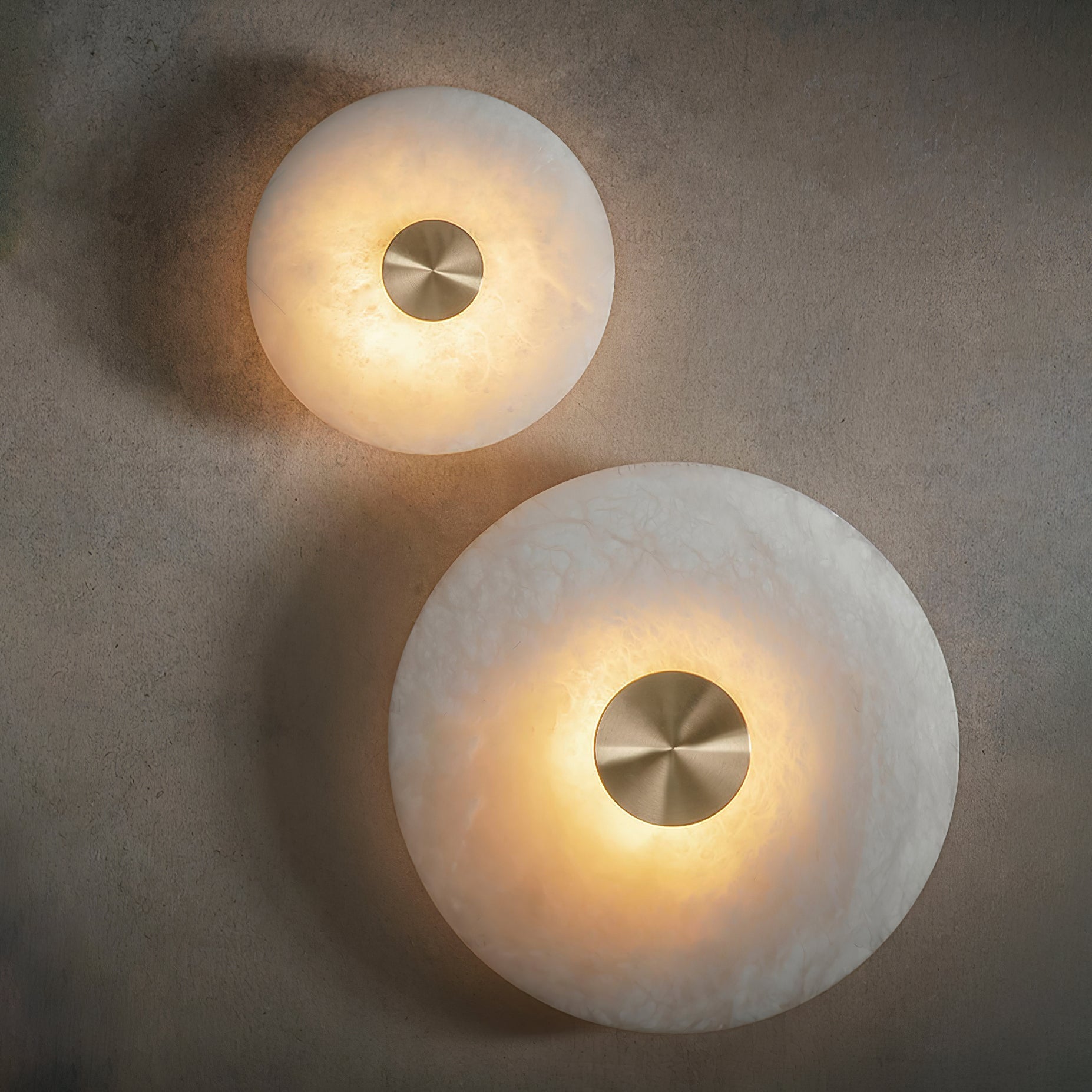
All four sizes share the same 2.8 inch (7 cm) depth — only the disc face grows. That makes the decision simpler than it looks: you are choosing how much wall real estate the circle claims, not how far it sticks out.
| Diameter | Depth | Best for |
|---|---|---|
| 7.9 in / 20 cm | 2.8 in / 7 cm | Bedside, powder room, tight hallway |
| 9.8 in / 25 cm | 2.8 in / 7 cm | The safe default for most residential walls |
| 11.8 in / 30 cm | 2.8 in / 7 cm | Dining room, entry, staircase feature wall |
| 13.8 in / 35 cm | 2.8 in / 7 cm | Double-height foyers, large commercial walls |
A workable rule: the disc should be roughly one-quarter to one-third the width of the furniture or architectural element it relates to. Beside a 60 inch headboard, a 9.8 inch disc reads balanced; a 13.8 inch disc reads heavy. On a blank 12 foot hallway wall with nothing else on it, the larger discs finally have room to breathe.
Mounting height and spacing
There is no single correct height, because the right number depends on what the light is serving. Use these as starting points, then adjust for the room:
- Beside a bed: center the disc 48 to 60 inches above the finished floor — roughly level with the top third of the mattress to headboard zone. If you read in bed, aim the bottom edge slightly above shoulder height when seated.
- Hallway, standing circulation: 60 to 66 inches to center keeps the glow above eye level so nobody walks into a bright circle of light. In a corridor longer than 10 feet, space fixtures 8 to 10 feet apart; in a shorter one, a single centered fixture is enough.
- Stairwell: align with the tread line rather than a flat floor height, 60 to 66 inches measured from the tread directly below each fixture, so the run of lights reads as a consistent diagonal.
- Above a bathroom vanity mirror: 66 to 72 inches to center as a pair flanking the mirror, or higher if mounted as a single above it. Keep clear of the mirror edge by at least 4 inches.
- Pairs: keep symmetric spacing from the anchor object (bed, mirror, artwork) — measure from the anchor, not from the wall ends, or small wall irregularities will make the pair look off-center.
Because the disc is flat against the wall, it lights the wall surface itself more than the floor. That is the point: it creates a wash of warm stone glow that reads as architectural detail. If you need light on a surface, this is the wrong tool.
Light temperature: 3000K, 4000K, or 6000K
The integrated LED is offered in three color temperatures, and the choice changes the whole mood more than the diameter does.
- 3000K warm light — the natural pairing for alabaster. It keeps the stone looking creamy and amber-tinged, and suits bedrooms, dining rooms, and living spaces. This is the option most residential buyers should take.
- 4000K neutral light — cleaner and slightly cooler. Useful in bathrooms, dressing areas, and hallways where you want the stone to read white rather than golden.
- 6000K cool light — crisp and blue-white. Better suited to commercial corridors and utility spaces; in a bedroom it will fight the warm brass and the stone’s character.
Two practical notes. The fixture is hardwired and controlled by an external wall switch — it is listed as compatible with common push switches, which are not included. And the product specification does not list dimming, so do not assume a dimmer will work with the integrated module; if dimming matters for your scheme, confirm it with the supplier before you order a set.
Alabaster vs. glass vs. acrylic shades
| Shade material | Light character | Watch out for |
|---|---|---|
| Alabaster | Soft, mineral, warm; glow appears to come from within the stone | Natural veining varies per piece; heavier than glass; not for wet zones |
| Glass (opal or frosted) | Even and clean, more uniform, slightly cooler in feel | Can look flat next to stone; fingerprints show on clear variants |
| Acrylic | Bright and lightweight, budget-friendly | Reads synthetic up close; scratches and yellows over time |
In a room where you are already using stone, marble, travertine, or unlacquered brass, alabaster sits naturally in that material family. In a rental or a fast-turnover project, acrylic is the pragmatic call.
Specifications at a glance
| Materials | Brass, alabaster, metal |
| Light source | Integrated LED (not user-replaceable) |
| Color temperature | 3000K warm / 4000K neutral / 6000K cool |
| Voltage | AC 110–240V |
| Mounting | Hardwired; wall mount, also suitable for ceiling integration |
| Rating | IP20 damp-rated, indoor only |
| Finishes | Brass body, white alabaster shade |
| Control | External wall switch (switch not included) |
| Certification | UL, ETL, CE and SAA listed |
Dimensions are hand-measured and may vary slightly. Color temperature can look different in photos versus on your wall, since batch temperature and monitor calibration both shift perception.
A short pre-purchase checklist
- Confirm you have a switched wall box where each sconce will go — this is hardwired, not plug-in.
- Check the wall can take the weight and that the mounting plate lands on solid substrate, using appropriate anchors for drywall, plaster, or masonry.
- Confirm your bathroom or wet-area plan against the IP20 indoor rating, not against the room’s name.
- Pick the color temperature before you order — 3000K for residential warmth, 4000K for bathrooms and hallways.
- Measure from the anchor object, not the wall ends, when laying out a pair.
- If matching pieces matters to you, ask the supplier about current stock so your discs come from a similar batch.
Bulk orders, custom dimensions, and layout advice are available directly through the MiniHouzz product page.
Frequently asked questions
Can an alabaster wall sconce go in a bathroom?
Yes, with conditions. This fixture is IP20 damp-rated for indoor use, so it suits a well-ventilated bathroom away from direct water. It is not appropriate inside a shower, over a tub, or in a steam room — those need a wet-rated fixture.
Is the LED replaceable?
No. The LED is integrated into the fixture and is not intended to be replaced by the user. That design is what keeps the glow even, with no visible bulb behind the stone.
Will two sconces look identical?
No. Alabaster is a natural stone, so veining patterns differ from piece to piece. A pair will share tone and size but not an identical pattern — the maker notes this on the product page.
Can I mount it on the ceiling instead of the wall?
The fixture is designed for wall mounting and the product notes describe smooth ceiling integration as an option. For a ceiling install, have your electrician confirm the mounting and wiring arrangement before ordering.
How many do I need for a hallway?
Under about 10 feet, one centered fixture is usually enough. Longer corridors read better with fixtures every 8 to 10 feet, centered at 60 to 66 inches above the floor.