
A flower shape glass ceiling lamp is a flush-mount fixture where layered glass petals sit directly against the ceiling instead of hanging from a chain — and that single detail is why it works in rooms where a chandelier would feel like too much. This one pairs a brass lamp body with white glass shades and comes in three head counts (3, 4 and 6), priced at $247. The short version: choose the 3-head for a bedroom or entry, the 4-head for a primary bedroom or study, and the 6-head for a long hallway or a larger living space. Then pick bulbs that match how the room is used, not just what looks bright in a showroom.
Below is what actually decides whether you will be happy with it six months from now: how the layered glass reads in a real room, which size fits your ceiling area, what bulb to put in an E26/E27 socket, and what to check before the electrician arrives.
What the layered glass and brass body actually do
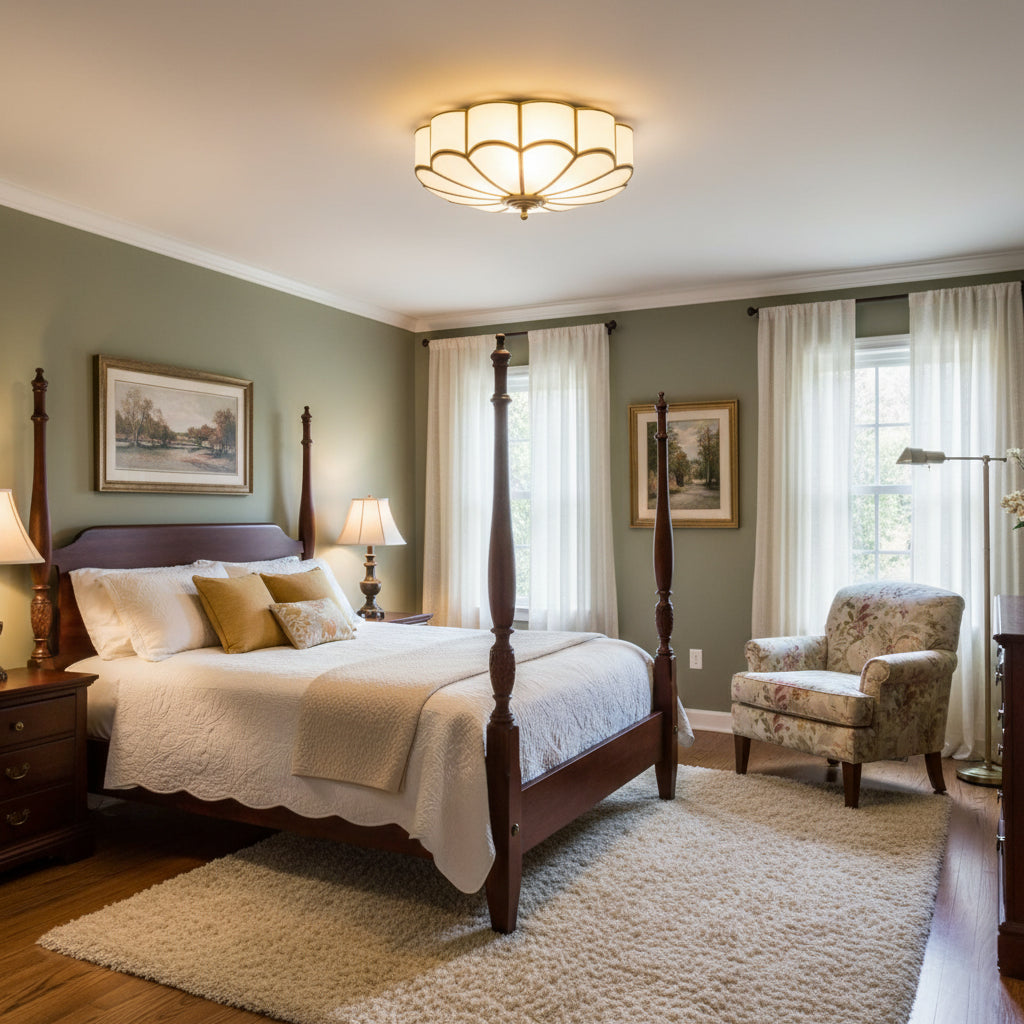
The fixture is built from a brass lamp body and a glass lampshade, with white glass as the finish option. The flower construction is not a single diffuser — glass petals are stacked in layers, which is what creates the three-dimensional effect the design is named for. In practice that means two things.
First, the light leaves the fixture from several overlapping edges rather than one flat panel, so the glow reads softer and less like a spotlight on the ceiling. Second, the glass pattern stays visible when the light is off. A white glass shade over a brass frame is effectively a piece of wall-and-ceiling sculpture that happens to light the room, which is the whole reason to choose this over a plain flush mount.
Brass is worth thinking about honestly. It is a warm metal that reads closer to antique gold than to polished chrome, so it sits naturally with wood tones, cream walls, linen and rattan. If your room is built around cool grays and black hardware, the warmth will still work, but it will be the accent rather than the background.
Sizing: 3, 4 or 6 heads in real dimensions
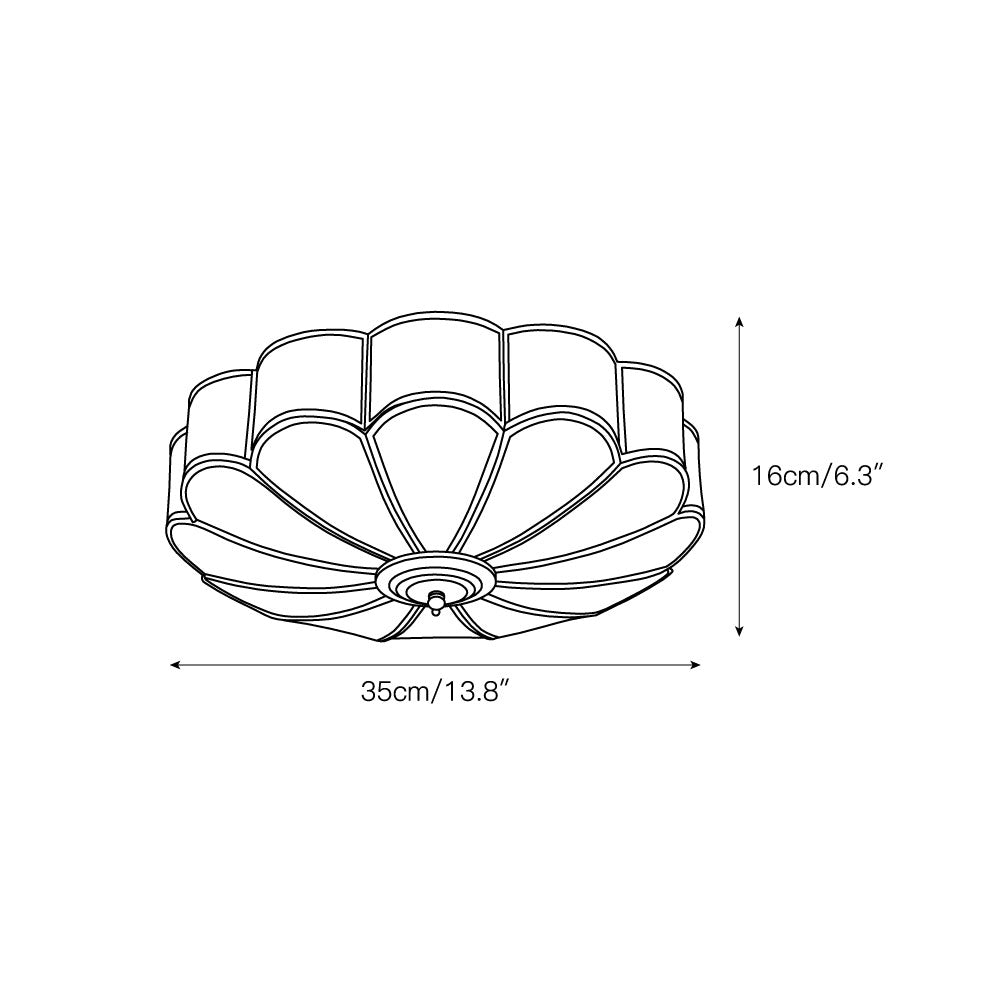
The three versions are not just brighter or dimmer versions of the same lamp — they are different footprints, and the footprint is what has to fit your ceiling.
| Version | Diameter | Height | Best-fit space (rule of thumb) |
|---|---|---|---|
| 3 heads | 35 cm / 13.8 in | 16 cm / 6.3 in | Small bedroom, entry, powder area, balcony, up to roughly 100 sq ft |
| 4 heads | 45 cm / 17.7 in | 17 cm / 6.7 in | Primary bedroom, study, dining nook, roughly 100–160 sq ft |
| 6 heads | 60 cm / 23.6 in | 19 cm / 7.5 in | Long hallway, larger living room, double-height stairwell landing |
The height figures matter more than they look. Because this is a flush mount, the number is how far the fixture projects below the ceiling: about 6.3 in on the 3-head, 7.5 in on the 6-head. On an 8 ft ceiling that leaves an unobstructed clearance of roughly 7 ft — comfortable for walking under, and the reason this style is a safer choice than a pendant in hallways and small bedrooms.
One sizing rule that holds up in real rooms: a single flush mount should sit roughly in the center of the ceiling area it serves, with at least 2 ft of clear ceiling between the edge of the shade and the nearest wall. If your room is wide enough that a 23.6 in fixture looks undersized, the better answer is usually two 3-head or 4-head units rather than one 6-head stretched across the space.
Where it works, and where it does not
Strong fits
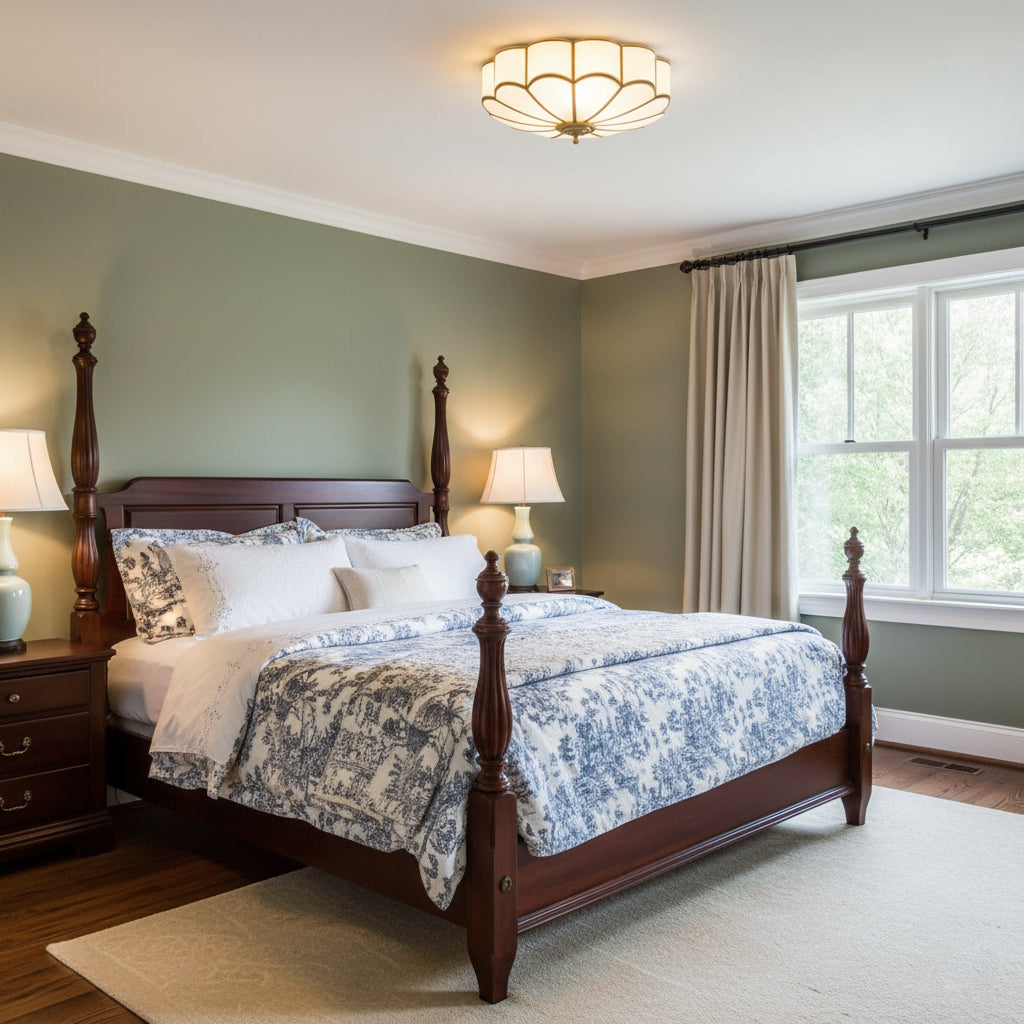
- Bedrooms. The glass petals soften light directly overhead, which is exactly where a bare bulb is most annoying. Pair the 3-head with a 2700K bulb and you get a low-glare layer that does not fight bedside lamps.
- Hallways and entries. Flush mounting means no head clearance issue and no sway. In a hallway longer than about 12 ft, space units every 8–10 ft along the run instead of using one fixture in the middle.
- Studies and reading corners. Go up in color temperature here — 3500K to 4000K reads cleaner on paper and screens, while the diffused glass keeps it from feeling clinical.
- Balconies and covered landings. Only where the ceiling stays dry. See the caveat below.
Where to think twice
The product page does not list an IP rating, so treat this as an indoor, dry-location fixture. That rules out shower enclosures, saunas, and exposed outdoor porches where rain or heavy condensation reaches the fixture. A ventilated bathroom is a judgment call; an enclosed steam-heavy bathroom is not.
It is also the wrong answer for a room where you want directional light — over a kitchen island, above a dining table, or as task lighting on a workbench. Flush mounts spread ambient light; they do not aim it.
Bulbs, sockets and color temperature
The fixture uses an E26 or E27 socket, and bulbs are not included. That is good news: you are choosing the light quality, not inheriting it.
- 2700K–3000K for bedrooms, hallways and anywhere you want the brass to look warm rather than yellow.
- 3500K–4000K for studies, home offices and utility hallways where you need to read detail.
- LED, 5–9W per socket is a sensible starting point for ambient light in a bedroom or hallway. The listing does not publish a maximum wattage, so check the rating printed on the socket or label before fitting anything higher output.
- Dimming only works if the bulb is dimmable and the wall switch is a compatible dimmer. Neither is part of the fixture, so this is a two-part purchase.
- Shape matters less than you would expect with a diffusing glass shade — an A19 or a small globe both sit inside the petal layers without poking out.
One practical note on multi-head versions: the heads share one supply, so all sockets should carry the same bulb type and color temperature. Mixing warm and neutral bulbs in the same fixture reads as a fault, not as design.
Before installation: a five-minute checklist
- Confirm you have a ceiling junction box. This is a hardwired fixture, not a plug-in. If the current light is a pull-chain or a surface-mounted box with no box behind it, the electrician will need to add one.
- Check what the box is anchored to. Shipping weight is not published on the listing, so if your box is a lightweight retrofit box in drywall, have it confirmed as fixture-rated before hanging anything from it.
- Measure your ceiling height. Under 8 ft, favor the 3-head or 4-head so the projection stays proportionate to the room.
- Plan the switch before the fixture. If you want dimming, buy the dimmer and dimmable bulbs together — retrofitting after the ceiling is closed up is the expensive version.
- Use a licensed electrician. Cutting the breaker is step one, but verifying the circuit and the box rating is not a DIY step in most jurisdictions.
For care, dust the brass with a dry microfiber cloth and wipe the glass with a damp cloth and mild soap. Skip ammonia-based glass cleaners and abrasive pads — they can cloud the finish and dull the brass tone that makes the fixture worth buying. If you like patina, leave the brass alone; if you prefer it bright, a brass polish used sparingly and away from the glass is the safer order of operations.
How it compares with the usual alternatives
| Option | What you gain | What you give up |
|---|---|---|
| This flower glass flush mount | Sculptural detail at ceiling level, no head clearance issue, three size options | Ambient light only, no IP rating listed |
| Plain brass globe flush mount | Simpler, easier to match with other hardware | Less character when the light is off |
| Small glass chandelier | More presence, more layered light | Hangs lower; awkward in low ceilings and narrow hallways |
| Recessed downlights | Disappears into the ceiling, cheap to multiply | No decorative value, harder to make glare-free |
The honest summary: buy this because you want the ceiling itself to be part of the room. If you only need lumens, a recessed can is cheaper.
Frequently asked questions
Is this flower ceiling lamp dimmable?
Only with the right parts. The fixture has no built-in dimmer, so you need dimmable bulbs plus a compatible wall dimmer. With standard non-dimmable bulbs it will simply switch on and off.
Which size should I choose for a 10 x 10 ft bedroom?
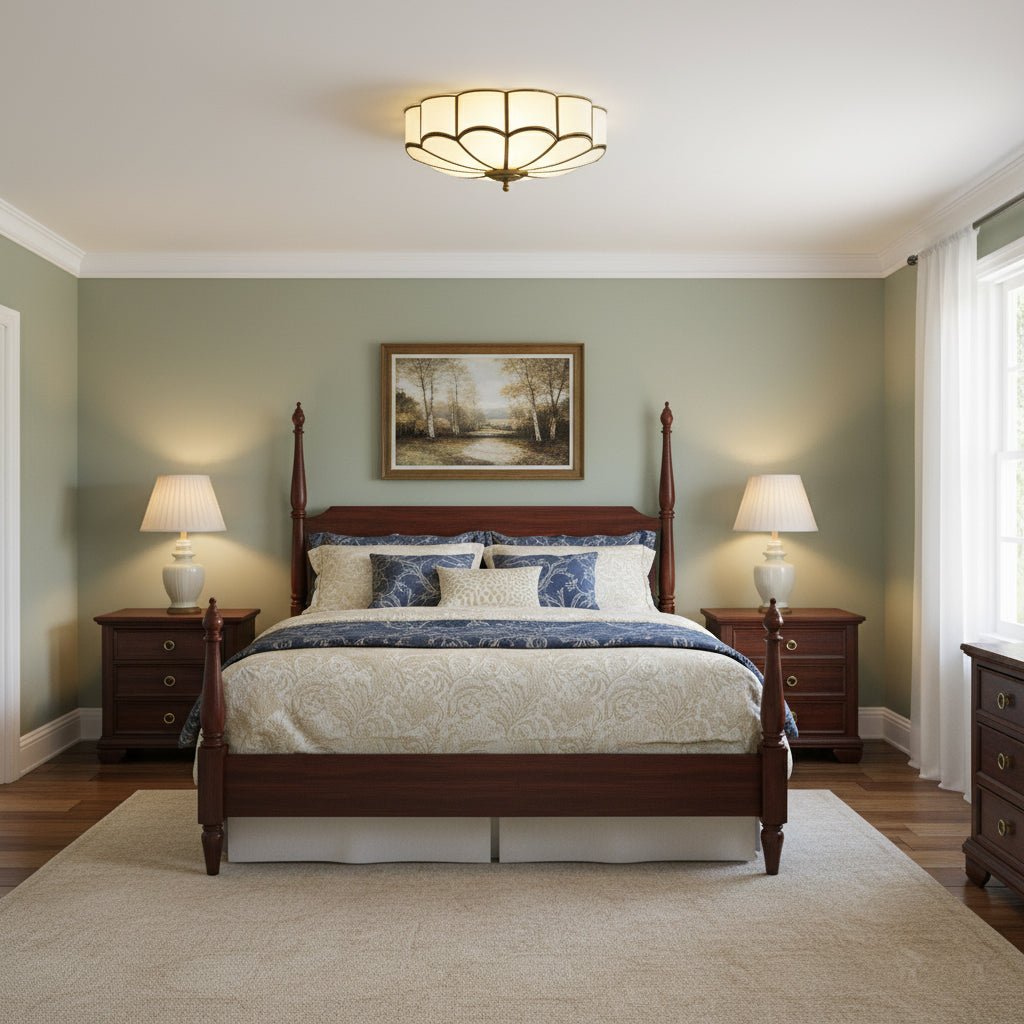
The 3-head (13.8 in diameter) or the 4-head (17.7 in) are both reasonable at that size. The 3-head reads as a delicate accent; the 4-head reads as the room’s main fixture. On a ceiling under 8 ft, lean toward the 3-head.
Does it come with bulbs, and what type does it take?
No bulbs are included. It takes E26 or E27 bulbs, which covers standard US and European sockets, so you can choose the color temperature that suits the room.
Can it be installed in a bathroom?
No IP rating is published for this fixture, so it is best treated as a dry-location light. A well-ventilated bathroom is a judgment call; a shower enclosure or steam room is not appropriate.
How far below the ceiling does it hang?
The 3-head projects about 6.3 in, the 4-head about 6.7 in, and the 6-head about 7.5 in. Because it is a flush mount, that projection is the total drop — there is no chain or rod to shorten.
Is it certified?
The product listing states UL certification, ETL listing, CE approval, RoHS compliance and FCC certification. Confirm the specific mark on the unit you receive if your project requires documentation for an inspector.
The short version
If you want a brass ceiling fixture that reads as a designed object rather than a light source, the flower shape glass ceiling lamp does that job in a way most flush mounts do not — the layered petals give it depth when it is off and softness when it is on. Match the head count to your ceiling area, buy dimmable bulbs if you want dimming, and keep it out of wet zones. The 3-head at $247 is the easiest place to start for a bedroom or entry, and the 6-head version is the one that finally fills a long hallway.
See the flower shape glass ceiling lamp sizes and finishes on MiniHouzz →