
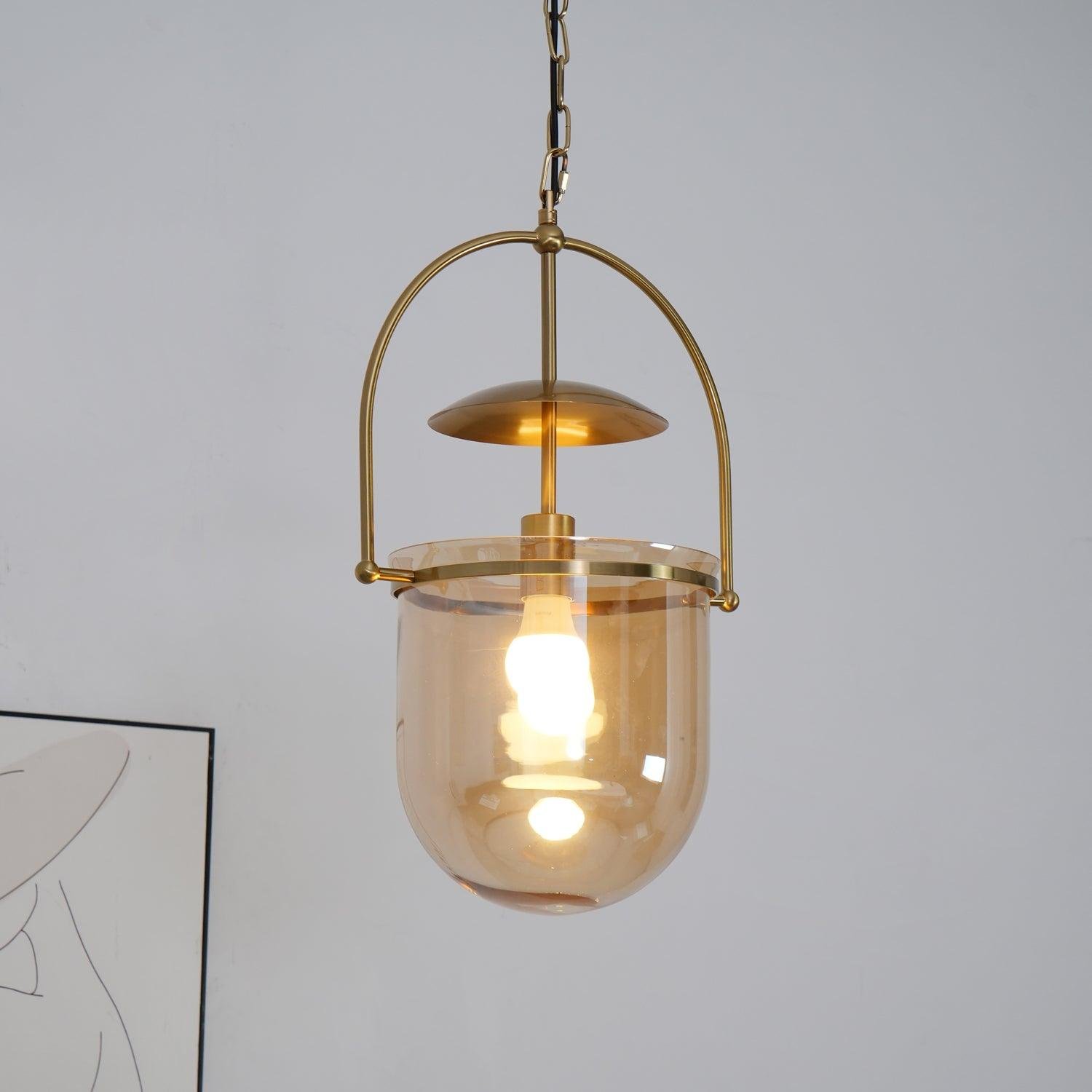
If you are weighing an amber glass pendant light for a kitchen island or bedroom, the short answer is this: it earns its place when you want warm, low-glare light with a visible glass form, and you have at least 13.4 inches of clear width to hang it in. This one is a cup-shaped amber glass shade on a gold metal body, 13.4 inches across and 19.7 inches tall, with a 19.7-inch chain and a standard E26/E27 socket that takes LED or Edison bulbs.
The reason amber glass works is simple. Clear glass throws the filament straight at your eye; amber tints the beam before it leaves the shade, so the fixture reads as a soft glowing object rather than a bright point. That is why it suits rooms where the light is part of the scenery — over a counter, beside a bed, at the end of a hallway.
See the Amber Glass Cup Pendant Light in gold →
Design, materials and finish
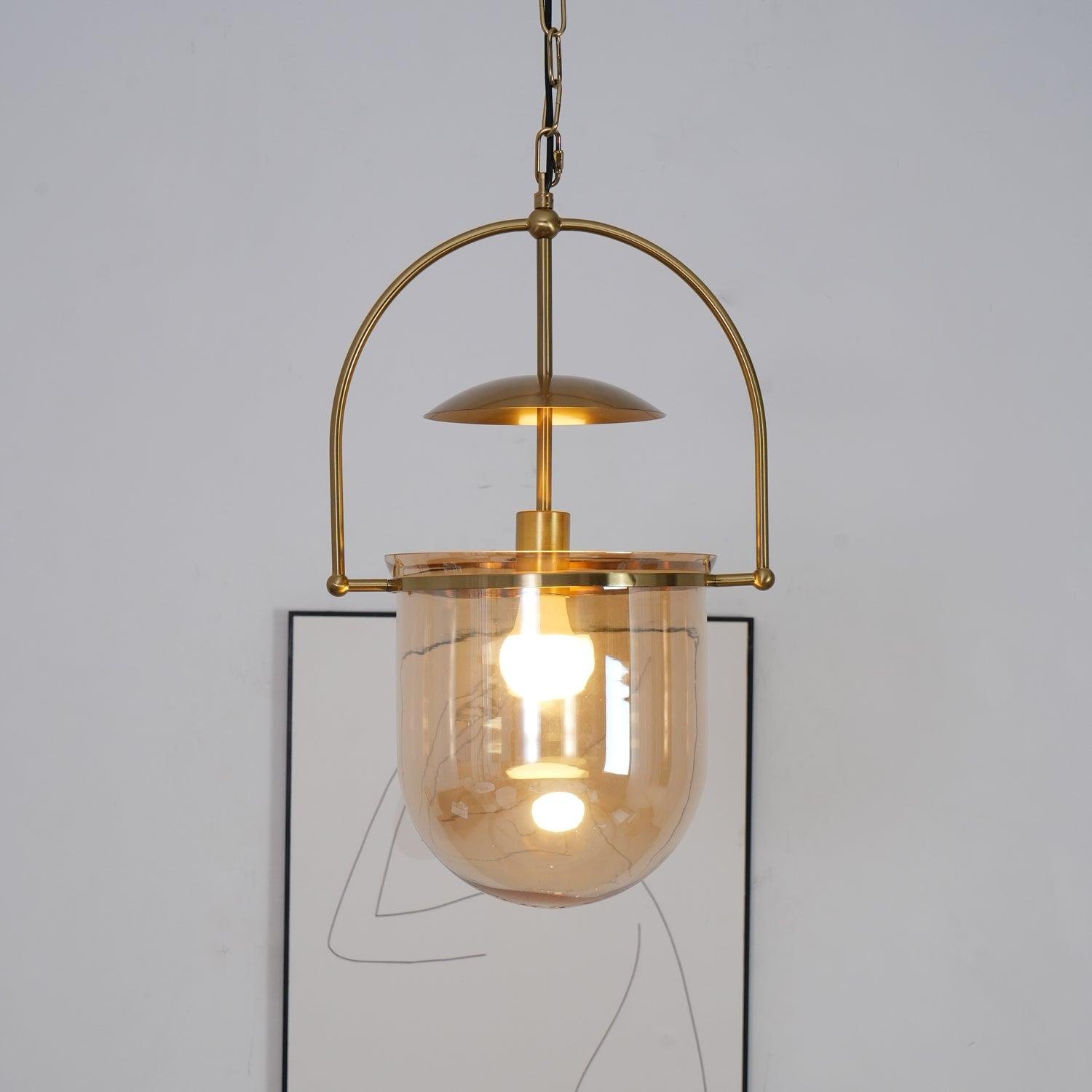
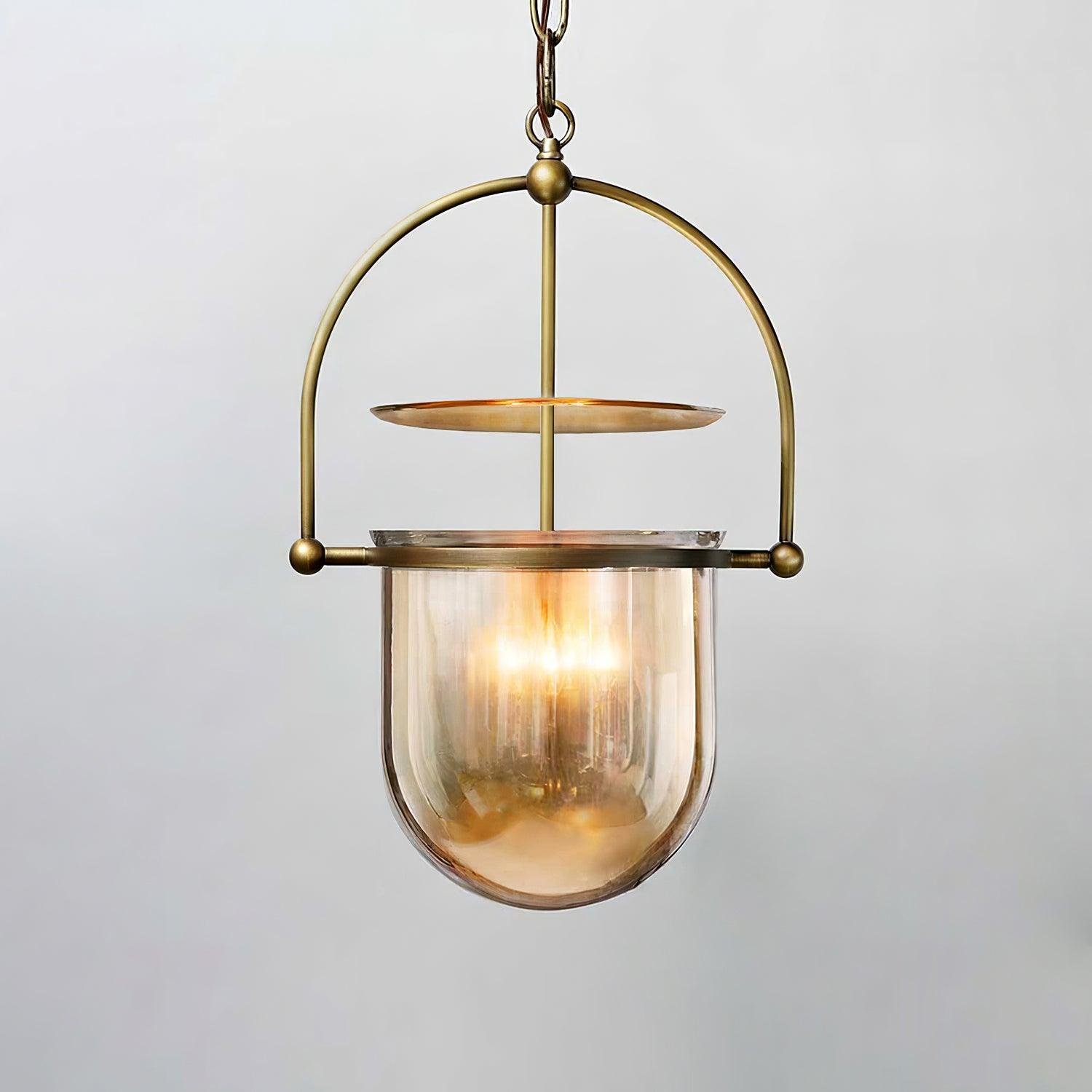
The body is metal with a gold finish; the shade is amber glass. Metal gives the frame its shape retention and lets the glass sit in a rigid ring instead of sagging, which matters on a cup profile because the open mouth is the widest point. The result is a fixture that looks architectural from the side and glows from below.
Because the shade is glass and open at the bottom, you get a direct pool of light below the fixture plus a halo through the amber wall. In practice that means good task light on a counter directly underneath and softer ambient fill around it — a combination that hard, opaque shades cannot produce.
Where the gold finish helps, and where it does not
Gold sits between brass and polished nickel in warmth. It reads as deliberate against white oak, walnut, cream cabinetry and warm plaster, and it reads as contrast against cool greys and black. If the rest of the room is already doing warm metals — brass hardware, copper accents — gold here will blend rather than compete. If the kitchen is entirely chrome and stainless, expect this fixture to be the one warm object in the frame, which is either the point or the problem, depending on what you want.
Sizing: what 13.4 inches actually buys you
The shade is 34 cm (13.4 in) in diameter and 50 cm (19.7 in) in overall height. That is a mid-scale pendant, not a mini. It is large enough to hold a room on its own over a small table or a kitchen sink, and it is small enough that three in a row will not overwhelm a standard island.

How many, and how far apart
- One pendant: a rough guideline is a fixture diameter no larger than about one third of the surface it hangs over. At 13.4 inches, that points to a table, sink or peninsula roughly 40 inches wide or more.
- Two pendants: divide the island length into thirds and center each fixture on those points, leaving roughly 26 to 30 inches of clear space between shade edges.
- Three pendants: divide the length into quarters. On a 7-foot island this is usually the cleanest rhythm.
- Odd numbers generally look more settled than even ones when the island is long and open.
These are starting points, not rules. The check that actually matters is this: stand where you will stand, and confirm no shade blocks your sightline to the person across the counter.
Hanging height and installation
The fixture is hardwired and comes with a 19.7-inch (50 cm) chain, extendable on request. That chain length is workable for an 8-foot ceiling only if you accept a fairly close hang; on a 9-foot ceiling over an island you will likely want the extension.
Heights that usually work
- Over a kitchen island: bottom of the shade 30 to 36 inches above the countertop. Go toward 36 if people sit at the island, toward 30 if it is purely a work surface.
- Over a dining table: bottom of the shade 28 to 32 inches above the tabletop.
- Bedside: bottom of the shade around 20 to 24 inches above the nightstand, and out of the path you walk when getting up.
- Hallway or stairwell: keep the lowest point at least 80 inches above the floor, or 6 inches above the head of the tallest person in the house, whichever is greater.
Because the shade opens downward, a lower hang gives you more concentrated light on the counter and more visible glow from the side. A higher hang flattens the effect. If you are unsure, hang it high first, live with it for a day, then shorten the chain — shortening is a five-minute job, lengthening usually is not.
Before you cut the ceiling
Hardwired fixtures need a junction box at the mounting point. If you are replacing an existing pendant, the box and switch leg are already there and the swap is straightforward. If you are adding a new drop over an island, plan on an electrician and confirm the joist location first. The fixture is controlled by a common push switch (not included) and is not specified as dimmable — so if dimming matters to you, treat that as a separate decision involving a compatible dimmer and bulb rather than an assumption.
Bulbs and the light you actually get
The socket is E26 or E27, so bulb choice is where most of the character of this fixture is decided. Bulbs are not included.
| Goal | Bulb choice | Color temperature |
|---|---|---|
| Warm, cozy, evening | LED, frosted or clear globe | 2700K |
| Warm but readable | LED, high CRI | 3000K |
| Visible exposed filament look | Edison-style LED | 2200K–2700K |
| Task light on a work counter | LED, higher lumen output | 3000K–3500K |
Amber glass already warms the light, so a 2700K bulb behind amber can push the room quite orange. If the walls are cream or the cabinets are walnut, that is usually welcome. If the room is already warm-toned, a 3000K bulb keeps the amber glow without tipping the whole space toward orange.
One practical note: with an open-bottom cup shade, the bulb is visible from below. A bare clear bulb will read as a bright dot when you look up from the counter. A frosted globe or an Edison-style LED with a visible filament both solve this, in different ways — frosted for softness, Edison for character.
Rating and where it can go
The fixture is IP20 damp-rated and specified for indoor use. That means it is fine in dry rooms and in areas where it will not be exposed to moisture. It is not a bathroom-shower or exposed-outdoor fixture. In a bathroom, keep it away from the direct splash zone and make sure the room ventilates well. On a covered porch, it depends on how much wind-driven rain reaches the fixture — if the answer is any, it is the wrong fixture.
Full specifications
| Diameter | 34 cm / 13.4 in |
| Height | 50 cm / 19.7 in |
| Materials | Metal, glass |
| Body finish | Gold |
| Shade finish | Amber |
| Light source | LED or Edison bulb (not included) |
| Base type | E26 / E27 |
| Voltage | AC 110–240V |
| Adjustable height | 19.7 in / 50 cm chain, extendable on request |
| Wiring | Hardwired |
| Control | Common push switches (not included) |
| Moisture resistance | IP20, damp-rated |
| Environment | Indoor |
| Certification | UL, ETL, CE, SAA listed; RoHS compliant, FCC certified |
Dimensions can vary slightly with manual measurement. Amber glass also shifts in tone depending on the bulb behind it and the light in the room, so expect the shade to look deeper in the evening than in daylight.
How it compares to other pendant styles
- Versus clear glass: clear maximizes brightness and shows off the filament; amber softens the glare and turns the shade itself into the visual. If the fixture hangs at eye level near seating, amber is the kinder choice.
- Versus opaque metal or ceramic shades: opaque shades throw light down and almost none sideways. The amber cup does both, which makes it more useful over a counter you also want to look at from the living room.
- Versus a larger dome: a 13.4-inch cup is domestic and quiet. If the island is 9 feet long and the ceiling is 10 feet, a single fixture at this scale will look undersized — use two or three.
- Versus a cluster of small pendants: clusters create texture; a single cup creates a focal point. This fixture is best used as the one thing the eye lands on.
Living with glass and gold
Dust shows on the inside of an open shade, and it shows more when the light is on. A quick wipe of the interior glass every few weeks with a dry microfiber cloth keeps the glow even; clean the exterior with a soft damp cloth and dry it immediately. Avoid ammonia-based glass cleaners on the amber finish. On the gold body, a dry cloth is enough — abrasive polishes will dull the finish over time.
Frequently asked questions
How big is the Amber Glass Cup Pendant Light?
It measures 34 cm (13.4 in) in diameter and 50 cm (19.7 in) in overall height, with a 19.7-inch chain that can be extended on request.
What bulb does it take?
An E26 or E27 base bulb — LED or Edison style. Bulbs are not included. Because the shade is open at the bottom, a frosted globe or an Edison-style LED reads better than a bare clear bulb.
Is it dimmable?
The fixture is not specified as dimmable and is designed for common push switches. Treat dimming as a separate decision requiring a compatible dimmer and bulb.
Can it go in a bathroom or outside?
It is IP20 damp-rated and intended for indoor use, in areas not exposed to moisture. It is not suitable for direct water contact or exposed outdoor installation.
How many do I need over an island?
For islands around 6 to 7 feet, two or three in a row is typical; for a compact peninsula or a sink, one is usually enough. As a starting point, keep the gap between shade edges at roughly 26 to 30 inches.
Bottom line
This is a fixture that does its best work as the single warm note in a room: over a kitchen island at 30 to 36 inches above the counter, beside a bed, or at the end of a hallway where you want light that looks like an object rather than a source. Choose a 2700K bulb for evening warmth, a 3000K bulb if the room is already warm-toned, and plan on the chain extension if your ceiling is 9 feet or higher.
Check current price and availability for the Amber Glass Cup Pendant Light →