
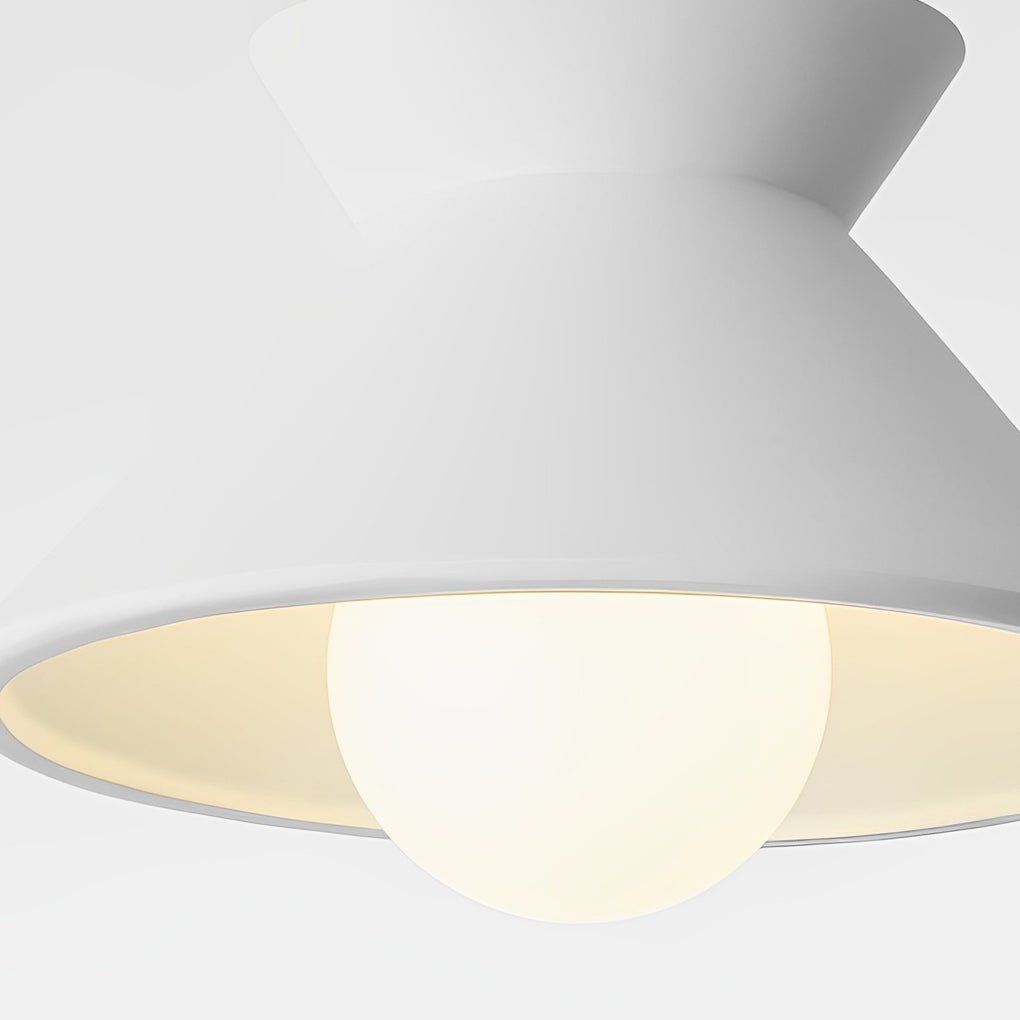
A white cement pendant light is a single-shade fixture cast in refined cement, and it earns its place in a room for two reasons: it throws a soft, neutral white light and it reads as architecture rather than decoration. The MiniHouzz version measures 9.3 inches in diameter and 8.3 inches in height, hangs from an adjustable 47.2-inch cord, and runs on 110V with a 4000K neutral white output. That combination suits kitchen islands, dining tables, bedrooms and corridors — but the details decide whether it looks intentional or accidental.
This guide covers the numbers you actually need before you buy: how big the shade is against your table or island, how high to hang it, what 4000K means in a real room, and how to mount it on a sloped ceiling.
Cement as a shade material: what it does well
Cement is a dense, matte material. Because the surface scatters light instead of reflecting it sharply, a cement pendant tends to produce a calm, even glow inside the shade with a soft pool of light below — no glare bouncing off the ceiling. The matte finish also hides fingerprints better than glossy metal or glass, which matters in kitchens where hands and steam are constant.
The trade-off is weight. This fixture weighs 6.61 lb (3.0 kg). That is heavier than a comparable glass pendant, so confirm your ceiling box and mounting hardware are rated for it before installation. On a standard drywall ceiling with a properly anchored box, that weight is routine; on a thin panel or a drop-ceiling grid, it is not.
Cement is also a cool-toned material by nature. In a white finish it stays quiet and architectural — it will not fight a marble counter, an oak table, or a painted cabinet. If your kitchen already has a lot of pattern, the shade recedes; if the room is minimal, it becomes the focal point.

Dimensions: sizing the shade to your surface
The shade is 9.3 inches (23.6 cm) in diameter and 8.3 inches (21.1 cm) tall. Treat those numbers as your sizing constraint, not the cord length.
As a working rule for a single pendant over a surface, the shade diameter should land somewhere around one-fifth to one-quarter of the surface’s width. At 9.3 inches, this fixture is a natural fit over:
- A two- or three-seat kitchen island — one pendant, centred, or a row of two spaced evenly across a longer run.
- A small dining table up to roughly 40 inches wide — one shade centred on the table.
- A breakfast nook, entry, hallway or reading corner — where a single accent light is the point.
- A bedroom as a bedside or corner pendant, hung off-centre.
If you are running two or three of these over a long island, space them evenly and keep the gap between shades roughly equal to the shade diameter. Three 9.3-inch shades across a 72-inch island gives a comfortable rhythm rather than a cluster.
How high to hang it
These are conventional starting points, adjusted for ceiling height and who is standing underneath:
- Over a kitchen island: 30 to 36 inches from the bottom of the shade to the countertop. If the island is also an eating surface, go to the upper end of that range — 36 inches — so sightlines stay open across the counter.
- Over a dining table: 30 to 34 inches from the shade bottom to the tabletop. Lower reads more intimate; higher keeps conversation unobstructed.
- In a hallway or entry: keep the shade bottom at least 6.5 to 7 feet above the floor so no one walks into it.
- In a bedroom corner: 6 to 7 feet above the floor, or lower if it hangs beside a chair rather than over a walkway.
The 47.2-inch (120 cm) hanging wire is adjustable, so the fixture can serve a standard 8-foot ceiling with room to spare, and still work on a taller ceiling if the canopy position allows. Measure from your ceiling to your target shade height before you cut or coil the cord — and leave a little margin rather than trimming to the exact inch.

Light quality: what 4000K neutral white actually looks like
This fixture is specified at a 4000K colour temperature — neutral white. It is a useful middle ground: warmer than the 3000K that many living rooms use, cooler than daylight, and clean enough that white cabinets and stone counters do not pick up a yellow cast. It is the colour temperature most often chosen for task-adjacent spaces — kitchen islands, prep areas, corridors — where you want to see what you are doing without the room feeling clinical.
A few practical notes:
- 4000K is a specification of the light output, not the shade. Since the fixture takes LED bulbs, the colour temperature you end up seeing is determined by the bulbs you install. Match your bulbs across every pendant in a row, or the mismatch will be obvious.
- Confirm the socket type before ordering bulbs. The fixture is LED-compatible at 110V; check the socket specification in your order details so you buy the right base.
- Dimming depends on the bulb and the switch. If dimming matters to you, choose a dimmable LED bulb and confirm your wall dimmer is compatible with it — the fixture listing does not claim a dimming range.

Installation: sloped ceilings, dry locations, and what to plan for
The adjustable hanging wire and versatile mounting design make this pendant suitable for most ceiling types, including sloped ceilings — the manufacturer’s guidance is to consult a qualified electrician for the specifics of your install. In practice, that means planning three things:
- The ceiling box. It has to carry 6.61 lb. If you are replacing a light fixture, check what is actually behind the existing canopy rather than assuming.
- The drop. Decide the finished shade height first, then set the cord. On a sloped ceiling, the same cord length will put the shade at different heights along the slope — keep the shade vertical, not perpendicular to the ceiling.
- The location. This fixture is designed for indoor use in dry locations. It is not intended for bathrooms, laundry rooms or other damp environments. If you need a pendant over a sink or in a humid space, source a fixture specifically rated for that location instead.
For a row of pendants, set out the positions on the ceiling with painter’s tape before you drill anything. Centring a pendant on the island rather than on the room is almost always the right call in a kitchen.
Care and maintenance of a cement finish
Cement is forgiving but not indestructible. Dust regularly with a soft, dry cloth. For anything more than dust, use a slightly damp cloth with mild soap and wipe dry immediately — standing water is the enemy of a cement surface. Skip abrasive cleaners and harsh chemicals, which will dull or scar the delicate texture that makes the shade worth having in the first place.
One honest expectation to set: cement shades can vary slightly in tone between batches, and photography, monitor settings and colour temperature all shift how white reads on screen. Slight variation is normal for the material.
Specifications at a glance
| Specification | Detail |
|---|---|
| Style | Modern / Retro |
| Material | Cement |
| Colour | White |
| Diameter | 9.3 in (23.6 cm) |
| Height | 8.3 in (21.1 cm) |
| Hanging wire | 47.2 in (120 cm), adjustable |
| Weight | 6.61 lb (3.0 kg) |
| Voltage | 110V |
| Colour temperature | Neutral White (4000K) |
| Bulb compatibility | LED bulbs |
| Average rated life | 3000 hours |
| Location rating | Indoor, dry locations |
| Certification | UL Certified, ETL Listed, CE Approved, RoHS Compliant, FCC Certified |
| Best for | Dining room, living room, bedroom, kitchen island, corridor |
Cement, glass or metal: a quick way to choose
If you are deciding between shade materials for the same spot:
- Choose cement when you want a matte, architectural look, soft diffused output, and a finish that does not show handling marks. Accept the extra weight and the need for a rated ceiling box.
- Choose glass when you want maximum light spread and a lighter fixture, and you are comfortable cleaning a transparent surface regularly.
- Choose metal when you want a crisp directional pool of light and a finish that reads sharper and more industrial.
Cement sits in the middle: more diffuse than metal, more substantial than glass, and quiet enough to work in a room that already has a lot going on.
Frequently asked questions
What are the exact dimensions of this white cement pendant light?
9.3 inches (23.6 cm) in diameter by 8.3 inches (21.1 cm) in height, with an adjustable hanging wire of up to 47.2 inches (120 cm). Adjust the drop to suit your ceiling height and the surface below.
Can it be installed on a sloped ceiling?
Yes — the adjustable hanging wire and versatile mounting design suit most ceiling types, including sloped ceilings. Have a qualified electrician confirm the mounting for your specific ceiling.
What bulb does it take?
It is compatible with LED bulbs and operates at 110V with a 4000K neutral white output. Confirm the socket base type in your order details before buying bulbs.
Can I hang it in a bathroom or damp area?
No. It is designed for indoor use in dry locations. Bathrooms, laundry rooms and other damp environments are not recommended unless a fixture is specifically rated for them.
How do I clean the cement finish?
Dust with a soft, dry cloth. For deeper cleaning, use a slightly damp cloth with mild soap and wipe dry immediately. Avoid abrasive cleaners and harsh chemicals.
How far apart should multiple pendants be?
Space them evenly, with gaps between shades roughly equal to the 9.3-inch shade diameter, and centre the group on the island or table rather than on the room.
Where it works best
The strongest use for this fixture is a single shade or an evenly spaced row over a kitchen island or dining table, in a room where you want neutral task-adjacent light and a matte architectural accent. It is also a clean choice for an entry, a hallway, or a bedroom corner where one well-proportioned pendant does the whole job.
It is not the right pick for a damp room, for a ceiling that cannot carry 6.61 lb, or for anyone who needs a fixture with a published dimming range or a specified lumen output — those details are not part of this listing, so ask before you buy rather than after.
Need a different drop, a custom dimension, or lighting layout advice for a row of pendants? The MiniHouzz design consultants handle exactly that. See the Modern White Cement Pendant Light →
Related reading from the same collection: pair it with warm wood or stone surfaces for contrast, and keep every bulb in the room at the same colour temperature so the 4000K reads as a decision rather than an accident. Check current price and availability here.