
A hallway needs a fixture that throws light sideways, sits tight to the ceiling, and doesn’t turn a narrow corridor into an obstacle course. A flush mount ceiling light is the right answer for most hallways — and the Cask barrel light is a good example of the type done with some design intent: a 5.9-inch-deep metal drum, two diameters, two finishes, and a GU10 socket you can tune to the room.
Here’s the short version. On a standard 8-foot ceiling, the Cask leaves roughly 7 feet 6 inches of headroom, which clears typical code clearance and looks intentional rather than squeezed. For a hallway under about 10 feet long, buy the 3-head (9.8 in / 25 cm). For longer runs or a wider foyer, go 5-head (11.8 in / 30 cm). Use 2700–3000K GU10 LEDs if the hallway is part of your living space; step up to 3500–4000K only if it’s a working corridor you actually need to see in.
What the Cask light actually is
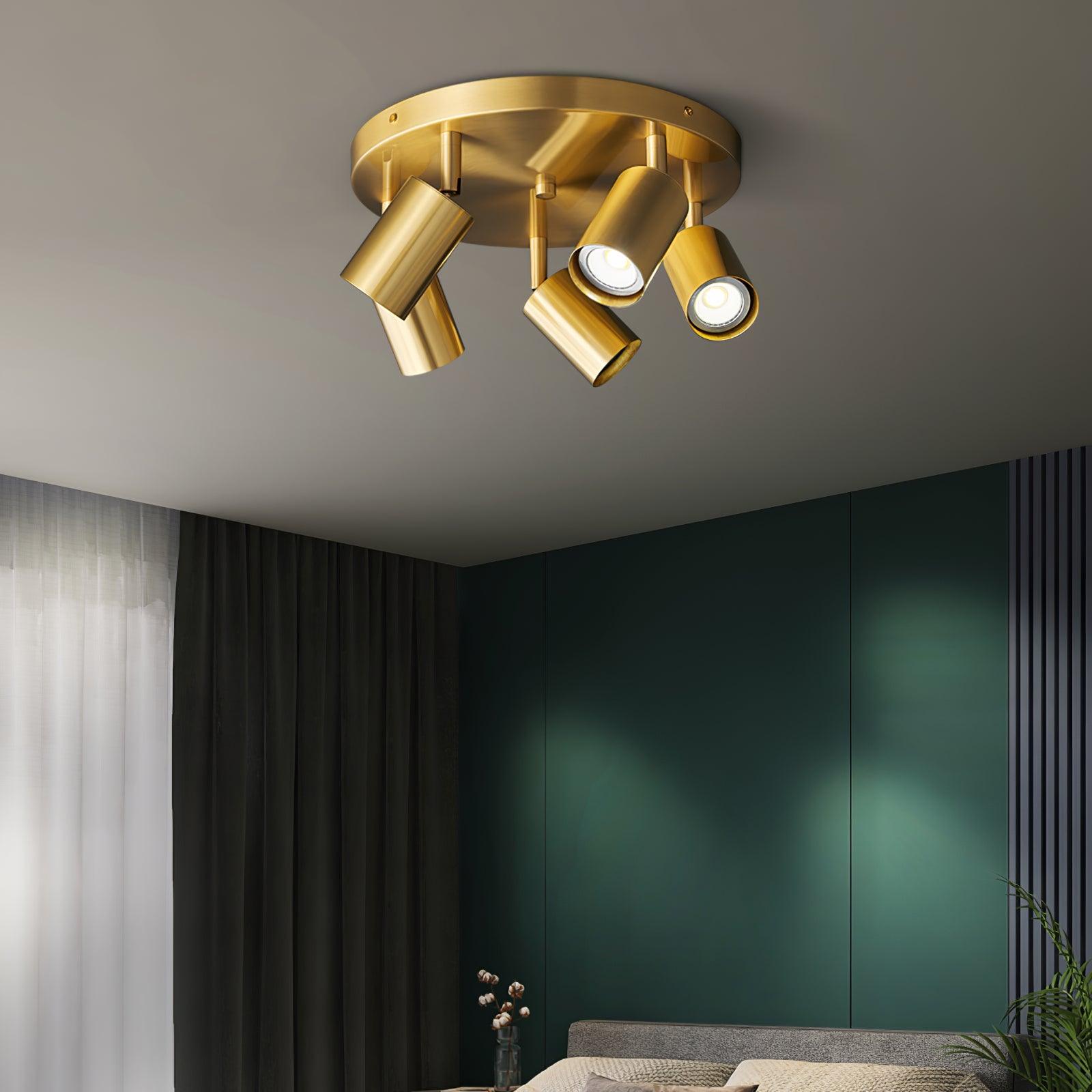
The design borrows the silhouette of an old whisky barrel: a straight-sided metal drum with a slight cask-like profile, no glass shade, no visible bulb clutter. That restraint is the point. In a hallway — a space you pass through in three seconds — a fixture either reads as clean architecture or as decoration fighting for attention. This one stays in the first category.
The style is Scandinavian in the literal sense: simple form, metal body, nothing ornamental. It sits comfortably in modern, minimalist, and transitional interiors, which matters if your hallway is a pass-through between rooms decorated in different eras.
Material, finish, and why metal wins in a corridor
The fixture is built in metal throughout. In a hallway that’s the correct material choice for a boring reason: hallways get bumped. Bags, coat shoulders, kids on scooters, movers with a sofa. A metal drum shrugs that off; fabric shades and glass diffusers don’t.
Two finishes are offered, and they solve different problems:
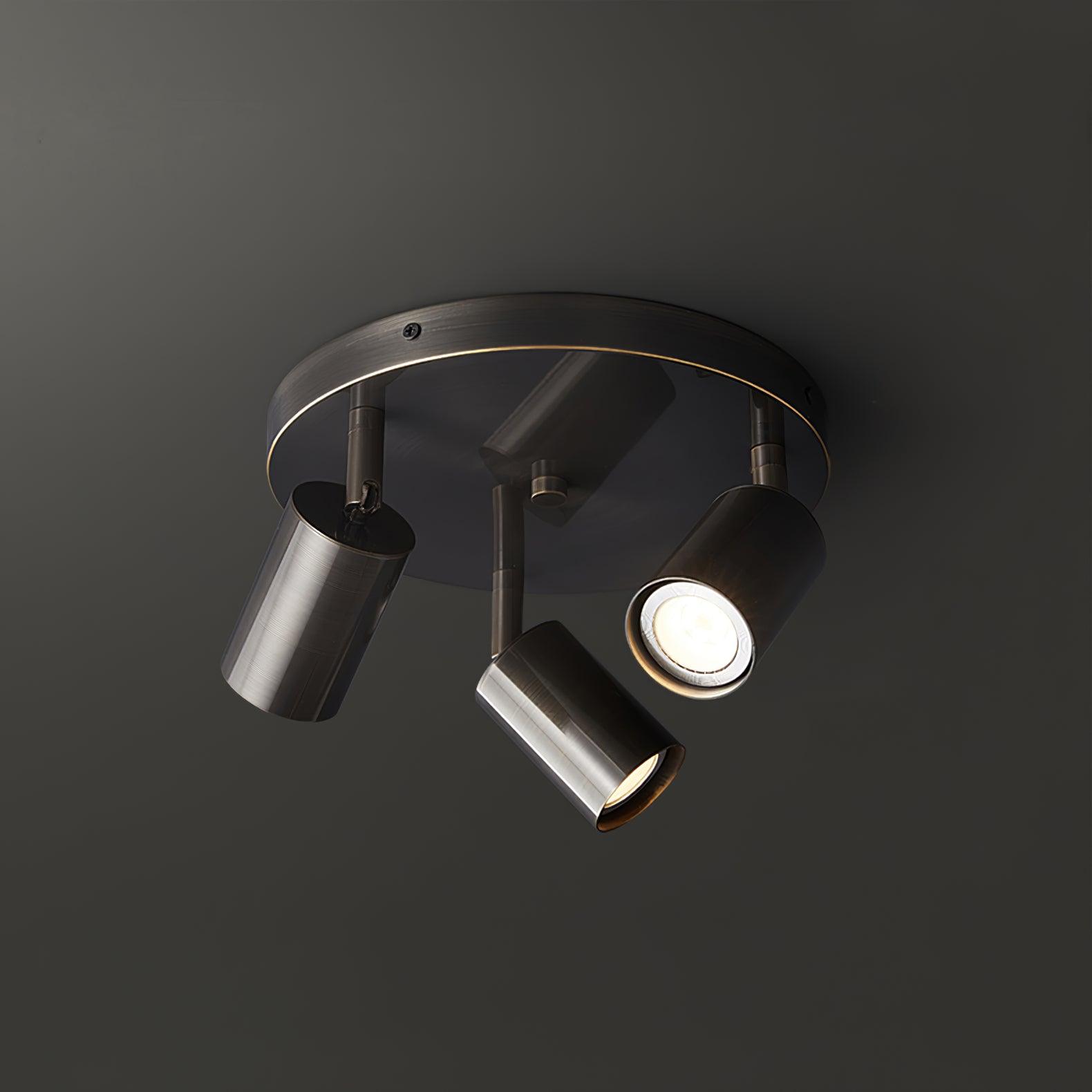
- Black — visually recedes. Best when your ceiling is white and low, or when you want the fixture to disappear and let the light do the work.
- Brass — warms up a cool-toned space and pairs naturally with wood floors, warm neutrals, and older homes. It also shows fingerprints slightly more, which is worth knowing before you spec one for a high-touch hallway.
There’s no brass-and-black combination and no custom RAL colours — the catalogue is two options. Pick based on what your floor and door hardware already are, not on what looks good in isolation.
Sizing: which one fits your ceiling
Both sizes are the same depth. Only the diameter and the number of heads change, which makes the decision simple.
| Spec | 3 Heads | 5 Heads |
|---|---|---|
| Diameter | 25 cm / 9.8 in | 30 cm / 11.8 in |
| Height | 15 cm / 5.9 in | 15 cm / 5.9 in |
| Bulb base | GU10 | GU10 |
| Max wattage | 25W per head | 25W per head |
| Voltage | AC 110–240V | AC 110–240V |
| Mounting | Ceiling, hardwired | Ceiling, hardwired |
| Rating | IP20, indoor | IP20, indoor |
| Materials | Metal | Metal |
As a working rule: the fixture diameter should be roughly one-third to one-half the width of a narrow hallway. A 36-inch-wide corridor takes the 9.8-inch version without crowding the walls. A foyer 5 feet across or wider can carry the 11.8-inch. Both sizes are offered in brass and black — check the current size and finish options here.
How to place it in a hallway
Ceiling height and clearance
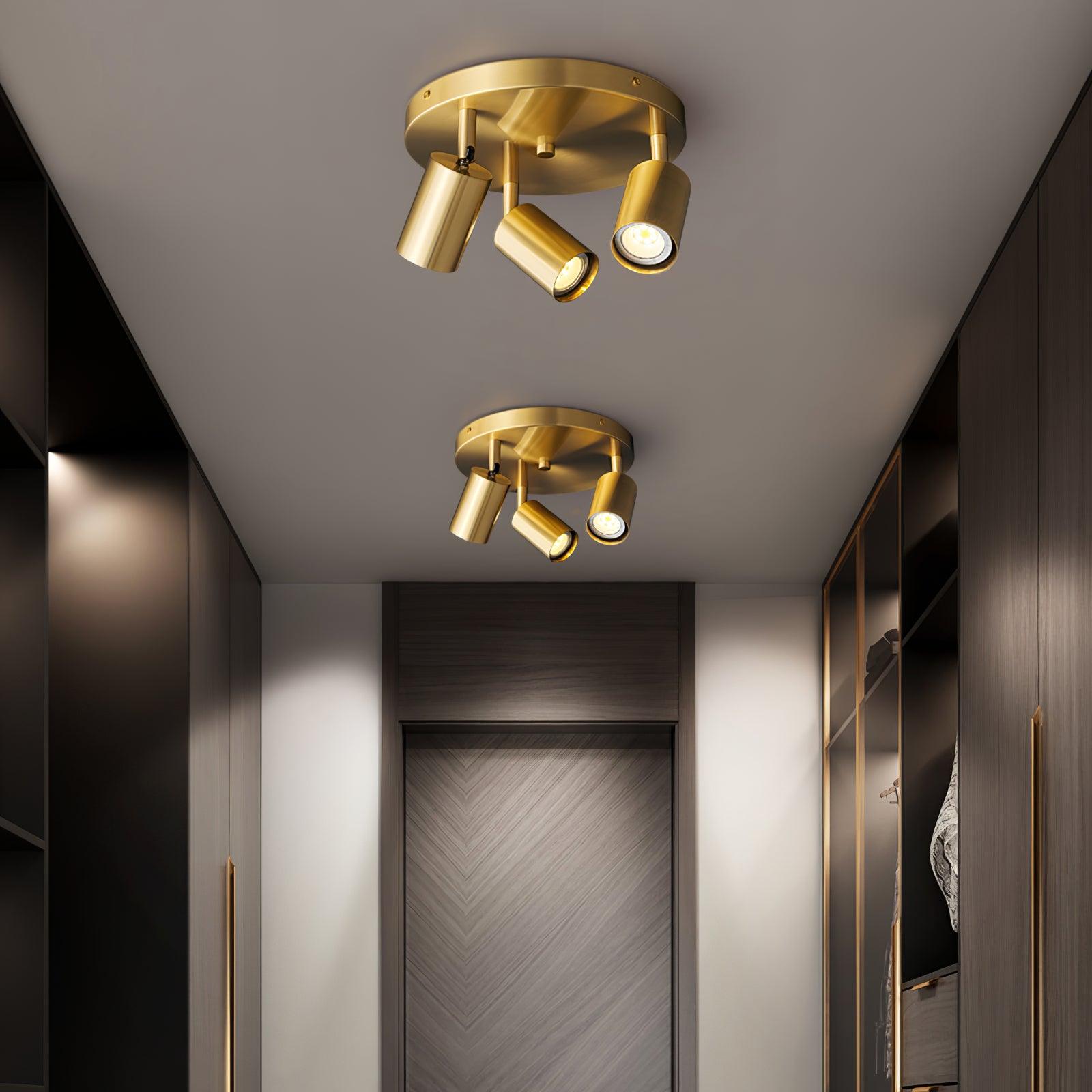
At 5.9 inches deep, the Cask is a true flush mount, not a semi-flush. On an 8-foot ceiling you keep about 7 feet 6 inches of clearance; on a 9-foot ceiling, about 8 feet 6 inches. That’s comfortable for a hallway where people walk with their hands full.
If your ceiling is below about 7 feet 6 inches, measure before ordering. A flush mount of this depth will still fit, but the fixture will sit in your line of sight and read as heavier than it does on a normal ceiling.
Spacing along the run
A single fixture centred on the hallway is the cheapest and often the best answer. For runs longer than about 10 feet, evenly spaced multiples look better than one lonely light in the middle:
- Divide the hallway length by the number of fixtures, and place each fixture at the midpoint of its segment.
- Keep roughly 3 feet between fixture edges so the pools of light don’t merge into one flat wash.
- On a 20-foot hallway, two fixtures 10 feet apart on centre is the usual starting point.
None of these are laws. Door placement, closet doors, and where the stairs land will overrule the math.
Entryway and foyer
Entryways want the light slightly toward the door, not dead centre of the room, so faces aren’t backlit when someone opens the door at night. If you have a two-storey foyer, this fixture is the wrong tool — it throws light down, and a tall space will feel unlit above eye level. Flush mounts belong over low, human-scale circulation space.
Bathrooms and damp rooms
The manufacturer lists this fixture as IP20 and damp-rated for indoor use only. That covers a bathroom, a laundry room, or a basement corridor where humidity comes and goes — but it is explicitly not for outdoor use or wet locations. Don’t put it on a covered porch, in a shower enclosure, or anywhere it takes direct spray.
Bulbs: the part that decides how the hallway feels
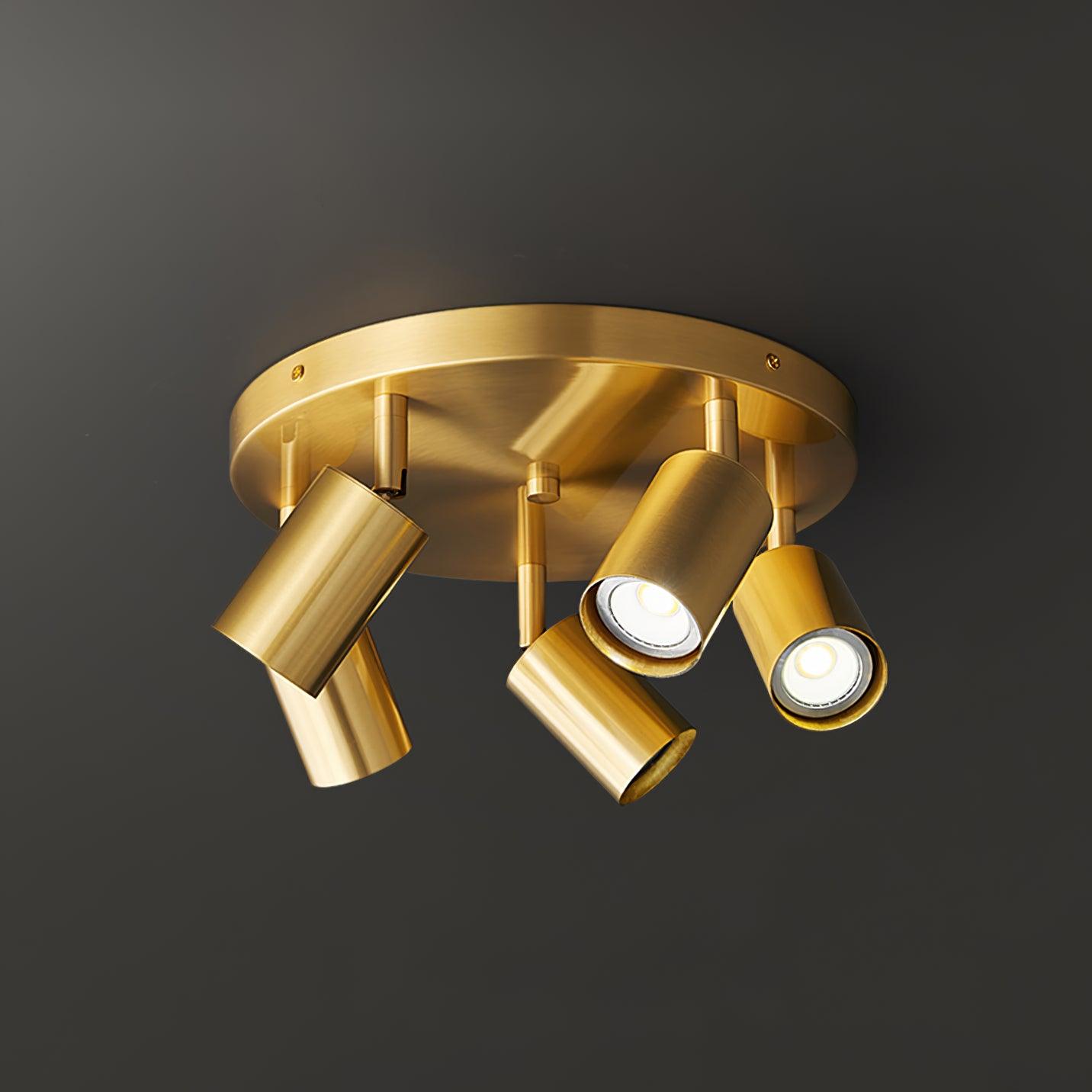
The fixture takes GU10 bulbs — LED or Edison-style — up to 25W per head. Bulbs are not included, which is normal for this category and genuinely useful: you get to choose the colour temperature instead of inheriting whatever the factory picked.
- 2700K — warm, residential, closest to an incandescent. Right for hallways that connect bedrooms and living rooms.
- 3000K — the safest all-rounder. Slightly crisper, still warm. Good default if you’re unsure.
- 3500–4000K — neutral white. Use it for a utility corridor, a mudroom, or stairs where visibility matters more than mood.
Two practical notes on GU10 LEDs. First, buy the same brand and the same colour temperature for every head — mixed batches of “3000K” can differ visibly side by side. Second, check the beam angle. A narrow 25–36° spot punches a bright hot circle onto the floor; a wider 60° flood gives the even, soft wash a hallway actually wants. For most corridors, wide flood.
On brightness: 25W is the ceiling, not the target. A 5–7W GU10 LED per head is typically plenty for circulation space, and dimmable bulbs are worth the small premium if the fixture is on a dimmer circuit. Bulbs aren’t included, so budget for them alongside the fixture — the Cask light itself is priced at $178.99.
Installation: what to expect
This is a hardwired ceiling fixture, controlled by a standard wall switch (switch not included). That means a junction box, a live and neutral feed, and a ground. If you’re replacing an existing ceiling light, the wiring is usually already there and the swap is straightforward for an electrician. If there’s no box, you’re into new wiring, and that’s a different job.
The manufacturer recommends installation by a licensed electrician, and for a hardwired ceiling fixture that’s the right call — not a disclaimer to skip. Certifications listed for this product are UL, ETL, CE, and SAA, with RoHS compliance and FCC certification noted. Confirm the unit shipping to you carries the mark your local inspector expects: UL or ETL for North America, CE for the EU, SAA for Australia.
One thing worth deciding before the electrician arrives: whether you want the fixture on a dimmer. Retrofitting one afterward is cheap, but it’s cheaper still to decide now.
Where it works, and where it doesn’t
Good fit: hallways, entryways, foyers with standard ceiling heights, bedrooms, dens and home offices, small dining rooms, kitchen perimeters, boutique hotel corridors, restaurant circulation areas.
Poor fit: two-storey foyers and stairwells (needs a pendant or a chandelier), outdoor porches and covered patios (indoor rating only), shower enclosures, and any room where you want the light source itself to be the feature rather than the light it produces.
Compared with the alternatives in the same price band: a flush mount beats a semi-flush in low corridors because it doesn’t eat headroom; it beats a bare-bulb fixture on looks; and it beats a recessed downlight if you want to avoid cutting ceiling holes or if the ceiling is concrete. What it gives up versus recessed lighting is evenness — one central fixture in a long hallway creates a bright middle and dim ends, which is exactly why the spacing rules above matter.
Frequently asked questions
Is this fixture bright enough for a hallway on its own?
With three or five GU10 LED heads at 5–7W each, yes for a typical residential hallway. If your hallway is longer than about 10–12 feet, plan on two fixtures rather than oversizing the bulbs — one very bright fixture in the middle of a long corridor looks worse than two moderate ones.
Can I use it in a bathroom?
The product is listed as IP20 and damp-rated for indoor use only, so a bathroom is within its intended use — but not a wet location, and not outdoors. If your bathroom has a shower that mists the whole room, keep the fixture out of the direct spray zone.
Does it come with bulbs?
No. It takes GU10 LED or Edison bulbs, maximum 25W per head, and bulbs are sold separately. Buying your own is an advantage here: you control colour temperature and beam angle, which is most of how the finished room will feel.
What’s the difference between the 3-head and 5-head versions?
Diameter only — 9.8 inches versus 11.8 inches — plus the number of light sources. Both are 5.9 inches deep and both are metal. Small halls and narrow corridors take the 3-head; wider foyers and longer runs take the 5-head.
Do I need a special switch?
No. It works with a common wall switch, which is not included. If you want dimming, you’ll need dimmable GU10 bulbs and a compatible dimmer.
The bottom line
If your hallway is a standard-width corridor with a normal ceiling, a flush mount is the correct fixture type, and the Cask is a well-resolved version of it: shallow enough to keep headroom, metal enough to survive the traffic, and quiet enough in form that it won’t date. Choose 3-head for narrow runs under 10 feet, 5-head for wider entryways, pick black to disappear and brass to warm the space, and spend your attention on the bulbs — 3000K wide-flood GU10 LEDs will do more for how that hallway feels than any other decision in this article.
See the Cask ceiling light — sizes, finishes and current price at MiniHouzz →