
A glass pendant light does two jobs at once, and that is why it keeps showing up in high-end kitchens. It delivers task light exactly where hands are working, and it stays visually quiet while doing it — no bulk, no visual weight, nothing blocking the sightline across an island or a dining table.
If you are specifying one for a kitchen island or dining room, the short answer is this: pick a shade between roughly 5 and 10 inches in diameter, hang the bottom of the glass 30 to 36 inches above a countertop (a little lower, 30 to 34 inches, over a dining table), and use a warm-white bulb around 2700K–3000K so the glass glows rather than glares. Everything else — finish, count, spacing, cable length — follows from the room.
The MiniHouzz glass pendant light is a useful reference point for how those decisions actually play out, because it comes in three sizes with a 59-inch adjustable cable and four finishes. Here is how to think through each choice before you buy.
Why glass reads as luxury without trying
Opaque fixtures announce themselves. Glass ones don’t. A transparent or tinted glass shade lets the bulb, the cable, and the room behind it remain visible, so the pendant occupies space without filling it. In a kitchen, that matters more than it does anywhere else in the house, because the island is usually the one place where you want light overhead and an uninterrupted view across the room at the same time.
Glass also changes character with the light source. The same shade looks crisp and architectural with a clear bulb, soft and amber-toned with a warm Edison filament, and almost sculptural when switched off in daylight. That range is why the material has stayed in Scandinavian and modernist interiors for decades rather than cycling out.
Design and materials
This collection is built on a simple formula: a metal body, a glass shade, and clean Scandinavian lines. The glass is the visual event; the metal is the structure that holds it. Because both the body and the shade are offered in the same finish family — transparent, amber, smoke gray, or rose gold — you can either let the fixture disappear into a neutral scheme or use the metal as the accent.
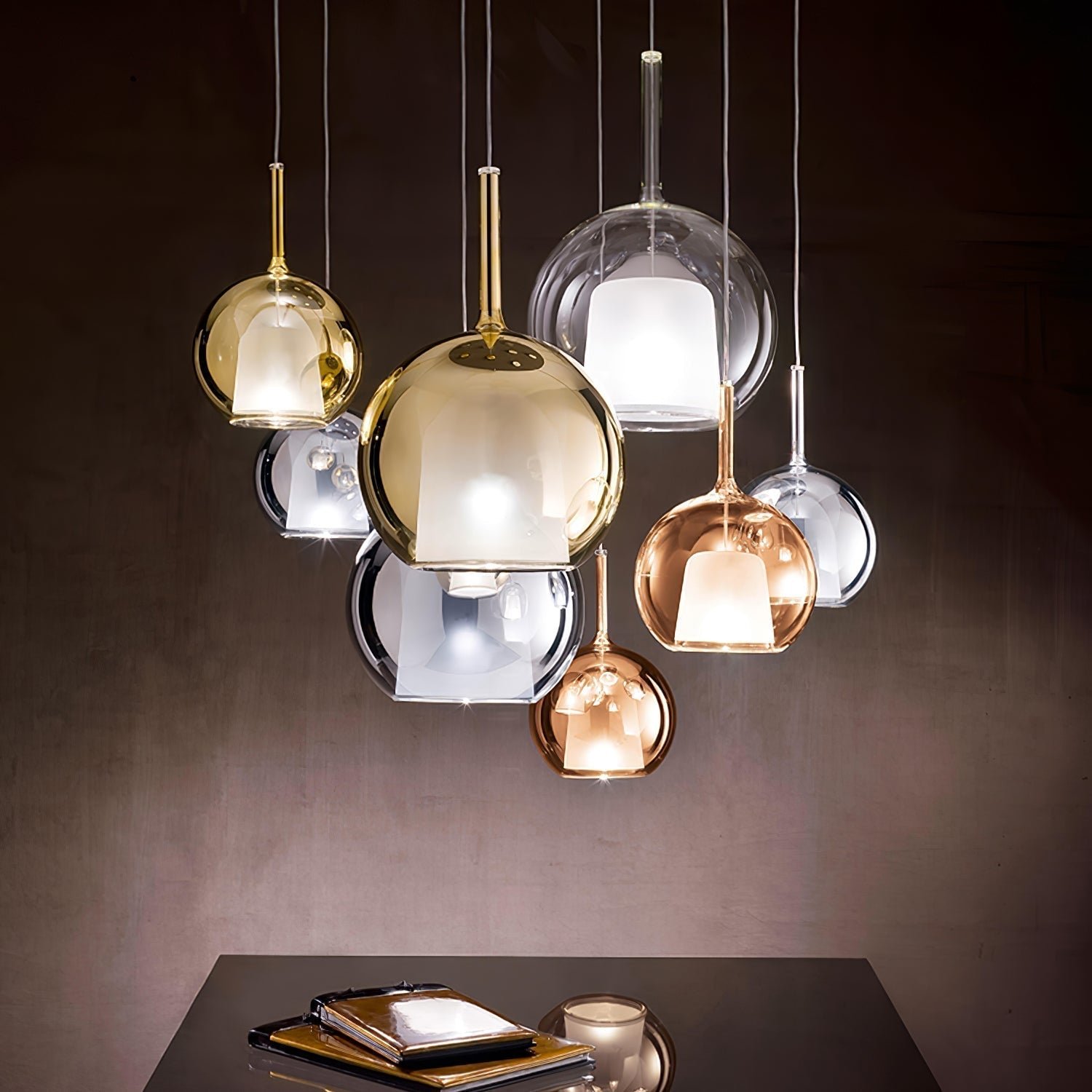
A few practical notes on the build, taken from the manufacturer’s specification: the fixture is hardwired and mounts to the ceiling, it is rated for indoor use with an IP20 moisture rating (so keep it out of direct steam and spray — fine over an island, not ideal directly beside a shower), and it works on AC 110–240V, which means it is equally at home on a US 120V circuit and a European 220–240V supply. The bulb is replaceable, which is the detail people forget to check until year three.
On safety paperwork, the fixture is UL and ETL listed, CE approved, SAA listed, RoHS compliant, and FCC certified. If you are buying for a rental, a spec house, or a permitted remodel, those listings are the difference between passing inspection and re-buying the fixture.
Choosing the right size
Size is decided by the surface underneath, not by the ceiling height. A 5-inch shade over a 36-inch-wide island looks stranded; a 10-inch shade over a narrow breakfast bar crowds it.
| Size | Dimensions | Bulb base | Best suited to |
|---|---|---|---|
| Small | ∅ 5.1 in × H 11.8 in (13 cm × 30 cm) | G4, 3W | Pairs or trios over a compact island, bedside, narrow hallway |
| Medium | ∅ 7.9 in × H 14.2 in (20.1 cm × 36.1 cm) | E27, 40W | The default for a single pendant over a small dining table or sink |
| Large | ∅ 9.8 in × H 16.9 in (24.9 cm × 42.9 cm) | E27, 40W | A statement single over a round table, or two over a long island |
If you are hanging more than one, work backwards from the island length. A common approach is to leave 12 to 18 inches of clear counter at each end, then divide the remainder evenly between fixtures. With shades in the 5-to-8-inch range, that usually lands you at 24 to 30 inches on center; with 10-inch shades, give them 30 to 36 inches so the glass doesn’t visually merge into a single mass.
Hanging height, spacing, and the cable
Height is the single most common mistake, and it is almost always too high. Light thrown from a pendant drops in a cone; if the fixture sits above eye level, you light the room and not the work surface.
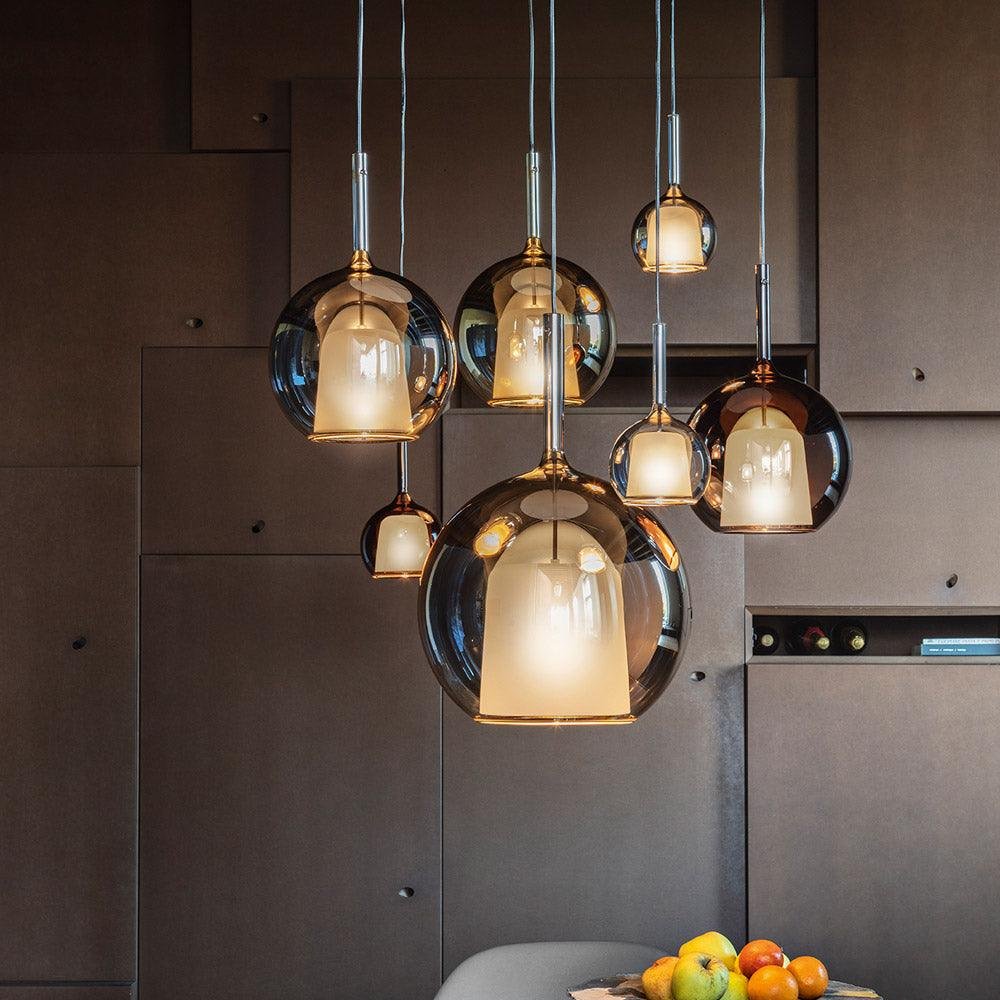
As a starting point:
- Over a kitchen island: 30–36 inches from the countertop to the bottom of the shade. If your household is tall or the island is used for prep rather than seating, go toward 36. If people sit at the island with their backs to it, keep the bottom above seated eye level.
- Over a dining table: 30–34 inches from tabletop to the bottom of the fixture. Lower reads more intimate; higher reads more formal and gives more room for centerpieces.
- Over a bedside or side table: 20–28 inches above the surface, adjusted to taste.
- In a hallway or stairwell: keep the lowest point at least 6 ft 8 in above the floor for clearance.
The 59-inch (149.9 cm) cable on this fixture is adjustable and can be lengthened on request, which covers standard 8-to-10-foot ceilings with room to spare. Measure from the ceiling canopy to the bottom of the shade rather than guessing — and if you are ordering several pendants for one run, set them at the same height with a laser or a string line, not by eye.
One caveat the manufacturer is explicit about: this is a ceiling-mount fixture intended for flat ceilings. On a sloped or vaulted ceiling, have an electrician assess the mounting and safety before you commit. That is not a limitation specific to this light — most canopy-mounted pendants behave the same way.
Bulbs and color temperature
Because the bulb is visible through the glass, the bulb is part of the design. Two rules cover most of it.
Match the base to the size. The smallest pendant takes a G4 base at 3W; the two larger sizes take an E27 base at up to 40W. Do not exceed the stated wattage, and if you are swapping an incandescent Edison bulb for an LED, check the LED’s actual wattage rather than assuming equivalence.
Choose 2700K–3000K for living spaces. Warm white makes amber and rose gold glass look rich and makes clear glass look soft rather than clinical. 4000K and above is a workshop color — useful in a garage, harsh over a dining table. For a filament look, a dimmable LED Edison-style bulb in the E27 sizes gives the vintage silhouette without the heat.
Which finish, and where
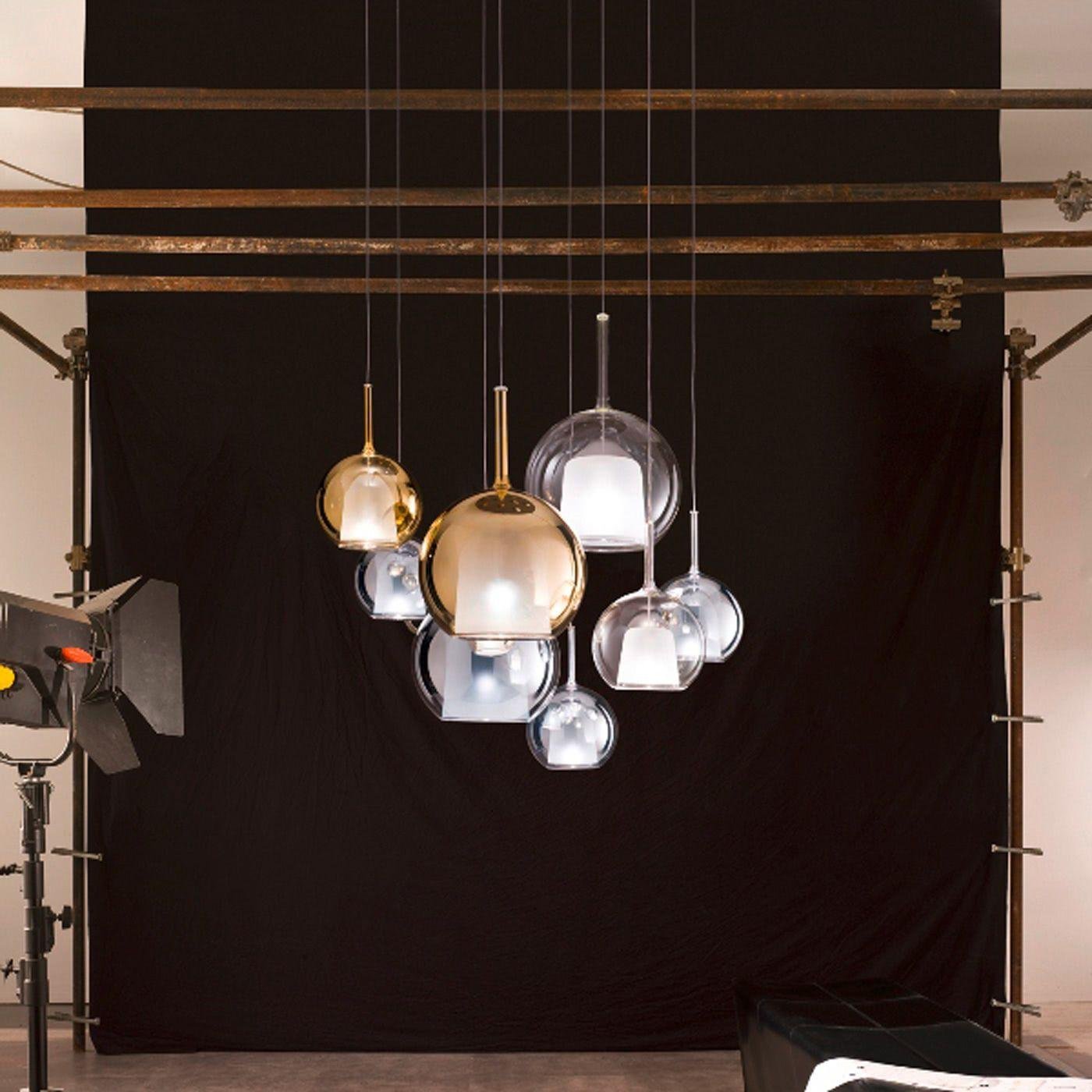
- Transparent: the most architectural option. Best in bright rooms with white, oak, or stone surfaces, and the easiest to mix with other fixture styles.
- Amber: warms a cool-toned kitchen instantly. Works well over wood and in rooms with little natural light; be careful in a very warm scheme, where it can tip into heavy.
- Smoke gray: the most contemporary of the four. Good against concrete, black hardware, and stainless; it mutes the bulb so the fixture reads as a shape first and a light second.
- Rose gold: use it as the accent rather than the background. One or two over an island, paired with neutral glass, is usually enough.
A useful test: photograph the room in daylight, then look at the image in black and white. If the room already has strong tonal contrast, smoke gray or clear glass will sit comfortably. If it reads flat, amber or rose gold adds the missing warmth.
Specifications at a glance
| Material | Metal and glass |
|---|---|
| Light source | LED or Edison bulb, replaceable |
| Bulb base | E27 (medium and large) or G4 (small) |
| Voltage | AC 110–240V |
| Mounting | Ceiling, hardwired |
| Hanging cable | 59 in / 149.9 cm, adjustable, can be lengthened as required |
| Moisture rating | IP20, indoor use away from moisture |
| Finishes | Transparent, amber, smoke gray, rose gold |
| Controls | Compatible with common wall switches (not included) |
| Certifications | UL, ETL, CE, SAA listed; RoHS compliant; FCC certified |
Dimensions may vary slightly due to manual measurement, and finish or color temperature can shift a little between batches and between screens — worth knowing if you are matching an existing fixture.
Before you order: a five-point checklist
- Measure the surface, not the ceiling. Island length, table diameter, counter depth.
- Confirm the ceiling type. Flat ceiling: straightforward. Sloped or vaulted: bring in an electrician first.
- Count your circuits. Multiple pendants on one switch is normal; individual switching needs planning before drywall.
- Decide the bulb before the fixture. Base type and color temperature determine how the glass will actually look.
- Check the paperwork for your jurisdiction. UL and ETL for North America, CE for Europe, SAA for Australia — all listed here.
If you need a specific drop length, a custom configuration, or help laying out a run of pendants across an island, the MiniHouzz design consultants handle custom requests directly, and expedited shipping is available on request.
FAQ
How high should I hang a glass pendant over a kitchen island?
Start at 30–36 inches from the countertop to the bottom of the shade. Go lower if the island is mainly a seating and social surface, higher if it is a primary prep zone or if tall users will be working under it.
Can I hang this pendant on a sloped ceiling?
It is designed for ceiling mounting and is generally suited to flat ceilings. For sloped ceilings, the manufacturer recommends consulting a professional electrician to confirm a safe installation.
What bulb does it take?
The 5.1-inch pendant uses a G4 base at 3W. The 7.9-inch and 9.8-inch versions use an E27 base at up to 40W. Both LED and Edison-style bulbs work, and the bulb is replaceable.
Is the hanging height adjustable?
Yes. The cable is 59 inches (149.9 cm) and adjustable, and it can be lengthened as required for higher ceilings or a deeper drop.
Can I use it in a bathroom?
It carries an IP20 rating and is intended for indoor use where it is not exposed to moisture. That makes it a reasonable choice in a powder room but not in a wet zone such as directly over a shower or bath.
The short version
Glass pendants work because they solve two problems with one object: they put light where you need it and they keep the room legible. Get the size right relative to the surface, hang the shade low enough to actually light the counter, choose a warm bulb, and let the finish follow the room’s existing palette rather than fight it.
The MiniHouzz glass pendant light collection covers the range from a 5.1-inch accent to a 9.8-inch statement piece, in four finishes, with the certifications and adjustable cable that make specification straightforward. At $104.99 it sits in the range where you can afford to use three across an island instead of one — which is usually the better design decision anyway.