
A directional wall sconce solves a problem most wall lights ignore: aiming. Instead of washing a fixed cone of light up the wall, this fixture uses a 90–360° adjustable joint so you can point the beam at a painting, a reading chair, a stair rail, or a hallway turn — and re-aim it later without rewiring anything. It is a brass-bodied indoor spotlight that mounts flush to the wall, runs on a standard G5.3 LED or Edison bulb at roughly 5W, and works on 110–240V.
The honest answer to “is this the right sconce for my room?” is: it is the right choice when the wall is a backdrop, not the subject. If you need even ambient glow across a whole hallway, a diffused sconce does that better. If you need controlled light — accent, task, or architectural punctuation — keep reading.
How the 90–360° Joint Changes the Room
The joint is the whole product. A 90° range lets you tilt the head off the wall plane; the 360° rotation lets you swing it through a full circle around its axis. In practice that means one fixture can do three jobs depending on where you stop turning it:
- Grazing the wall — head turned almost parallel to the surface, so light skims texture and makes plaster, brick, or panelling read as material rather than a flat colour.
- Cross-lighting a surface — head angled 30–45° off the wall, aimed across a canvas or a shelf run. This is the position that flattens shadows on artwork.
- Throwing into the room — head turned outward to act as a small downlight or uplight over a chair, console, or stair landing.
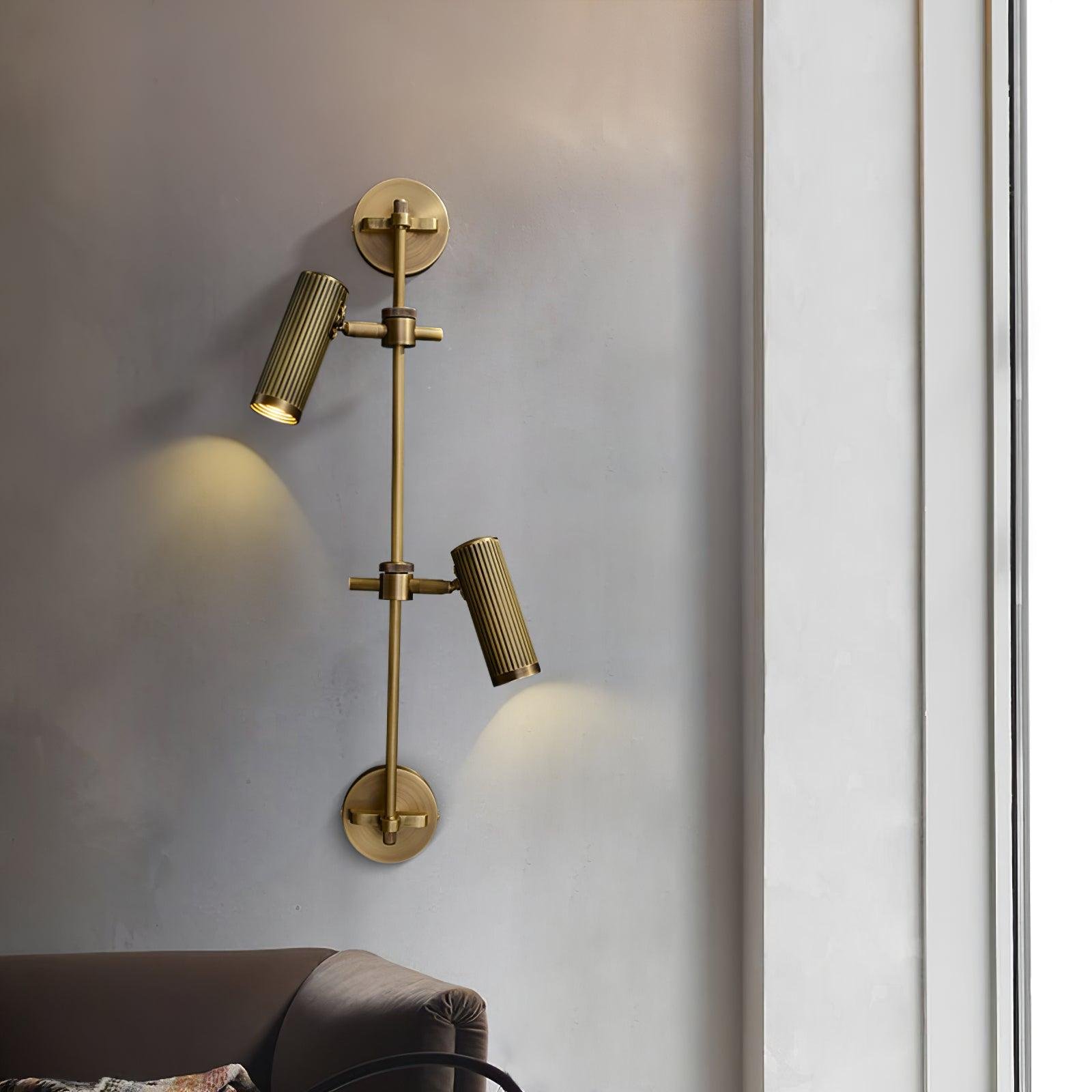
Because the head is small relative to the body, the beam stays tight. That is what makes it useful beside a bed or in a corridor where you want light on a landing point, not a lit ceiling.
Brass, Bronze, and a Finish That Ages
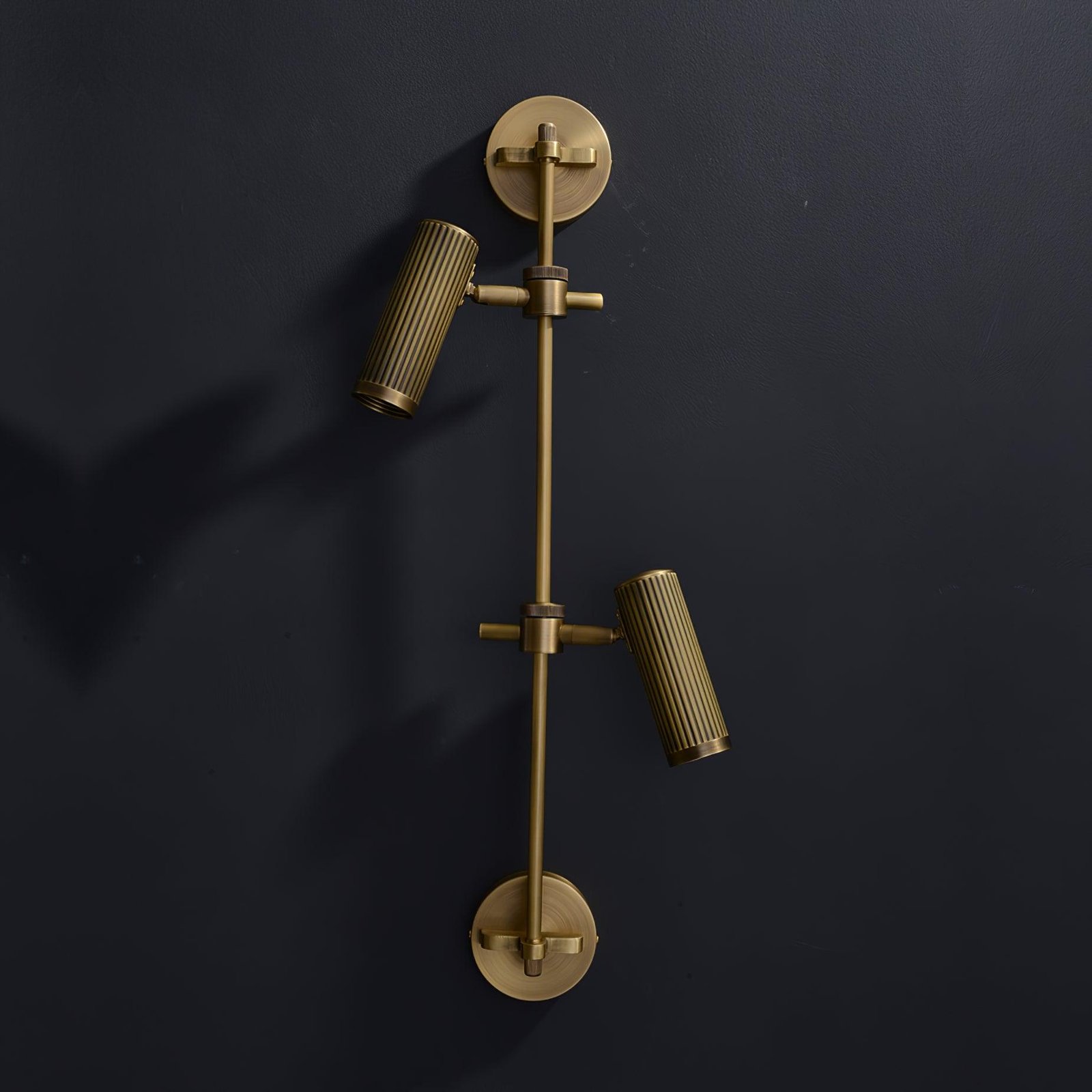
The body is brass and metal, finished in bronze using a process of moulding, polishing, oxidising, then polishing again. The oxidising step is why the colour is not a flat painted brown — it is a chemically darkened surface that sits somewhere between warm bronze and aged brass.
Two practical consequences:
- It reads as metal, not coating. Under raking light you get the slight sheen and depth that painted steel cannot fake, which is exactly what you want if the fixture is meant to look period-appropriate in an older house.
- Hands and humidity leave marks. An oxidised finish is stable in normal indoor conditions (IP20), but it is not a sealed lacquer. Wipe with a dry or barely damp cloth; skip abrasive polish, which will strip the intentional darkening unevenly.
Placement: Heights, Spacing, and Where to Aim
The fixture is a tall, narrow form — the single-head version stands 55 cm (21.7 in) high with a 17 cm (6.7 in) diameter. That shape wants vertical wall space, usually in a narrow slot rather than a wide open wall. Concrete numbers to work from:
Bedroom
Mount the backplate so the lit head sits roughly level with your shoulder when seated — commonly 30–40 in (75–100 cm) above the mattress top, or about 48–56 in (120–142 cm) from the floor. Aim the head slightly down and toward the pillow for reading, or rotate it toward the wall for a soft halo effect if you prefer no direct glare. Place one per side of the bed if you are replacing table lamps; keep them equidistant from the headboard so the pair reads symmetrical.
Hallway and entry
Long corridors read better with fixtures spaced 6–8 ft (1.8–2.4 m) apart at a consistent height — 66–72 in (168–183 cm) from the floor is a reliable default for a small spotlight. If you have a turn, a stair, or a change in flooring, put one fixture at that point and aim it down: guiding light beats evenly distributed light in circulation spaces.
Art, shelving, and consoles
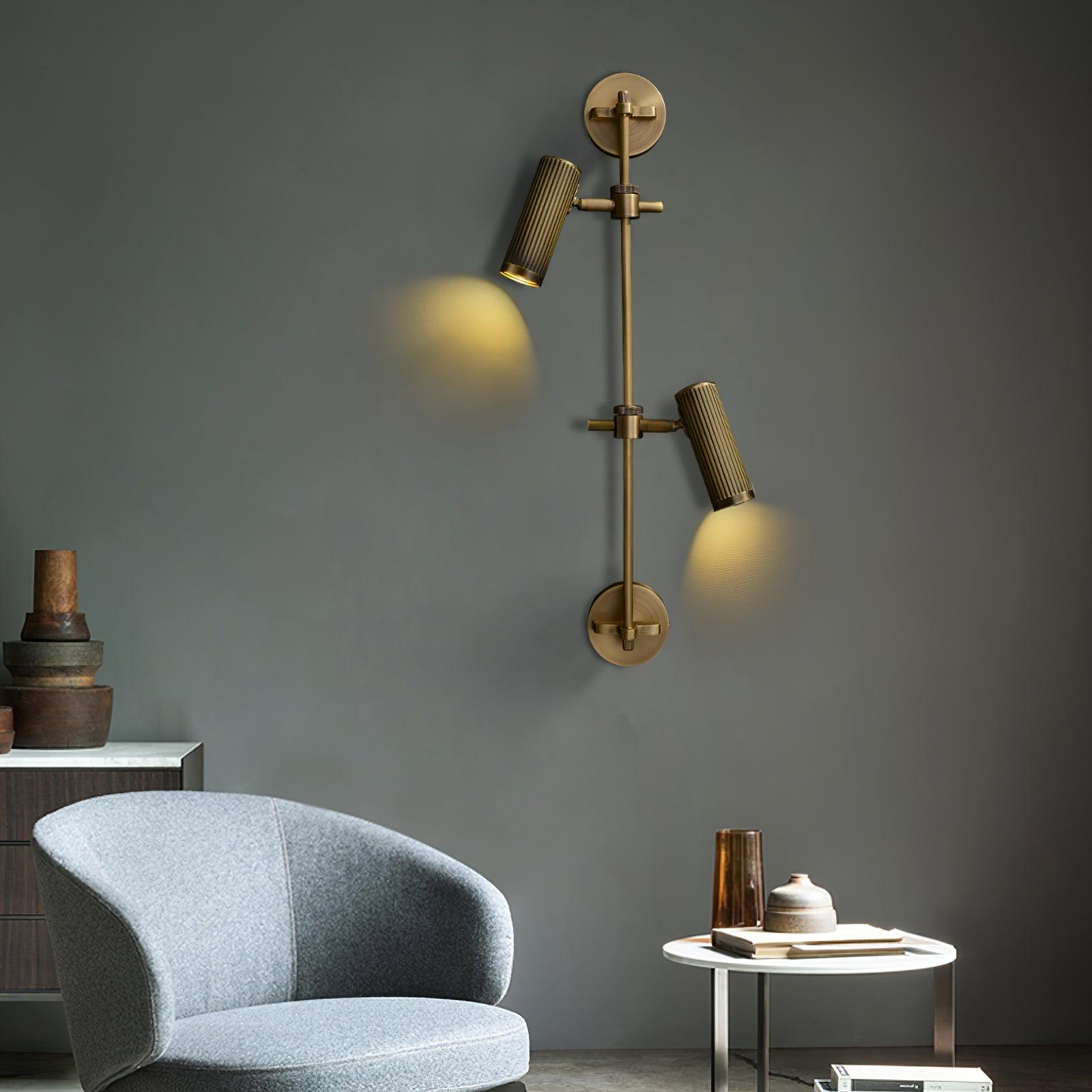
For a canvas, place the fixture 6–10 in (15–25 cm) above the top edge and offset slightly to one side, then angle the head across the surface at 30–45°. Cross-lighting from one side reads as texture; two fixtures from both sides read as even. Over a console or sideboard, aim down at roughly 25–35° off vertical so the pool of light lands on the objects rather than the wall above them.
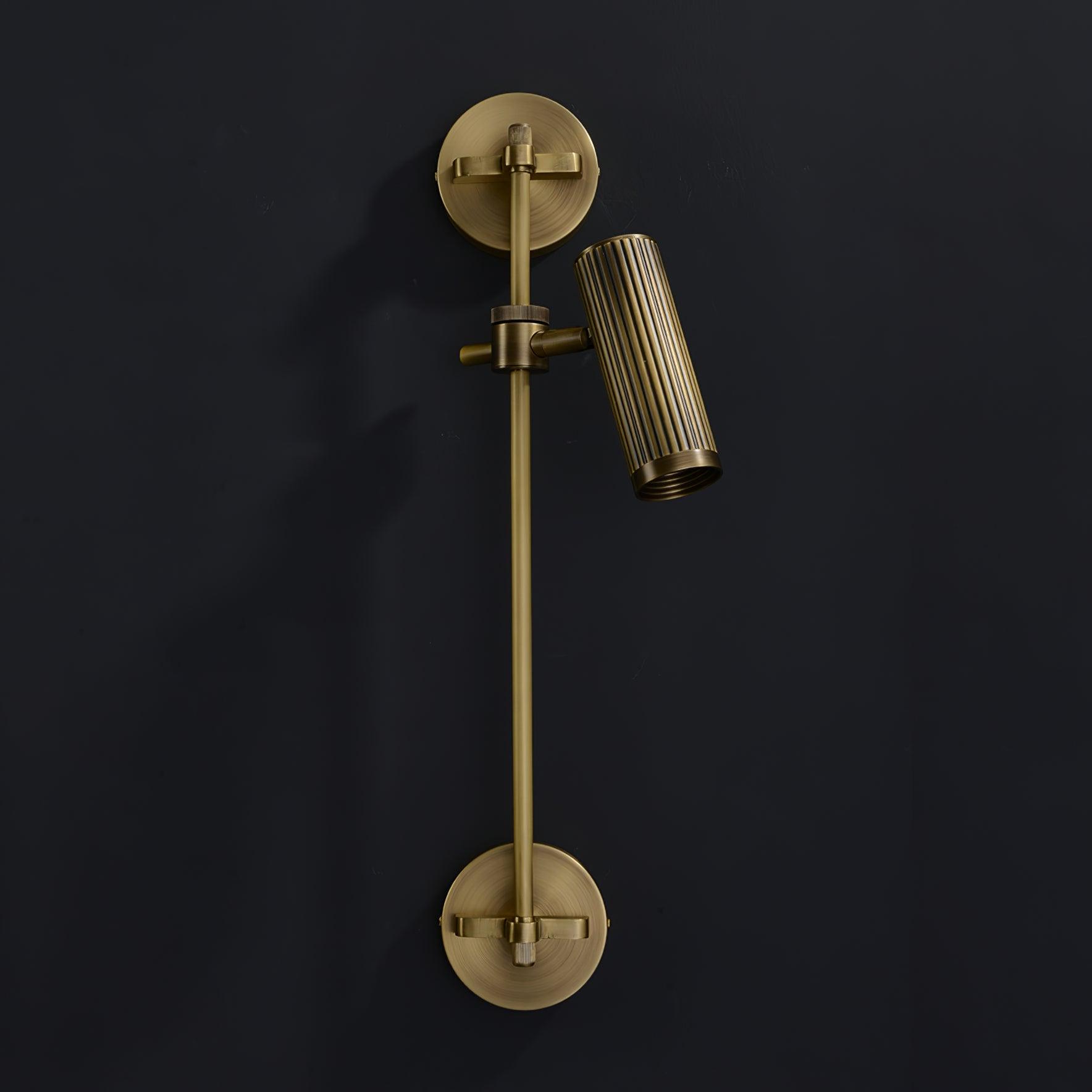
A planning note that saves a second order: sketch the wall and mark how far the head reaches when fully extended. The single-head unit projects from a 17 cm base but the head can swing well outside that footprint — nothing should block its arc, including door swing and wardrobe clearance.
One Head or Two? Sizing Compared
The model is offered as a single fixture or as a set of two. The geometry is not simply doubled — the two-head version is taller and wider to carry the second head.
| Configuration | Dimensions | Best for |
|---|---|---|
| 1 head | 17 cm dia × 55 cm H (6.7 in × 21.7 in) |
Bedsides, narrow hallway piers, a single artwork, stair landings |
| 2 heads | 24 cm dia × 71 cm H (9.4 in × 28 in) |
Wide walls, double-height entries, symmetrical pairs either side of a mirror or console |
Listed weight is 4 kg / 8.8 lb. Because that is a real mass on a wall, fix into a stud or a proper masonry anchor rather than drywall plugs alone — a spotlight you reposition regularly will work a loose fixing free over time.
Both configurations ship as one fixture or a set of two in the same bronze brass finish; the set is two individual fixtures packed in one order.
Bulbs, Switching, and Light Quality
The socket is G5.3, rated for an LED or Edison bulb at around 5W, on AC 110–240V. Two details worth knowing before you install:
- Dimming is a bulb decision. The fixture itself is not dimmable out of the box — the supplied default bulb is not dimmable either — but it is compatible with dimming when you fit a dimmable bulb. If dimming matters, plan the bulb and the dimmer switch together, and confirm the switch is compatible with LED loads.
- Control is on the fixture. Switching is a push button on the unit, not a wall switch requirement. That suits retrofits where pulling a new switch leg would mean opening the wall — but it also means a sconce mounted high is awkward to reach, so keep the button within hand height if you intend to use it daily.
On colour temperature, the practical rule for a bronze brass fixture is warm: a directional beam is a hard light source, so very cool white will look clinical against aged metal. If you are lighting artwork, higher colour rendering matters more than the exact Kelvin number — pick a bulb whose rendering is honest, and keep the secondary fixtures in the room in the same family so the wall does not show two different whites.
No driver and no battery are required, and the fixture carries UL, ETL, CE, RoHS and FCC compliance as listed by the manufacturer.
Specifications
| Item | Detail |
|---|---|
| Material | Brass, metal |
| Finish | Bronze (moulded, polished, oxidised, polished) |
| Light source | LED or Edison bulb, G5.3 base |
| Power | ~5W |
| Voltage | AC 110–240V |
| Adjustment | 90–360° directional joint |
| Control | Push button switch (not dimmable as supplied) |
| Mounting | Wall |
| Environment | Indoor, IP20 |
| Weight | 4 kg / 8.8 lb |
| Driver / battery | Not required |
FAQ
Can the light direction really be adjusted through 360°?
Yes. The fixture uses a 90–360° adjustable joint, so the head can be tilted off the wall and rotated around its axis to point where you need it. Aim it before you tighten the joint, and re-check after the fixture has hung for a day.
Is this sconce dimmable?
Not as supplied. The fixture is compatible with dimming if you install a dimmable bulb, but the default bulb included is not dimmable.
What bulb does it take?
A G5.3 LED or Edison bulb at approximately 5W. The fixture runs on AC 110–240V, so it does not need a driver.
Can I use it in a bathroom or outdoors?
No. It is rated IP20 and specified for indoor use, so it is not suited to damp or wet locations such as showers, exposed porches, or exterior walls.
How high should I mount it?
For bedside use, roughly 30–40 in above the mattress top. For hallways, 66–72 in from the floor at consistent spacing. For artwork, 6–10 in above the top edge, angled across the surface.
Where It Earns Its Place
Buy this sconce if you have a specific thing to light and want the fixture to stay out of the way while doing it: a bedside, a corridor turn, a piece of art, a stair landing, a console. The adjustable joint, solid brass body, and bronze oxidised finish are the reasons it costs more than a fixed wall light — they are also the reasons it will still look deliberate in ten years.
Buy something else if you need broad ambient wash, wet-location rating, or dimming straight out of the box with no bulb swap.
Available as a single fixture or a matched set of two, in a bronze brass finish that suits period interiors, boutique hotels, and modern rooms where one warm metal accent is doing the work.
View the Adjustable Brass Directional Wall Sconce — single or set of two →