
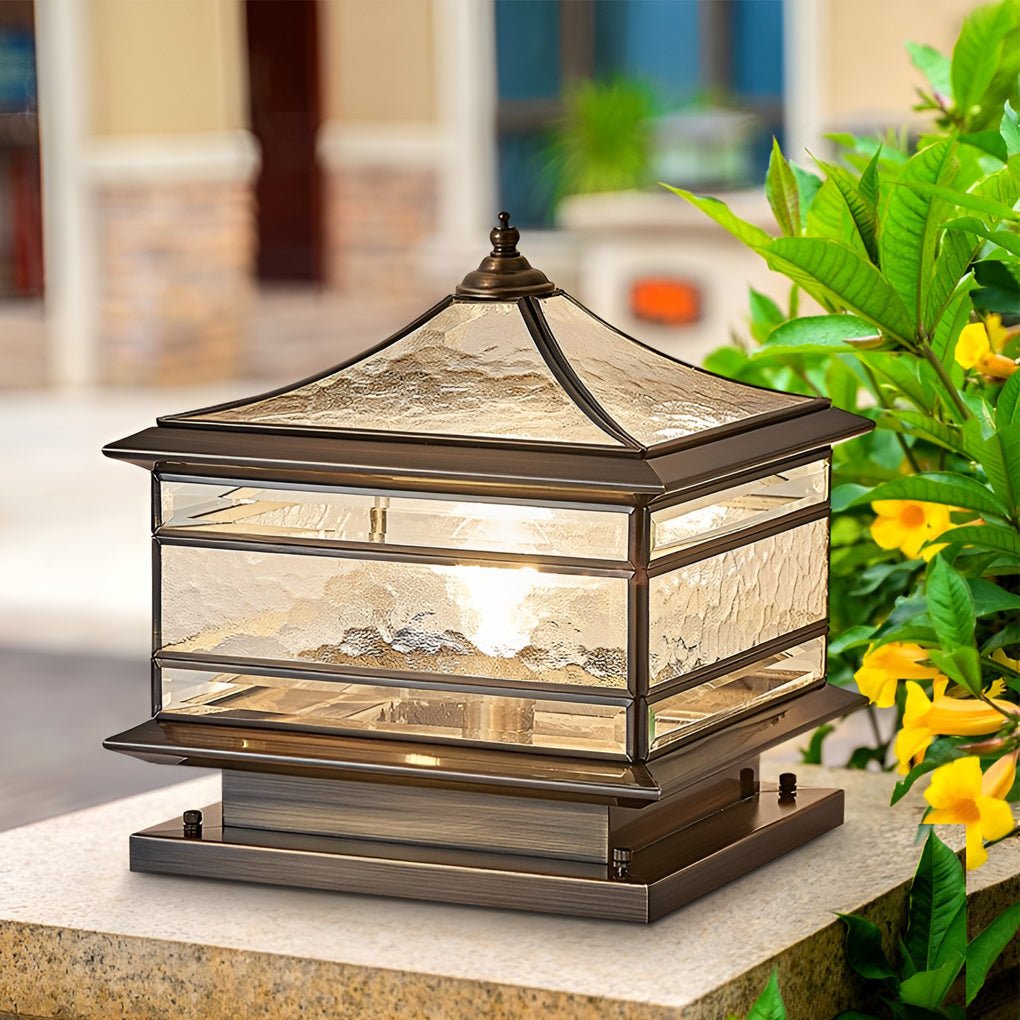
A copper fence post light is one of the few exterior fixtures that looks better a few years after installation than it did on day one. This model from MiniHouzz is built around that idea: an H65 copper body, a tempered glass shade, and a changeable E27 bulb, offered in three sizes and two power options. If you are deciding between the solar and hardwired versions, or wondering which of the three sizes belongs at a gate versus along a fence line, the short answer is: match the size to the post cap and the audience — 9.8 inches for a garden path, 11.8 inches for a standard gate pillar, 15.7 inches for a driveway entrance or villa wall.
The rest of this guide covers what the copper and glass actually do for you, how the two power options differ in installation, and the practical numbers — mounting heights, spacing, bulb choice — that make an outdoor post light look intentional rather than improvised.
Design and materials: what H65 copper and tempered glass change

H65 copper is the reason this fixture is worth considering over painted aluminum or die-cast zinc. The alloy designation refers to a high copper content, and the practical result is a body that resists rust and deformation and does not flake the way coated metals eventually do. Copper oxidizes gradually into a brown-to-verdigris patina, which means the finish evolves instead of failing. If you want the bright new-penny look to last, expect to polish; if you prefer the aged look, do nothing at all.
The shade is tempered glass, not acrylic. Tempered glass carries two advantages outdoors: it holds up to temperature swings and impact better than ordinary glass, and it does not yellow or scratch the way plastic diffusers do after a couple of seasons. The description notes high light transmittance with a bright but non-glaring output — a function of both the glass and the shade’s shape, which spreads light outward rather than firing it straight down.
Coastal and salt-air installations
Copper and tempered glass are a sensible combination near the ocean. Salt air attacks the fasteners and coatings on most budget fixtures long before it bothers solid copper, and glass does not degrade from humidity. That said, no exterior fixture is maintenance-free in a coastal environment — plan on an occasional freshwater rinse to keep salt deposits off the glass, especially on the side facing the prevailing wind.
Every fixture in this line uses the same construction, so size is the only thing that changes as you move up: see the current copper post light options here.
Solar or hardwired: decide this before you dig
These are two separate products, not one hybrid. The fixture ships either as a hardwired unit or as a solar unit, and the description is explicit that it is not designed to run both ways at once. Choosing wrong means living with a compromise for years, so match the option to the site.
| Hardwired | Solar | |
|---|---|---|
| Power | Tied to a 110–220V circuit | Self-contained, no circuit needed |
| Best for | Gates, doorways, villa walls near an existing circuit | Fence lines, garden paths, remote posts with no trenching budget |
| Installation effort | Higher — requires a qualified electrician and a buried conduit run | Lower — mount and go |
| Output consistency | Full brightness whenever switched, year-round | Depends on sun exposure and season |
| Ongoing cost | Electricity only | None beyond eventual battery replacement |
Choose hardwired if the post is within reasonable trenching distance of a circuit, if the light needs to work on a schedule or a switch, or if you want guaranteed brightness through short winter days. Hardwiring is the only way to get consistent output in a shaded courtyard or on the north side of a house.
Choose solar if trenching would mean tearing up a finished driveway or mature landscaping, or if the post sits far from any power source. Solar units live or die by panel exposure — a post under tree canopy will underperform regardless of how good the fixture is.
Both versions use the same copper body, the same tempered glass, and the same E27 socket. Full specs for each are on the product page.
Three sizes: match the fixture to the post

The most common mistake with post lights is undersizing. A fixture that looks generous on a product page can look like a candle stub on a 6-inch masonry pillar. Use the post cap as your reference: the light’s base should be close to the cap width, and the fixture should read as the top of the post, not a decoration sitting on it.
| Option | Dimensions | Weight | Typical use |
|---|---|---|---|
| 1 | 9.8″ W × 9.8″ D × 11.8″ H (24.9 × 24.9 × 30.0 cm) | 8.81 lb (4.0 kg) | Garden paths, deck posts, smaller fence pillars |
| 2 | 11.8″ W × 11.8″ D × 13.8″ H (30.0 × 30.0 × 35.1 cm) | 11.02 lb (5.0 kg) | Standard gate pillars, doorway flanks, balcony posts |
| 3 | 15.7″ W × 15.7″ D × 17.7″ H (39.9 × 39.9 × 45.0 cm) | 17.63 lb (8.0 kg) | Driveway entrances, villa walls, large masonry piers |
Weight matters as much as width. At 8 kg, the largest option is a substantial piece of metal and needs a post that is genuinely anchored — not a decorative hollow column bolted to a concrete paver. If you are retrofitting an existing post, weigh the old fixture first; if the new one is materially heavier, check the anchor bolts before you commit.
Confirm the exact dimensions against your post cap before ordering, and note the manufacturer’s own caveat that manual measurements may vary slightly: check sizes and current pricing.
Placement: heights and spacing that look right

Gates and doorways
For a post light used as a marker at a pedestrian gate, mounting the fixture so the light source sits roughly 5 to 6 feet above grade keeps glare out of eye level while still throwing light onto the path and the gate hardware. On a vehicular gate, go higher — around 6.5 to 7 feet — so headlights and taller vehicles do not clip the shade. If you have two posts flanking a gate, keep them at identical heights; a half-inch mismatch is visible at night.
Fence lines and driveways
Spacing is where most fence lighting goes wrong. A practical starting point is one post light every 8 to 10 feet for continuous fence lines, which gives overlapping pools of light without a runway effect. For longer driveways, spacing of 15 to 20 feet reads as deliberate rather than repetitive, and pairing lights across the drive — offset rather than directly opposite — looks more natural.
Two conditions change these numbers: fixture size and mounting height. Larger fixtures on taller posts can be spaced further apart; small fixtures set low need tighter spacing to avoid dark gaps. Treat the numbers above as a starting layout and check it after dark before finalizing anchors.
Sight lines and safety
Position lights so the glass faces the area you want lit, not the windows you want dark. On a patio-adjacent fence, aim the open faces toward the patio and away from bedroom windows. Because the shade distributes light in all directions, a post light close to a wall will bounce a surprising amount of light back inside.
Choosing an E27 bulb for the look you want
The fixture uses an E27 socket and is designed so you can change the bulb yourself — which means the light quality is your decision, not the manufacturer’s. Rated for 110–220V, it suits both North American 120V circuits and 230V systems elsewhere.
| Color temperature | Effect | Where it works |
|---|---|---|
| 2200–2400K (amber) | Deep, candle-like warmth | Historic and cottage exteriors, copper patina, low-glare entries |
| 2700K (warm white) | Classic incandescent feel | The safe default for copper and glass — flatters both |
| 3000K | Slightly crisper warm | Driveways and gates where you want more definition on paving |
| 4000K+ | Neutral to cool | Rarely appropriate outdoors on copper; reads clinical |
For an amber or vintage filament bulb, use an LED version — they run cooler and last far longer than incandescent, which matters inside an enclosed glass shade. Avoid oversized decorative bulbs that physically crowd the glass; a bulb touching the shade traps heat and shortens both bulb and socket life. Check the maximum wattage marked on the socket label before installing anything, and if the marking is unclear, ask the supplier or your electrician rather than guessing.
Bulb is not included — pick one that suits the fixture’s E27 socket when you order the copper post light.
Specifications at a glance
| Material | H65 copper body, tempered glass shade |
| Lamp base | E27, bulb replaceable by user |
| Voltage | 110–220V |
| Power supply | Hardwired or solar (separate options, not combined) |
| Sizes | 9.8″, 11.8″, 15.7″ widths — three options |
| Best-suited scenes | Gate, doorway, villa, fence, balcony, patio, garden |
Care and the patina question
Copper requires almost nothing, which is the point. Rinse the glass with water and a soft cloth when it gets dusty or salt-coated; avoid abrasive pads, which can leave micro-scratches that hold dirt. If you want to slow the darkening of the copper, a non-abrasive wax helps, but most owners prefer to let it age. Do not use harsh chemical cleaners on the tempered glass.
One honest note on expectations: copper will change color. If you need a fixture that looks identical in five years, painted aluminum is the more predictable choice. If you want a fixture that develops character, copper is the right material.
Frequently asked questions
Is this post light suitable for coastal areas?
Yes. The H65 copper body is resistant to rust and corrosion, and the tempered glass shade withstands salt air and moisture far better than plastic diffusers. Occasional rinsing keeps the glass clear.
Can I use it with both a solar panel and a hardwired connection?
No. The fixture is sold as two distinct options — hardwired or solar — and is not designed to run on both simultaneously. Choose at the time of order.
What bulb does it take?
An E27 bulb, changeable by you. Because the socket is standard, you can choose your own brightness and color temperature — 2700K is the most forgiving choice for copper.
Will a heavier fixture fit my existing post?
Check the post’s anchoring and cap width first. The largest option weighs 17.63 lb (8 kg), which is considerably more than a typical builder-grade post light. If the existing anchors look light-duty, reinforce them or size down.
How do I decide between the three sizes?
Start from the post cap. Match the fixture’s base width to the cap, then confirm the height reads as a natural termination of the post rather than a small object sitting on top. When in doubt between two sizes on a substantial masonry pier, the larger one usually looks better after dark.
Bottom line
This copper fence post light makes sense if you want an exterior fixture with real material integrity — H65 copper, tempered glass, a standard E27 socket you control — and you are willing to let the finish age naturally. Pick the power option based on whether you can trench, pick the size based on your post cap, and let a 2700K LED do the rest.
View the Copper Outdoor Fence Post Light — three sizes, hardwired or solar →